Showing posts with label Christianity. Show all posts

Thursday, January 22, 2026

Secret and Unsearchable Things

The past year and a half or so, I've been working on several articles, each of which involved biblical questions without a completely satisfying answer. In fact most of these questions have been debated for centuries. This is not surprising in that, a deity of whom we could completely comprehend would not be much of a god. Of course, the true and living God is not like that. The late Ravi Zacharias once opined that, God revealed to us enough information to come to him, but not so much information that we could get by without faith.

Deuteronomy 29:29 tells us that, The secret things belong to the LORD our God, but the things revealed belong to us and to our children forever, that we may follow all the words of this law.

This was hammered home to me time and again as I attempted to work on these articles for a time, then get frustrated, back off for a while, and finally attempt to look at them from a different perspective, then rinse and repeat. During these projects, I felt much like Job must have when questioned by the Lord Almighty in Job chapters 38 through 41. I was also constantly reminded of a number of verses:

Great is our Lord and mighty in power; his understanding has no limit (Ps 147:5).

Great is the Lord and most worthy of praise; his greatness no one can fathom. (Ps 145:7).

Do you not know? Have you not heard? The Lord is the everlasting God, the Creator of the ends of the earth. He will not grow tired or weary, and his understanding no one can fathom. (Is 40:28).

Another one that entered my mind quite often was Isaiah 55:8-9, For my thoughts are not your thoughts, neither are your ways my ways,” declares the Lord. “As the heavens are higher than the earth, so are my ways higher than your ways and my thoughts than your thoughts.

My number one go-to verses when I run into “unsolvable” obstacles remains the Doxology in Romans 11:33-36:

Oh, the depth of the riches of the wisdom and i knowledge of God! How unsearchable his judgments, and his paths beyond tracing out! “Who has known the mind of the Lord? Or who has been his counselor? Who has ever given to God, that God should repay them?” For from him and through him and for him are all things. To him be the glory forever! Amen.

Recently, I finally published the articles linked below:

Could Jesus Have Sinned when He took on a Human Nature?

The Sovereignty of God and the Free Will of Man

The Sovereign Power of God - Historical Development of the Doctrine

Who was Melchizedek? His Identity and Importance

Tuesday, January 6, 2026

How to Use Technology with Intention So You Can Stay Grounded, Present, and Spiritually Connected

Webmaster Note: Guest Post by Sara Bailey from TheWidow.

In a culture defined by speed and distraction, technology often becomes the noise that drowns out the still, sacred voice within. Yet, when used prayerfully, it can also become the tool that helps us return to stillness, to presence, and to God. This is not about rejecting devices but redeeming them, so that every click, swipe, and creation can serve the renewal of your soul...

Most of us spend large parts of our day connected, reading, responding, or simply scrolling, often without realizing how much of our attention has been given away. The challenge isn’t just how much time we spend online, but how rarely we pause to ask whether that time restores or depletes us. The pace of digital life can quietly erode reflection, making stillness feel inefficient and prayer feel optional. This isn’t a moral failure, it’s the nature of our environment. But followers of Christ are called to live by intention, not impulse. Reclaiming digital time begins by treating attention as a sacred resource, something to be offered purposefully, not consumed casually. Here are small ways to begin:

Webmaster Note 2: Many people believe that the various types of media and technology are inherently evil. The truth is that most of the various platforms, in and of themselves, are actually neutral. It is how media is used that results in it being good, bad, or neutral. In her article, Sara provides many good tips on using media for good.

Read the entire article on our Original Blog.

Wednesday, December 17, 2025

Beyond Homework: Creative After-School Paths for Christian Families

Webmaster Note: Guest Post by Sara Bailey from TheWidow.

Christian families are often looking for after-school activities that nurture faith, curiosity, and character at the same time, without feeling like an extension of the school day. The familiar options—sports teams, tutoring, church youth group—can be wonderful, yet many parents sense there is more out there. The deeper challenge is helping children discover God’s world as wide, surprising, and full of callings they haven’t imagined yet.

Read the entire article on our Original Blog to learn how to encourage children to enjoy faith-friendly activities that stimulate learning without compromising your family and Christian values.

Monday, December 8, 2025

Nurturing Wonder: Helping Children Grow into Self-Motivated, Faith-Filled Learners

Webmaster Note: Guest Post by Lucille Rosetti from The Bereaved Blog, a valuable independent contributor to our blog. The views and opinions expressed in the article are those of the author, and may or may not necessarily reflect those of ad Dei Gloriam Ministries.

Children are born curious. They touch, ask, and imagine; not to test your patience, but to understand the world God made. For Christian parents, this curiosity isn’t something to control, it’s something to steward. When shaped with love and faith, it becomes the foundation of wisdom, confidence, and lifelong learning. Read the entire article on our Original Blog. This article contains many excellent learning tips for children and their parents and/or teacher. It addresses such important subjects, such as curiosity, learning tips, study habits and much more.

Wednesday, November 26, 2025

Fox Business Host Declares Thanksgiving is a Secular Holiday

While flipping TV channels this morning, I happened upon Stu Varney's "My Take" on the Fox Business Network. He was speaking of the Thanksgiving holiday. Here is a transcribed exerpt:

"Thanksgiving is a uniquely American celebration. Everywhere else in the world, it is just Thursday. But here, it's a very special day. It's not a patriotic celebration, that's July 4th.

So far... so good. But then he proclaims "It's not a religious celebration. That's Christmas, or Easter for Christians. Thanksgiving is just that: a day to be thankful for the friends and family we hope to have around us.”. He then commented on typical foods, conversations and other thoughts. You can watch the entire two minute take at:

Stu's Take on Thanksgiving.

First, I want to note that Mr Varney is not a left-wing loon, but fairly conservative and a very likable well mannered host. But I must take exception to his comment that "Thanksgiving is not a religious celebration". This would have certainly come as a shock to the Pilgrims who celebrated that first Thanksgiving in 1621. Perhaps Mr Varney meant that it is no longer thought of as a religious holiday, since many, particularly those who have attended classes in the public school system in the past several decades, have long forgotten the true original meaning of the holiday. In that, he would certainly be correct.

In addition, I want to recognize and thank Mr Varney for acknowledging Christmas as a religious holiday. For the majority, Christmas, like Thanksgiving, has become a secular holiday in which the true meaning has been long forgotten. Each year, we're bombarded with so-called Christmas movies in which Jesus Christ has been replaced with Santa Clause, without even a hint of its true meaning. For those who would like to know more about our country's true Biblical Christian roots, we invite you to check out some of our previous writings.

America’s Christian Heritage.

Biblical Roots of America’s Thanksgiving Holiday.

Hope everyone has a very Happy and Blessed Thanksgiving!

Tuesday, September 2, 2025

Essential First Steps for Families After Closing on a New Home

Webmaster Note: Guest Post by Lucille Rosetti from The Bereaved Blog, an independent and frequent valuable contributor to our blog. The views and opinions expressed in the article are those of the author, and may or may not necessarily reflect those of ad Dei Gloriam Ministries. We have no relationship with any of the organizations linked within the article.

Caution!!! Links in this article are provided by the guest author and may link to Content Marketing / Native Advertising and other sites containing first and third party ad trackers and cookies, along with other privacy threats such as passing on your info to social media sites. We urge our readers to take precautions such as using privacy browsers, ad-blocking apps, VPNs, anti-tracking devices, disabling third-party cookies and other appropriate measures before clicking on any external links.

Image Source: Pexels
Man Gardening Buying a house marks more than a financial milestone—it represents the beginning of a new chapter for your family. Once the papers are signed and the keys are in your hands, the work of shaping a safe, stable, and faith-centered household begins. These early days set the tone for years to come, and the choices you make immediately after closing matter greatly. Think of them as foundations, not just for the structure you purchased, but for the rhythms of family life inside it. By approaching this transition thoughtfully, you can protect your investment, nurture your loved ones, and open space for God’s guidance in your new surroundings.

Secure the Home Inside and Out

One of the first priorities is protecting your household from preventable risks. Changing locks, adding lighting, and checking every entry point gives your family peace of mind before your first night in the house. This is also the moment to walk your property line and think about practical safety layers. Whether it’s a new fence, outdoor motion lights, or landscaping choices, being intentional early will keep intruders and accidents at bay. Many families overlook how important the outside perimeter can be in shaping daily comfort. Reviewing proven methods of securing your property’s perimeter ensures you can rest without worry, confident that your new home is both welcoming and protected.

Review and Transfer the Builder Warranty

If your home is newly built, don’t forget to examine your warranty documents. Many builders provide coverage for structural elements, systems, and workmanship, but you must confirm the transfer is complete and active under your name. Missing this step could leave you paying for expensive repairs that were otherwise covered. Mark the expiration dates of each category—roofing, HVAC, foundation—and set calendar reminders. Families that stay proactive in this area often save thousands of dollars and preserve peace of mind. Understanding the importance of a structural warranty helps you lean on protection already in place, with some warranties like 2-10 offering up to 10 years of structural coverage.

Learn the Utilities and Shut-Off Points

Water, electricity, and gas are lifelines in your home, and knowing where the shut-offs are located isn’t optional—it’s essential. If a pipe bursts or a gas leak occurs, minutes can mean the difference between minor damage and major disaster. Take time now to explore your basement, crawl space, or utility closet to find the controls, label them clearly, and explain their function to older family members. Keep a simple flashlight nearby so you’re never caught fumbling in the dark during an emergency.

Organize Important Documents Immediately

Closing day leaves you with a stack of paperwork thicker than most people expect. Deeds, loan agreements, warranties, and receipts should never be tossed in a random drawer. Instead, purchase a fireproof lockbox or filing system to keep everything protected and easy to find. Make it a family standard from day one by organizing closing documents safely and storing them in a place everyone can access if needed. This habit not only saves time when tax season comes but also reduces stress when questions about property lines or loan terms arise. Family members who step in during illness or travel will also benefit from knowing exactly where these papers are kept.

Test Every Safety Detector

Fire and carbon monoxide are invisible dangers that no new homeowner should ignore. Even if the previous owner assured you the detectors were fine, test them yourself and replace batteries immediately. Consider upgrading to interconnected models that alert the entire home if one sensor detects a problem. Children, elderly family members, and pets rely on you to keep these systems working flawlessly. Schedule reminders on your phone for regular checks, turning safety into a habit rather than a once-and-done task.

Prepare Financially for Home Repairs

Homeownership doesn’t end with a mortgage payment—repairs and replacements will come faster than you think. A broken appliance, roof leak, or unexpected plumbing issue can derail family budgets if no reserve is set aside. Starting a separate savings account for housing emergencies removes the temptation to dip into funds meant for tithes, groceries, or schooling. Even modest contributions add up over time and cushion you against costly surprises.

Find a Faithful New Church Home

Beyond locks and documents, your new community will shape your family’s spiritual growth. Seeking out a local church where worship, teaching, and fellowship align with your beliefs ensures your transition doesn’t stall your walk with Christ. Visit several congregations, talk to leaders, and observe how children’s ministries or outreach programs fit your family’s needs. Remember, a church is more than a building—it’s the people who will pray with you, support you, and hold you accountable in seasons of both joy and hardship. Relocating can feel disorienting, but anchoring yourself in a congregation quickly restores rhythm and belonging.

These first steps aren’t simply chores—they are investments in safety, stability, and spiritual well-being. Let each measure remind you that a house may be purchased in a day, but a home is built through daily care and prayer.

Tuesday, August 19, 2025

Finding Light in the Middle Years: A Christian Journey Through Crisis

Guest Post by Lucille Rosetti from The Bereaved Blog. The views and opinions expressed in the article are those of the author, and may or may not necessarily reflect those of ad Dei Gloriam Ministries. We have no relationship with any of the organizations linked within the article.

Caution!!! Links in this article are provided by the guest author and may link to Content Marketing / Native Advertising and other sites containing first and third party ad trackers and cookies, along with other privacy threats such as passing on your info to social media sites. We urge our readers to take precautions such as using privacy browsers, ad-blocking apps, VPNs, anti-tracking devices, disabling third-party cookies and other appropriate measures before clicking on any external links.

Image Source: Pexels
hand-opening-bible A mid-life crisis can feel like a private storm, one that shakes your sense of purpose and unsettles your relationships, faith, and vision for the future. For Christians, it can be a strange and sometimes lonely place to stand — caught between what’s been built and what’s still unfinished. The good news is that God’s Word and the lived wisdom of believers offer not just comfort, but a path forward. Inspiration isn’t a magic spark that appears in perfect moments; it’s something we cultivate in the middle of difficulty. Positivity is not a shallow optimism, but a steadying trust that God can work good out of the most uncertain seasons. These years can become a refining fire, not a dead end.

Embrace Your Faith

Some moments in life press us hard enough to make us listen in ways we’ve avoided before. A mid-life crisis can be just that — a divine nudge to re-center your life on what truly matters. Instead of interpreting the struggle as pure loss, consider what if your midlife crisis is a wake-up call to slow down and hear God’s voice in the noise. Scripture is full of people who faced turning points in the middle of their story: Moses at the burning bush, David in the caves, Paul on the road. Each found new strength and direction by trusting God’s leading rather than clinging to their old plans. Allow prayer and the Word to become not just a daily habit, but a place where your new season begins to take shape.

Practical Life Tools

Sometimes the most immediate relief in a stressful season comes from removing small daily frustrations. For example, reducing tech-related headaches can create more mental space for prayer, rest, and focus. Knowing a few ways to convert files to PDF without fuss can cut down on wasted time at work or in ministry prep. These small efficiencies, though they seem unrelated to spiritual renewal, can clear away unnecessary stress so your mind and heart can attend to bigger, more eternal matters.

God’s Steadfast Keeping

There’s comfort in knowing that your stability isn’t dependent on your own grip. As life shifts and questions pile up, resting in God’s steadfast keeping anchors your hope in something unshakable. He is the one who carries you through — not your willpower, not your strategies, but His faithful character. This truth dismantles the fear that you’ll somehow “fail” at navigating this stage. It reminds you that your life is held by hands far stronger than your own, and that every season is within His reach.

Education as a Reset Path

For some, a mid-life crisis is tied to career dissatisfaction or a longing for new challenges. In such cases, pursuing further education can serve as a practical and hope-filled step forward. Exploring the IT bachelor of science degree requirements might open doors to fresh vocational opportunities, providing both a mental reset and a renewed sense of purpose. Learning something new can reignite confidence, expand your community, and create pathways for service you hadn’t considered before.

Find Community & Serve

Isolation has a way of distorting reality. When you serve alongside others, even in small ways, you see that you’re part of a much bigger story than your personal crisis. By letting service reshape your outlook, you open yourself to encounters that shift your perspective and remind you of God’s work in the world. Volunteering at your church, mentoring a younger believer, or joining a local outreach effort puts you shoulder to shoulder with people who also need encouragement. This shared work pulls you out of self-focus and into God’s mission, often bringing joy you didn’t know you’d lost.

Recalibrate Rather Than Collapse

The temptation during a mid-life crisis is to see it as a collapse, a sign that something’s irreparably broken. But it can also be a point to pause and intentionally shift course. You might start steering mid-life recalibration with intention by asking questions about your calling, habits, and the priorities you’ve set over the years. This isn’t about tearing your life down but about refining it — clearing space for the commitments and people who matter most. By approaching this time as a God-led audit, you replace panic with purpose and turn uncertainty into fertile ground for growth.

Creative Renewal

In the thick of change, creativity can become an unexpected lifeline. Mid-life offers the chance to rediscover or develop practices that connect you with God in fresh ways. Some believers find that rediscovering faith through creative practice — whether through painting, gardening, writing, or music — opens new channels for prayer and reflection. Creative acts invite you to slow down, notice beauty, and see God’s hand in the process of making. The act itself becomes a form of worship, a way of honoring the Creator by imitating His inventiveness.

A mid-life crisis doesn’t have to be a breaking point; it can be a turning point. The years ahead can be shaped by faith that listens closely, service that connects deeply, and creativity that refreshes the spirit. Let God’s keeping power steady you, let practical shifts lighten your load, and let purposeful steps guide you toward what’s next. The season you’re in now might hold the seeds of your most meaningful growth — not because it’s easy, but because God is working through it. And that truth, in the end, is where both inspiration and positivity find their deepest roots.

Monday, June 23, 2025

Misunderstood Verses: Camel Through the Eye of a Needle

CamelIn Matthew 29, verses 16-30, we find Jesus telling His disciples the parable of the rich young ruler (see also Mark 10:17-21 and Luke 18:18-30). Most of us are familiar with the parable. A rich young ruler approaches Jesus with the question of how to be saved. Jesus then tells him to keep all of the commandments, and the ruler claims that he has. Jesus then instructs him to sell all his possessions and give the proceeds to the poor so that he might have treasures in heaven. He further instructs him to “come follow Me”. Unfortunately, the ruler rejected Jesus'command and went away sad because he refused to part with his earthly wealth.
Jesus then said to his disciples, “Truly I tell you, it is hard for someone who is rich to enter the kingdom of heaven. Again I tell you, it is easier for a camel to go through the eye of a needle than for someone who is rich to enter the kingdom of God” (Mt 29:23-24). These two preceeding verses sometimes cause some difficulty in their interpretation for some readers.

The first difficulty is in regard to the statement about the camel going through the eye of the needle. Some have interpreted the “eye of the needle” as a city gate in Jerusalem called the “Eye of the Needle” or the “Camel Gate”, a gate so small that a camel could only pass though by kneeling or crouching. This however, strongly appears to be an urban legend. Another version of the legend states that its rider had to dismount, thus becoming vulnerable to predators. These false illustrations did not begin before the eleventh century AD and there is no backing evidence. Jesus is using hyperbole to illustrate the impossibility of anyone obtaining salvation by trusting in riches or anything else other than Him.

The second misunderstanding is that Jesus was stating that it is easier to get to heaven if you are poor. But this is not the way the disciples interpreted His words. If they interpreted Jesus' words to mean that it was almost impossible for rich people to be saved, their reaction would have been of relief because they were poor. Instead, they clearly interpreted His words as meaning that no one could be saved. Notice their reaction in verse 25. When the disciples heard this, they were greatly astonished and asked, “Who then can be saved?”.

To understand their reaction, remember that the New Testament had not even been started at this point. The only Bible they had was the Hebrew Scriptures (Old Testament). In the Old Testament, the Jews were still under the Old Covenant that promised blessings for obedience and judgment for disobedience. During this time, the major OT “role models“ such as Abraham, Moses, David etc were also blessed monetarily.

Of course, in our day, regardless of economic status, there is still only one way to get to heaven, by trusting in the one-time sacrifice of our Lord Jesus.

Thursday, June 19, 2025

The Stewardship of Knowledge: Why Lifelong Learning Matters for Christian Community Leaders

Webmaster Note: Guest Post by Lily Tamrick from The Parent Hubspot. The views and opinions expressed in the article are those of the author, and may or may not necessarily reflect those of ad Dei Gloriam Ministries. We have no relationship with any of the organizations linked within the article.

Caution!!! Links in this article are provided by the guest author and may link to Content Marketing / Native Advertising and other sites containing first and third party ad trackers and cookies, along with other privacy threats such as passing on your info to social media sites. We urge our readers to take precautions such as using privacy browsers, ad-blocking apps, VPNs, anti-tracking devices, disabling third-party cookies and other appropriate measures before clicking on any external links.

Image Source: Pexels
Woman at Podium In your calling as a Christian community leader, you're tasked with the sacred responsibility of shepherding souls, resolving conflict, offering guidance, and cultivating unity. But leadership doesn’t end at the pulpit or the meeting table. Today’s most impactful leaders are those who continue to evolve—spiritually, emotionally, and intellectually. Lifelong learning is not just a secular virtue; it's a biblical imperative. Paul urged Timothy to “study to show thyself approved,” a timeless reminder that discipleship and learning are inseparable. And in a fast-changing world where the needs of your community shift almost daily, keeping pace isn’t optional—it’s essential.

Biblical Foundations for Continuous Growth

Before diving into the practical benefits, it’s worth acknowledging the scriptural roots of lifelong learning. Proverbs is brimming with exhortations about the value of wisdom, knowledge, and instruction. “Give instruction to a wise man, and he will be still wiser” (Proverbs 9:9). From Moses learning how to lead from his father-in-law Jethro, to the disciples undergoing transformation under Christ’s daily teaching, the Bible is a rich tapestry of lifelong learners. Your journey as a leader echoes this same path—learning not for vanity, but for service.

Preventing Stagnation in a Dynamic World

Even the most devout leader can become stagnant if they rely solely on past experiences. Ministries that once thrived may falter if leaders aren't adapting to new technologies, emerging needs, and cultural shifts. Lifelong learning keeps your vision fresh. It encourages curiosity, humility, and relevance—traits that your congregation and community instinctively recognize and respect. When you embrace education, whether formally or informally, you send a clear message: leadership is a posture of growth, not arrival.

Earning a Degree to Advance Your Skills

For many leaders, formal education can be the key that unlocks the next level of impact. Earning a degree is not just about a piece of paper; it's about deepening your toolkit. A business degree, for example, equips community leaders with strategic, financial, and organizational skills to effectively manage resources, drive local initiatives, and create sustainable economic impact. Online degree programs make it easier to juggle learning with your ministry and personal priorities. If this speaks to you, try this: research flexible university programs that cater to working professionals—you might find the perfect fit to sharpen your calling.. Check them out and you might find the perfect fit to sharpen your calling.

Learning Enhances Empathy and Interpersonal Skills

At the heart of ministry is people. And people are nuanced, complicated, and ever-changing. Whether you're navigating a counseling session or a heated board meeting, deeper understanding—especially of psychology, sociology, and conflict resolution—can be invaluable. Lifelong learning broadens your empathy. You start seeing situations from multiple angles, often disarming tension before it escalates. You become a better listener. From Moses learning how a better listener, a more thoughtful speaker, and ultimately, a more effective bridge between individuals and God.

Expanding Outreach Through Digital Literacy

In the digital age, your reach is no longer limited to a building or ZIP code. Mastering tools like social media, livestreaming, email marketing and even podcasting can help extend your ministry’s influence. Lifelong learning in tech doesn't require becoming an expert coder. It just means being open to new platforms that help you communicate timeless truths in timely ways. Imagine the impact of a virtual Bible study attended by believers from across the country—or even the world. Digital literacy is one of the most underutilized but powerful resources at your disposal.

Developing Leadership Capacity in Others

One mark of a great leader is their ability to grow other leaders. But you can't give what you don't have. By modeling a commitment to learning, you encourage your congregation and team members to do the same. You show them that education isn’t something you “finish” at 22—it’s a lifelong discipline. Whether it’s through book clubs, seminars, mentoring programs, or mentoring programs. From Moses learning how collaborative study, you set a tone that fosters maturity, ownership, and accountability. This ripple effect can fortify your entire ministry.

Navigating Change with Wisdom and Courage

Communities evolve. Economic shifts, social justice movements, political tensions, and generational divides are all realities you have to confront with grace and discernment. Lifelong learning equips you to do that with more than gut instinct. From Moses learning how more than gut instinct. It gives you frameworks, case studies, data, and context. You won’t just react—you’ll respond. That subtle but profound difference is what sets a wise leader apart from a merely well-intentioned one. And the people you serve will feel the steadiness that education can help instill.

Leadership in the Christian community is a high calling—and it deserves a high level of preparation. The old models of “one and done” seminary degrees or relying on Sunday-only insight no longer suffice in a world where people are looking for relevance, clarity, and authenticity. Lifelong learning is not about chasing credentials; it’s about staying tender to the Holy Spirit, adaptable to the times, and faithful to your mission. Whether through formal degrees, reading widely, attending workshops, or simply staying curious, you answer the call not just to lead—but to grow. And in that growth, you multiply your impact in ways you may not yet imagine.

Sunday, July 14, 2024

The Accidental Prophet

Webmaster Note: The following post is currently banned from Facebook. We have appealed this decision and hope to hear of a good resolution in the next few days. We'll post an update if or when we get a resolution. UPDATE: Still no word weeks later, so looks like this article is permanently banned.

We derive our narrative from the Gospel of John, beginning in the eleventh chapter at the point where Jesus raised His good friend Lazurus from the dead. The prophecy comes from a somewhat surprising source, the High Priest Caiaphas who was the head of the Jewish believers from ~18 – 36 AD.

To give some context, Jesus was becoming much more popular with the masses. This greatly concerned the Jewish leaders in that their authority was being questioned by the people. The Jewish leaders were afraid that people questioning their authority might be considered as unrest by the Roman authorities. The Romans gave local leaders reasonable latitude to govern so long as peace was maintained; however, the Jewish leaders were afraid that any questioning of their religious system might be interpreted as unrest by the Romans. Thus, the Jewish council’s main concern was keeping the status quo of their religious system intact, whether it was true or not. The Apostle John writes in John 11:45-50:

Therefore many of the Jews who had come to visit Mary, and had seen what Jesus did, believed in him. But some of them went to the Pharisees and told them what Jesus had done.

Then the chief priests and the Pharisees called a meeting of the Sanhedrin. “What are we accomplishing?” they asked. “Here is this man performing many signs. If we let him go on like this, everyone will believe in him, and then the Romans will come and take away both our temple and our nation.

Then one of them, named Caiaphas, who was high priest that year, spoke up, “You know nothing at all! You do not realize that it is better for you that one man die for the people than that the whole nation perish.”

The irony and importance of this statement should not be lost. Here is the leader of the people’s representative before God, yet he appears ignorant of the many Old Testament prophecies concerning the coming messiah, or perhaps he pretended to be unaware due to political expediency. Whichever it may have been, he uttered one of the most profound prophetic statements concerning the gospel and work of the Christ.

John also recognized the importance of Caiaphas’ statement, introducing him at Christ’s trial with:

Caiaphas was the one who had advised the Jewish leaders that it would be good if one man died for the people.
In 1992, a tomb containing the bones of Caiaphas was discovered under the city of Jerusalem. We have biblical statements confirming that many priests became obedient to the newly establish Christian faith, such as:
So the word of God spread. The number of disciples in Jerusalem increased rapidly, and a large number of priests became obedient to the faith (Acts 6:7).
Unfortunately, there is no record that Caiaphas was one of the true believers. Yet, he did finally get the Romans to allow the crucifixion of Jesus to take place. Whether he fully understood the ramifications of his actions or not, his actions brought about the greatest gift ever given to mankind.

Tuesday, January 2, 2024

Retiring "to" Ministry

Green Waterfall Personal Update: I finally did it! After several years of declarations, promises, postponements, threats, reversals and other false starts, I finally retired from my position at a major international engineering company. I had been working from home the past 8-10 years.


I was never classified as an official tele-worker, just stopped going into the office. My transition from office to home didn’t happen overnight but was more of a gradual process. I was assigned to the Dallas office Water Group, but most of my work came from the Ports and Maritime Division of the Transportation Group. I primarily designed electrical substations, infrastructure and facilities for ports up and down the East Coast of North America from New England to Costa Rico. I also did a fair amount of work for the Power Group in the Middle East, where I designed electrical substations and facilities for privately owned industrial cities.

But, enough of the boring stuff. Let’s talk about “retirement”. The best advice that I ever got regarding retirement was “don’t retire from something, retire to something”. That is, your primary reason for retiring should not be to stop doing what you’re currently doing, but to do something better. In 2006, I began my website ministry, ad Dei Gloriam Ministries but was often frustrated due to the lack of available time for it. Sometimes I would even go months without working on the site. So, I finally put in my retirement papers to the engineering company and retired to devote much more time to my research and writing ministry.

I would also like to greatly thank all the excellent guest authors that have contributed to this blog the past few years. My input has been minimal, so you kept the blog from going almost completely dormant. Finally, a huge “thank you” to our loyal readers of our website and blog that have continued to “tune in” over the past few lean years. Finally, I thank God for His blessings and this opportunity, and hope to continue working as long as He allows. Soli Deo Gloria.

Monday, May 29, 2023

Memorial Day Tribute to our Brave Heroes 2023

Today, we pause from our barbeques and other typical holiday routines to pay honor to those who ultimate sacrifices set aside a special Memorial Day each year to remember and pay a special tribute in honor of those who have selflessly made the ultimate sacrifice to preserve the freedoms and privileges that we enjoy daily. As a very small token of gratitude to those who we can never fully repay, we've created our latest annual tribute page at 2023 Memorial Day Tribute.

May God continue to Bless our Brave Troups and their families!

Sunday, April 3, 2022

3 Tips for Organizing an Overseas Church Mission

Guest Post by Camille Johnson from The Bereaver Blog. The views and opinions expressed in the article and associated links are those of the author, and although we strongly agree with the premise of the article, all specific details may or may not necessarily reflect those of ad Dei Gloriam Ministries. We have no relationship with any of the organizations linked within the article.


Image Source: Unsplash

Organizing a church mission to another country is a wonderful way to bring a congregation closer together and show young members of the church how to spread God’s love around the world. This is a big undertaking, but if you're feeling overwhelmed, take a business-like approach. Establish steps for reaching your goals and get as many people on board as possible, taking into account each individual’s needs and finding out what motivates them.

Baptist Press notes that preparing for a successful journey involves a great deal of work and planning, including consideration of some of the challenges that are involved in traveling overseas with a group of teenagers. These three tips will make organizing an overseas church mission more manageable.

1. Involve Church Youth in Fundraising Efforts

Mission trips are more successful when participants feel comfortable around one another and have invested time and effort in preparing for the trip. That’s why you should involve your church youth from the very beginning by including them in fundraising efforts. The trip will hold more meaning for them when they have worked for it.

Popular youth fundraisers include selling faith-based candles, using church scratch cards, selling cookies and cookie dough. Your young church members also may hold car washes, bake sales, yard sales, or other community events to raise money for their trip.

Because you will involve the community in your fundraising events, you should advertise in your church bulletin, on your church sign, and in local newspapers. If your church has a social media page, put a few of your youth in charge of creating and sharing fundraising events because it is an inexpensive way to reach a larger audience.

If you plan to stand in front of local stores with cans to collect donations, design matching T-shirts for your mission participants to make them more visible and credible when they are out and about in the community. Of course, everyone should pack their shirts and wear them on the mission itself when the time comes.

Another important fundraising tool you could use is marketing via email. Email marketing has a very high return on investment, so you should leverage it for raising funds and awareness for your mission trip. If you can use the email list of your whole church’s congregation, then you should have no problem reaching your fundraising goals.

2. Make Sure Everyone is Onboard with the Mission’s Purpose

When organizing a mission trip overseas, the church’s mission should be first and foremost in everyone’s minds. Operate under the understanding that you are representing your church and are traveling to do public service and be the face of your church in another part of the world. It’s important for you to share the purpose of the mission with your young participants and their families so everyone understands the trip is not a vacation. You should create a mission itinerary, a daily schedule, and a list of mission goals and share them at the first informational meeting.

3. Clearly State Your Rules and Get Signatures Early in the Planning Process

You also should clearly state your expectations and team rules from the beginning so church members know the do’s and don’ts of the trip and can agree to them well ahead of time. State and explain the rules to parents at the introductory meeting but also invite mission participants to attend so you can spend the evening answering questions and assuaging parents’ fears.

For more ideas on when to hold meetings, which information to share when, and which forms you will need, check out the numerous resource-rich websites like YouthWorks and Faithward. Keep in mind that if you are traveling to a country that allows people younger than 21 to drink or has a reputation for heavy recreational drug use, you should make it very clear that your youth will not be participating even though the laws differ. Studies show that exposing teens to alcohol at an early age puts them at a greater risk of developing drug and alcohol problems later in life, as noted in TIME magazine.

Similarly, experimenting with drugs early in life or using them socially as teens also leads to a high risk of becoming dependent and affects brain development. Alcohol and drugs have no place in a church mission, and you should reiterate these points at your introductory meeting.

Lastly, you may want to clearly state what items they can and cannot bring. It’s also important to give them reminders of important items to bring, such as medications they take daily, clothes that suit the climate, and chargers or power banks for devices they’re bringing along.

Planning an overseas church mission trip requires a great deal of time and organization. But, if you involve church youth and parents early in fundraising and informational sessions and clearly state your purpose and rules early on, you will have a much more successful and meaningful trip.

Sunday, May 30, 2021

Memorial Day Tribute to our Fallen Heroes

Although we should remember our fallen heroes each day of the year, we set aside a special Memorial Day each year to remember and pay a special tribute in honor of those who have selflessly made the ultimate sacrifice to preserve the freedoms we enjoy daily. As a very small token of gratitude, we've created our latest annual tribute page at 2021 Memorial Day Tribute.

This past week, we received an email from Mikey's Funnies that I wanted to pass along to our readers. It was written by a local friend of his, Diane L Penrose, in 2005. Permission has been given to share with others, with attribution, but commercial use is strictly forbidden. It is simply entitled "Memorial Day":

It's not about the parties
Or picnics on the beach
It's in memory of those who have fallen
Just now beyond our reach

The men and women of past
Who gave of life and limb
To protect the freedoms that we enjoy
Our right to believe in Him

From our forefathers of yesteryear
To Grandpa in "forty-one"
Dad in Korea and Vietnam
A brother in Desert Storm

As you lounge beside the pool
Or stroll along the shore
Take a moment to reflect upon
Those that are no more

Take a look around you
At the life you hold so dear
Just a moment to remember
And you'll find that they're still here
May God continue to Bless our Brave Troups!

Monday, November 23, 2020

The Thanksgiving Hand

Guest Post by Jim Beatty – a fellow Servant of Jesus Christ


Let not mercy and truth forsake thee: bind them about thy neck; write them upon the table of thine heart ~ Proverbs 3:3 KJV

The editors of Reader’s Digest wrote a touching story about Mrs Klein’s classroom of first graders. Mrs Klein asked her students to draw pictures showing what Thanksgiving meant to them. She didn’t think the kids would have much to be thankful for being as they lived in a deteriorating neighborhood. So she expected to get drawings of turkeys, thanksgiving dinner spreads and the like.

When the children turned in their drawings, Mrs Klein was taken aback when she saw Douglas’s drawing of a hand. Douglas was typically so forlorn and likely to be found in her shadow when they went to recess. When she asked the class what they thought this hand represented, one kid said, “the hand of God that brings us food”, another said “the farmer that raises the turkeys” and another said “I think it’s all the hands that help us, but Douglas could only draw one of them”.

In her pleasure at the class’s response, Mrs Klein started the class on another project when she realized she had almost forgotten to ask Douglas what the picture was actually about. So, so she leaned over his desk and asked him whose hand it was, and the boy replied, “it’s yours, teacher”.

It seems Mrs Klein had taken Douglas by the hand from time to time, as she had done with many of her students, but it had meant so much to Douglas and it turned out to be her thanksgiving.

The editors of Reader’s Digest didn’t explain in the story why this small gesture had meant so much to Douglas, and they never explained why he was “forlorn and likely to be found in her shadow at recess”.

I have to think of people I’ve known in my own life, while in school, working various jobs, at social gatherings and even just in daily life who seemed out of place, didn’t fit in and sometimes just seemed a bit forlorn. The ones I have helped along the way and the ones who, in my own selfishness, pride and arrogance, I didn’t.

This story applies to adults and senior citizens as well as to school kids and it shows how sometimes the smallest of deeds can make a big impact on someone. Sometimes all a person wants is a friend. In a verse that comes to mind, Jesus said in Matthew 10:42 “And whosoever shall give to drink unto one of these little ones a cup of cold water only in the name of a disciple, verily I say unto you, he shall in no wise lose his reward.”

I remember a good friend of mine saying that she instructed her kids, “if you see someone at school who sits alone and doesn’t have any friends, you be their friend!”

The bible has numerous examples of kindness to strangers and acquaintances alike, such as David’s kindness toward Mephibosheth the son of Jonathan in 2nd Samuel chapter 9, the parable of the Good Samaritan in Luke 10, Paul’s shipwreck in Acts 27 and 28 where the islanders showed them unusual kindness. There are endless examples in scripture of God’s grace and kindness toward us, even though we don’t deserve it.

As people celebrate the national Thanksgiving Day holiday this year, let’s remember that thanksgiving isn’t all about us.

Quoting from Acts 20:35, “remember the words of the Lord Jesus, how he said, It is more blessed to give than to receive.” Let’s also remember Paul’s words in Colossians 3:12-13 “Put on therefore, as the elect of God, holy and beloved, bowels of mercies, kindness humbleness of mind, meekness, longsuffering; forbeareing one another and forgiving one another, if any man have a quarrel against any; even as Christ forgave you, so also do ye.”

Being a friend, being kind and giving someone a hand could mean so much to someone who is forlorn.

The Book of Daniel Trilogy

Back in 2011, I wrote a series of three articles on Bible Prophecy called Are We Living in the Last Days?, The Study of Prophecy – in Perspective, and Present Living in Light of Prophecy.

Recently, I completed another trilogy on the Book of the Prophet Daniel. The first was an Introduction to the Book of Daniel. This led to two additional spin-off articles, the first being Interpretations and Fulfillment of the Visions and Prophecies of Daniel. For this article, I spent a few weeks combing through various commentaries and other resources such as the Encyclopedia Britannica to determine the various persons and events that fulfilled many of the prophecies from the seventh through the second century BC. I also attempted to explore the prophecies still to be fulfilled in our future. If you've always wondered about many of the strange images and predictions within the book, hopefully this article will shed some light on the subject. A knowledge of Daniel is essential to understanding almost all aspects of future prophecy, including the prophetic portions of the New Testament.

The Book of Daniel contains more prophecies that have since been fulfilled than any other book in the Bible. As I was researching the meanings, I couldn't help but be amazed at the detail and precision by which each phrophecy was fulfilled. Thus, the fulfillments have a strong apologetics application. Because we have so many prophetic visions that have already been precisely fulfilled in the past, we would expect the same accuracy for those visions concerning the future.

The final article in the trilogy was entitled The Seventy Weeks of Daniel 9 – Four Interpretations. In this article, I examined various interpretations and timelines for this prophecy from an Old Testament (Maccabean) view, a Preterist (Reformed Historical) view, a Covenantal (Reformed Futurist) view and from a Dispensational (Futurist) view, pointing out the similarities and the divergences of each view. The Seventy Weeks of Daniel is the key to helping us understand the basic timeline of historical and future events prophesized in both the Old and New Testament.

I initially didn’t set out to do another prophecy-themed trilogy, but it just happened that way. Incidentally, I’m now working on the Introduction to the Book of the Revelation and, wouldn’t you know it, I currently have two spin-off articles in progress on it as well. The first spin-off considers how various events (and their timelines) are interpreted from a Preterist, a Historicist, an Idealist (Allegorical), and a Futuristic view. The final article will discuss four major interpretive views of the Millennial Kingdom of Revelation 20.

I’ll add the links to the Revelation articles in a new post when finished. To God be the glory…

Saturday, November 14, 2020

When the Skies of November Turn Gloomy

Guest Post by Jim Beatty – a fellow Servant of Jesus Christ… a sinner who has turned away from a sinful lifestyle… writing in hopes of throwing somebody a life ring.

Webmaster Note: This past week marked the 45th anniversary of the event of which Jim writes. He sent the article late last year, but we saved it until now for posting. The image below comes from the US Corps of Engineers and is in the public domain.


Most of us know about Veteran’s Day and I’m sure everyone knows when Thanksgiving is. Those dates are usually marked right on the calendar for us, because they are important days that we should remember. But there’s another important day in November that’s not generally marked on our calendar, and that is November 10th, the anniversary of the sinking of the Edmund Fitzgerald in 1975.

The Fitzgerald wasn’t one of the thousand foot “super tankers”, but a pretty big ship on the Great Lakes, with a length of almost 750 feet. Being what’s known as a “straight decker”, the Fitzgerald was perfect for hauling iron ore pellets, as she was that fateful night. Gordon Lightfoot took poetic liberties when he sang “They left fully loaded for Cleveland” when in fact, they left fully loaded for Zug Island, which is near Detroit, but I suppose you just can’t make Zug Island rhyme.

Captain McSorley was a veteran sailor with over 40 years experience and had taken command of the Fitzgerald only a few years earlier. It’s ironic that this was scheduled to be his final journey before retirement.

Lake Superior that night had waves of 35’, and the wind was about 60 miles per hour. The weather was so bad that the Soo Locks had been closed and the Coast Guard had issued a warning for all vessels to take safe harbor and to remain at anchor until the storm had passed.

The Captain of the Fitzgerald radioed that his ship was listing. They were taking water across the deck and both radars were out. The Steamship Arthur Anderson was following some distance behind, trying to guide them by radio to the safety of Whitefish Bay.

We know how the story ends. The Fitzgerald sunk suddenly... very suddenly in about 600 feet of water and all the men on board died.

I was working on the freighters in those days. In fact, we were safely at anchor in the lee of a small island on Lake Huron. But I remember from our lifeboat training that we were told, “There’s no need to panic, there’s no hurry, you don’t have to rush, it takes at least 45 minutes for a ship to sink. There’s plenty of time to get the lifeboats ready.”

But that’s not how it happened on the Fitzgerald that night. In fact, about a year later, I met a man who said he was working on the Arthur Anderson that night. He said it happened so quickly that with one sweep of the radar screen she was there, and the next sweep she was gone.

Gordon Lightfoot hit it square on when he sang, “The lake it is said... never gives up her dead... when the skies of November turn gloomy”.

You know, I have to wonder how many, if any, of those men had come to Christ at some time before that final journey. And I have to wonder how many of those men cried out to Christ with their last breath as they sank into that icy water.

Sometimes we get so caught up with the cares of the world and our own “stormy situations” that we forget about our relationship with God.

“Oh, you don’t understand! I’ve got to work a lot of overtime to pay off my student loans... or whatever. I don’t have time for that religious stuff right now”, or so we reason.

Others may be caught up in a lascivious lifestyle. Drinking and carousing, carelessly singing, “eat drink and be merry, for tomorrow we die!” Those poor spirits never even see the need to change their course, much less to get the lifeboats ready!

Others may think they can just put it off, “Oh, I’m a good guy and people like me. I mean, I go to church, you know... or at least sometimes. It’s not like you have to really follow all that stuff. Besides, I can always repent on my death bed. Certainly Jesus will wait for ME, won’t he?”

The trouble is, as the Edmund Fitzgerald shows us, sometimes the calamities of life happen so suddenly that we don’t always have time to even LOOK for the lifeboats. Proverbs 27:1 says, “Don’t boast about tomorrow, for a man doesn’t know what a day might bring”.

So the question is, “When should I change my course... when should I get my lifeboat ready?” Paul tells us in 2nd Corinthians 6:2, “And he said, in the favorable time, I listened in the favorable day, you needed salvation and I helped. Behold, THIS is the favorable time. Behold, THIS is the day of salvation”.

If there is anyone reading this message and has come to a point in your life where you see the need to change your course, you see that it’s time to get the lifeboat ready. I urge you to seek out competent biblical teaching, believe in the Word and repent from the world. Be baptized and receive the free gift of the Holy Spirit.

I urge you to seek out and build your relationship with the One who can calm the stormy sea. And I urge you to do this while it is still the favorable day, before one of life’s calamities can strike!

Saturday, October 17, 2020

Things That Go Bump In the Night

Guest Post by Jim Beatty – a fellow Servant of Jesus Christ


Witches, demons, fortune tellers, skeletons, ghosts, monsters and the like are common themes in October!

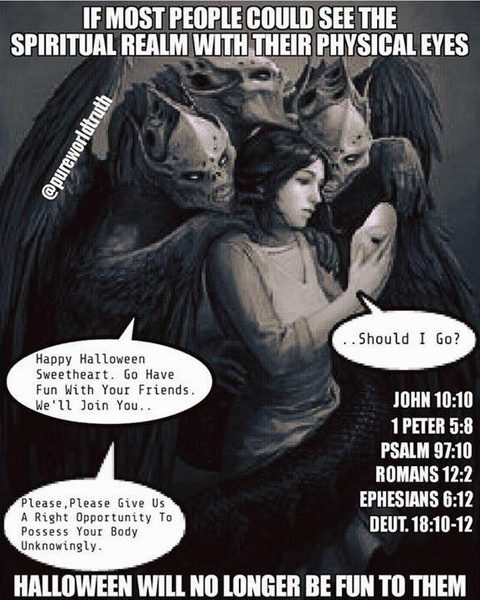
halloween no funSamhain was celebrated on the night of October 31 when the Druids believed the boundary between the world of the dead and the world of the living was blurred and demons would visit. These spirits played tricks and caused havoc, so the Druids would offer sacrifices to appease these spirits, hence the modern holiday question: “trick or treat?”

The Druids dressed in costumes to look like demons in attempt to befriend them and celebrated the holiday with drunkenness, psychoactive plants and debauchery. They believed that by communing with the nether world, they could tell fortunes, cast spells and speak with the dead.

According to the Encyclopedia Britannica, Pope Boniface IV created All Saints day, celebrated November 1st, around AD 600. This holiday was called “All-hallows” and the night before it, “Samhain”. Later, it became known as “All-Hallows Eve” and eventually, “Halloween”.

Most people today believe such celebrations are just good, clean fun. Kids get to dress up and get candy while going house to house giving each one a choice, “trick or treat?” I mean after all, demons, witches, ghosts and goblins aren't real, are they?

If demons, astrology, divination, necromancy, sorcery and idols don't exist, why did God forbid these practices in the Law of Moses and again through Paul in 1st Corinthians 6 and Galatians 5, among other places in the bible?

There are at least a dozen Hebrew names for demons in the Old Testament and demons are mentioned by every writer in the New Testament, with exception of the unknown author of Hebrews; but he did mention their ruler, Satan. Jesus taught in many passages that demons do exist, and many instances are recorded of Jesus and his Apostles casting them out of people that had been possessed. Demons are the fallen angels and can take on various physical forms.

People of many faiths celebrate Halloween and the bible does say, “One man esteemeth one day above another: another esteemeth every day alike. Let every man be fully persuaded in his own mind.” (Romans 14:5)

However, our bible also clearly says in 1 Corinthians 10:20-21 “But I say, that the things which the Gentiles sacrifice, they sacrifice to devils, and not to God: and I would not that ye should have fellowship with devils. Ye cannot drink the cup of the Lord, and the cup of devils: ye cannot be partakers of the Lord's table, and of the table of devils.”

Maybe I'm old fashioned, but rather than putting on a ghost, devil, witch or monster costume, why not put on "the whole armor of God; the belt of truth, the breastplate of righteousness, as shoes put on the readiness given by the gospel of peace; the shield of faith, with which you can extinguish all the flaming darts of the evil one; the helmet of salvation, and the sword of the Spirit, which is the word of God”? (Ephesians 6:13-20)

Sunday, October 11, 2020

Seek the Welfare of the City

This is a follow up post to yesterday’s article Are All Politics Local, in which we examined the Power of the Majority Party in the US Congress and noted several characteristics of Worldly and Godly Leaders.

Today, I’d like to discuss the application of Jeremiah 29 for the modern day Christian. In particular, we’ll address how God’s command in verse 7 for his people to “seek the welfare of the city where I have sent you into exile” should apply to true believers in our earthly countries.

As our regular readers know, we must first look at what the verse meant to the original audience before we can begin applying it to ourselves. As I’ve said many times (I’m certainly not the first to say this), the three top rules for interpreting scripture are “Context, Context, and Context”. We know from verses 1-3 that the majority of the chapter contains a letter that the Prophet Jeremiah sent from Jerusalem to the Jewish exiles that had been taken into exile to Babylon. So, looking at the immediate context, the letter begins:

Thus says the LORD of hosts, the God of Israel, to all the exiles whom I have sent into exile from Jerusalem to Babylon: Build houses and live in them; plant gardens and eat their produce. Take wives and have sons and daughters; take wives for your sons, and give your daughters in marriage, that they may bear sons and daughters; multiply there, and do not decrease. But seek the welfare of the city where I have sent you into exile, and pray to the LORD on its behalf, for in its welfare you will find your welfare. (Jer 29:4-7)
At first glance, Jeremiah appears to be telling the people that their main objective is to become good citizens of Babylon. But looking at the entire chapter, along with the prevailing themes of the Book of Jeremiah as a whole, we find the narrative to be a bit more complicated.

Let’s begin with the bigger picture. The primary themes of the book are that a Holy God must punish His people for their constant disobedience to His covenant, but the Prophet also speaks of hope for the future. Thus, even though the people are currently in exile as punishment, they will later be restored to their homeland. In addition, there is also a running battle between Jeremiah the true prophet, and various false prophets who are constantly attempting to damage Jeremiah’s credibility among the people.

Continuing in verse 8, we read:

For thus says the LORD of hosts, the God of Israel: Do not let your prophets and your diviners who are among you deceive you, and do not listen to the dreams that they dream, for it is a lie that they are prophesying to you in my name; I did not send them, declares the LORD.

“For thus says the LORD: When seventy years are completed for Babylon, I will visit you, and I will fulfill to you my promise and bring you back to this place. For I know the plans I have for you, declares the LORD, plans for welfare and not for evil, to give you a future and a hope. Then you will call upon me and come and pray to me, and I will hear you. You will seek me and find me, when you seek me with all your heart. I will be found by you, declares the LORD, and I will restore your fortunes and gather you from all the nations and all the places where I have driven you, declares the LORD, and I will bring you back to the place from which I sent you into exile.

(Jer 29:8-14)
The false prophets were telling the people to resist rather than to serve the King of Babylon; that they would only be there for a short time. Jeremiah however, accurately informed the people that their captivity would last seventy years. Furthermore, this was God’s righteous judgment so any rebellion would also be against God.

So Jeremiah was basically telling the people to be good citizens in their temporary home for seventy years, but cautioning them not to get so comfortable that they would refuse to return to their homeland when it was time to leave. In addition, the command to multiply also looked forward to the end of captivity since it would primarily be the sons and daughters whose families would return.

Thus, the parallel we can draw for Christians in our modern day is that, while we’re here on this earth, we should likewise be good citizens, but we should not get so comfortable as to want to stay here forever. The Psalmist writes, The years of our life are seventy, or even by reason of strength eighty; yet their span is but toil and trouble; they are soon gone, and we fly away (Ps 90:10).

As the old saying goes, “We should be in the world, but not of the world” as we look forwward to our permanent home in Heaven.

Prologue

Since this article is a follow-up to yesterday’s political post, I thought I’d address the meaning of the word “welfare” in our main verse. “Seek the welfare of the city” does not mean that we should vote for Socialist Democrats just because they’re attempting to turn the country into a welfare state (at least until they run out of everyone else’s money).

The word for welfare is translated “peace and prosperity”, “well-being”, or “the good” in various other Bible translations. It is the Hebrew word shalom that is most often translated “peace”, but also “welfare”, “safety” etc. Think of it as seeking the common good.

Saturday, October 10, 2020

Are all Politics Local?

The saying “All politics are local” is typically attributed to Tip O’Neill, the Speaker of the US House of Representatives in the 1970s and 1980s. This saying is still partially true, even with the vast amount of donations that pour in nationally for some state races, but the locals still do the voting (if you don’t count those who are bused in from out of state to vote multiple times). The out-of-state funding of local candidates has become the norm over the past few decades, but this strategy is now being extended to many local races

In the last few years, we’ve even seen George Soros backed funds buy many prosecutor races in targeted cities and counties. In just one example, a liberal prosecutor in North Carolina running on the platform of abolishing bail and refusing to prosecute most crimes received about $1.5 million dollars. In previous years by comparison, each candidate typically received only about $15 thousand. This strategy has led to an epidemic of increased crime and unrest across the country due to the Soros-backed prosecuters refusing to prosecute even serious crimes.

Power of the Majority Party

With the upcoming 2020 elections just around the bend and many voters have already begun to cast their ballots, we like to offer some brief thoughts about the importance of your vote, because you are voting for more than just a candidate. One of the single most misunderstood facts about voting is that when a person casts his or her vote, it is not just for a candidate, but for an entire party, and in the bigger picture, for an entire worldview.

Perhaps the easiest way to explain is to look at the 2108 mid-term elections. Prior to the election, the Republicans held a majority in the House and Senate. We should note that this fact doesn’t necessarily mean the Republicans had a solid majority, since as most people know, all Democrats are solid Democrats, but many Republicans are Republicans in Name Only (RINOs). A prime example was during the Republican’s attempt to repeal the expensive, one-size-fits-all Obamacare disaster and replace it with an individualized, more economical plan, RINO John McCain single-handly dealt one final blow to conservatism with his last vote in the Senate.

Be that as it may, the Democrats won the majority by running candidates proclaiming themselves to be “moderates” in over 30 precincts that had been carried by President Trump in 2016. Videos surfaced of aides to some of these candidates telling prospective voters that, “Our candidate is very liberal, but has to pretend otherwise due to the number of moderate voters in the district”. The “mainstream” media spiked the stories, and the candidates won by promising not to support Nancy Pelosi for Speaker of the House, and to be an independent voice for their constituents.

Regarding the first of these promises, Ms Pelosi was able to win over enough of these new members by cutting individual special deals to be re-elected as Speaker of the House, and place herself third in line for the Presidency. Regarding the new candidate’s promise of being an independent voice, all but one voted the impeach the President over non-criminal, policy disagreements between Trump and the unelected deep-state bureaucrats.

We’ll come back to these “moderates”, but we first must understand the power of the majority party, or more accurately, the power of their leader(s). The leader of the majority party has enormous power, even if that party has only a one-member majority. First, he or she appoints the chairman for each committee and sub-committees. The majority party also holds a majority of members on each committee. Since any legislation must pass several procedural obstacles in the committees to even get to the legislative body, these committee heads also have tremendous authority. The minority party can’t even bring a bill to the floor without getting an agreement with a sufficient number of members from the other party. It’s not surprising that most legislation never makes it to the body for a vote.

So, for the sake of argument, let’s pretend that many of the new “moderates” were sincere in their promises to vote independently, they would still have no control over which legislation the committees and Speaker will bring to a vote. Even if a bill makes it out of committee and they decide to break with the leaders on a vote, they will typically be threatened to either vote the party line, or have the party back an opponent against them in the next primary election. Thus, once they compromised on their “No to Pelosi” pledge, they were basically powerless to keep their promise to their local voters, even if that had been their intention.

So, before you cast a ballot, please consider the entire ramification of your vote. We mentioned that when we cast our ballot, we’re also electing a worldview. Although specifics can vary somewhat by candidates, one party generally believes in natural law (from God), freedom of religion, state and local rights, free-market economics, the right to life, security, free speech and other liberties guaranteed by the constitution; while the other typically believes in federal government autonomous control (socially, economically and otherwise), judicial activism, the right to kill babies, and globalism.

Worldly and Godly Leaders

In 1998, pastor and teacher John MacArthur preached a sermon entitled Characteristics of an Effective Leader in which he painted a picture of an effective leader according to the two prevailing worldviews. The secular world typically prefers a leader with the following qualities. “Visionary – that is looking to the future and, in some degree or another, being able to forecast the future and plan ahead for the future. Action oriented – that is more than just someone who muses about things, more than someone who comes up with ideas and schemes, somebody who can make things happen… So, you have this typical picture of a leader: visionary, action oriented, courageous, energetic, objective oriented, paternalistic, egocentric, intolerant of incompetence in others, and indispensible.” Meanwhile, from a Christian worldview, he states, “What makes an effective leader? He’s respected/trusted, takes initiative, uses good judgment, speaks with authority, strengthens others, is enthusiastic and optimistic about triumph, never compromises absolutes, focuses on objectives not obstacles, and leads by example.” We need more candidates fitting Pastor MacArthur’s description of a leader in all levels of government today.

If I could add a personal observance, worldly leaders tend to be life-long politicians, while Godly leaders often serve for a few years, then return to the private sector. There are many exceptions of course, but as a rule, I believe this is often because worldly leaders often attempt to raise government to the level of diety. Witness Barack Obama’s infamous “You didn’t build that” statement implying that private citizens or corporations are basically powerless without government. One other example is the recent mandates closing houses of worship, mostly in the blue states. While liquor stores and marijuana selers are considered “essential” businesses, churches are considered as “non-essential”. In Pastor MacArthur’s state of California, churches are facing tens of thousands dollars in fines hold holding services.

Loud Dogma

This coming Monday, Supreme Court nominee Amy Coney Barrett will appear before the Senate Judiciary Committee to begin confirmation hearings. In her previous hearing, in which she was confirmed to the US Seventh Court of Appeals, Diane Feinstein, the top Democrat on the committee, attached her for her faith with the now infamous statement, “The dogma lives loudly within you”. Of course, what went, and continues to go unsaid, is that the dogma also lives loudly within Sen Feinstein, albeit a completely different dogma. Still, a secular faith is just as much a dogma as is a religious one, even though it is not recognized as such by most people. Article VI, Section 2 of the US Constitution states “no religious Test shall ever be required as a Qualification to any Office or Public Trust under the United States”. The Constitution, as Obama once noted, can be a real inconvenience.

Finally, as the percentage of authentic Christians continues to drop in our country, we encourage all remaining believers to exercise their right and privilege to vote.