Showing posts with label apologetics. Show all posts

Monday, November 23, 2020

The Book of Daniel Trilogy

Back in 2011, I wrote a series of three articles on Bible Prophecy called Are We Living in the Last Days?, The Study of Prophecy – in Perspective, and Present Living in Light of Prophecy.

Recently, I completed another trilogy on the Book of the Prophet Daniel. The first was an Introduction to the Book of Daniel. This led to two additional spin-off articles, the first being Interpretations and Fulfillment of the Visions and Prophecies of Daniel. For this article, I spent a few weeks combing through various commentaries and other resources such as the Encyclopedia Britannica to determine the various persons and events that fulfilled many of the prophecies from the seventh through the second century BC. I also attempted to explore the prophecies still to be fulfilled in our future. If you've always wondered about many of the strange images and predictions within the book, hopefully this article will shed some light on the subject. A knowledge of Daniel is essential to understanding almost all aspects of future prophecy, including the prophetic portions of the New Testament.

The Book of Daniel contains more prophecies that have since been fulfilled than any other book in the Bible. As I was researching the meanings, I couldn't help but be amazed at the detail and precision by which each phrophecy was fulfilled. Thus, the fulfillments have a strong apologetics application. Because we have so many prophetic visions that have already been precisely fulfilled in the past, we would expect the same accuracy for those visions concerning the future.

The final article in the trilogy was entitled The Seventy Weeks of Daniel 9 – Four Interpretations. In this article, I examined various interpretations and timelines for this prophecy from an Old Testament (Maccabean) view, a Preterist (Reformed Historical) view, a Covenantal (Reformed Futurist) view and from a Dispensational (Futurist) view, pointing out the similarities and the divergences of each view. The Seventy Weeks of Daniel is the key to helping us understand the basic timeline of historical and future events prophesized in both the Old and New Testament.

I initially didn’t set out to do another prophecy-themed trilogy, but it just happened that way. Incidentally, I’m now working on the Introduction to the Book of the Revelation and, wouldn’t you know it, I currently have two spin-off articles in progress on it as well. The first spin-off considers how various events (and their timelines) are interpreted from a Preterist, a Historicist, an Idealist (Allegorical), and a Futuristic view. The final article will discuss four major interpretive views of the Millennial Kingdom of Revelation 20.

I’ll add the links to the Revelation articles in a new post when finished. To God be the glory…

Saturday, February 29, 2020

Ministry Update and Shout-outs for Leap Day 2020

Here are a few random items to close out February for this leap year.

Updates you may have missed:

We’ve finished and uploaded our Introductions to the books of Jeremiah and Lamentations, and the book of Galatians is in progress. When we first started this section, my original goal was to complete all the Bible’s books and sections by the end of 2012. Obviously, we’re not going to make that overly ambitious goal, but we’re now over halfway there and hope to pick up the pace. This is still one of our top priorities and we’ve expanded each article to include not only general information, key verses, authors, timelines, themes and purposes, but also brief surveys, historical backgrounds, theology, and interpretation hints and challenges. These articles have also resulted in many spin-off writings.

We’ve-formatted our Bible Reading Plans section for easier navigation and clarity for those who’d like to start a new plan this year. Our Bible reading plans are setup so that anyone can start and end anytime, not just at the start of a new year.

We also added SSL encryption to our main website and our Real Issues Blog for additional reader security by encrypting all data passing back and forth between our server and the browsers of our readers.

Personally, I’ve finally been able to cut back my hours on my regular job to free up more time for research, writing, and additional website updates. For the handful of readers that may be interested, I recently posted a A Personal Mini-History regarding my work over the past ten years or so.

A Couple of Shout-outs:

The first one is about 18 months overdue. In 2018, I received a very cordial email from Evan Plant, director of Mainsail Ministries. Evan has also been serving as a question responder for over ten year at Got Questions Ministries, one of the top Christain sites on the web. He notified us that he had used one our articles on the intermarriage of Ruth and Boaz as a resource for the question Should Ruth's being a Moabite have excluded David from being king?

We were very excited to hear this, and after exchanging a few emails, I also learned that Evan and I had similar technical backgrounds before he retired to concentrate full-time on his ministries. Hopefully, I'll be following him along a similar path soon. Thanks again Evan for using our article in your work. I highly recommend that our readers visit the Mainsail website for additional fine articles.

The second shout-out goes to Emerson de Oliveira of Logos Apologética Cristã (Christian Apologetics Logos). Emerson translated and published our article Benefits and Blessings of Studying Theology at Os benefícios de estudar teologia. This was also done in 2018 but I only stumbled onto it recently by accident.

I’ve always wanted to get some of our articles transferred into other languages but haven’t had the knowledge or the resources. I’ve issued engineering documents in Spanish and German in the past, but only did the technical terms myself. I always had to get help in creating sentences with proper grammar. Thanks so much Emerson for translating our article. We highly recommend Emerson’s site to our Spanish speaking readers.

Saturday, April 4, 2015

Logic of the Cross

Like clockwork every Easter, we see stories from various TV shows and magazines attempting to discredit the Bible account of Jesus’ death and/or resurrection. Never mind that these stories have been debunked over and over by the evidence, the media continues to pull them out, re-warm them over and breathlessly promotes them as new scientific discoveries that supposedly signals the death knell for Christianity.

Since the Cross is a central foundation of Christianity, it is also a prime target of those who attempt to discredit the Faith. There have been many excellent books written over the years greatly detailing the evidence for the resurrection. Indeed, the evidence supporting the Biblical accounts of the Crucifixion and the Resurrection is much stronger than many of the other historical events that we take for granted. Therefore, even though we have a historically based article in progress, we decided to examine the Cross from a logical viewpoint based upon 1 Corinthians 1:18.

The preaching of the cross is, I know, nonsense to those who are involved in this dying world, but to us who are being saved from that death, it is nothing less than the power of God (Phillips NT).
The first thing Paul notes is that the message of the Cross, that is Jesus dying for the sins of all who would believe in Him as Lord and Savior so that we might be forgiven and spend eternity with Him in Heaven (Jn 3:16, 17:24) is foolishness to those unbelievers dying in their sins. But even though it is considered foolish or even absurd to this group of people, let’s examine the message to determine if it actually makes sense.

I think we can all agree that most people have a built-in conscience that can tell right from wrong, justice from injustice, and good from evil. Even though postmodern thinking has blurred many of the lines of separation between good and evil, most would agree that evil should be punished while good should be rewarded. Most civilized people would not want an evil person to go unpunished so that he would feel free to continue to steal, murder etc.

The cross is God’s rightful and just punishment for the evil (sin) among mankind. Every person has sinned (lied, stolen, lusted, coveted etc) in attitude, thought or deed, and as a result, is deserving of death (Rm 3:23, 6:23). Furthermore, there is no forgiveness of our sins without the shedding of lifeblood (Heb 9:22). In the OT, the priests made continual animal sacrifices as a temporary covering of sin, but these sacrifices could not remove the stain of sin. But the Christ, being the God-Man, voluntarily sacrificed Himself once for all the sins (past present and future) of all those who would believe in Him (Heb 10:11-14). In fact, Jesus was the only perfect sacrifice that had the infinite value required to satisfy God’s righteous wrath against sin and pay the penalty to restore our relationship and judicial status (we are credited with living a perfect life and fulfilling the law – Rm 8:4) before God the Father. There was no other way for us to be reconciled with a Holy God. Thus, the events of the cross were entirely logical.

Of course, only those who believe (trust in, rely on) the work of Christ will be saved (Jn 3:16, Ac 4:12). Those who reject Jesus as Lord and Savior are already condemned (Jn 3:18) and the message of the cross remains illogical. For a more detailed discussion on our topic and subject verse (1Cor 1:18), including its context within Scripture (1Cor 1:18 – 2:5), the historical context of the Jews and Greeks, and Godly vs human wisdom, see The Cross - Foolishness or the Power of God?

Before we end this post, I’d like to address a couple of questions that some may be asking. The first, typical asked by unbelievers and even by some new believers is, “Why couldn’t God just forgive and forget? Why do we have to be perfect to get into heaven? Couldn’t God lower His standard just a bit or grade on the curve?” The thinking here is that, if God is good and He is a God of love, couldn’t He at least ignore the minor stuff.

To answer these questions, we must understand the simplicity of God. By simplicity, we don’t mean that God is a simple God. God is undeniably beyond our comprehensive understanding. By “divine simplicity”, we’re merely referring to His unity of being (or unity of His nature or character), primarily with respect to His attributes. God’s attributes are irreducible in that we can’t separate them or temporarily take one away. We can distinguish between them, but they always work together. Therefore God, whose eyes are too pure to even look upon evil, can’t tolerate sin (Hab 1:13) because His Holiness, Truth and Justice won’t allow it. However, because His Love is also working, He provided a substitute, His own Son. Thus, He is able to punish wrongdoing while still saving those who believe without compromising His Holiness.

The second question that might be asked by anyone is, “Why would God sacrifice His only Son for me?” I must admit that, on the surface, this seems very illogical. I certainly would not allow either of my sons to be sacrificed for anyone. The only rational explanation for God’s actions according to His eternal plan is His great love for each of us (Rm 5:7-8). It has often been said that neither the Roman soldiers nor the nails could have kept Jesus on the cross since He had legions of angels at His disposal (Mt 26:52-54). He voluntarily laid down His life (Jn 10:17-18) and the only thing holding Him to the cross was His great love for us. In light of what He did, shouldn’t we live for Him?

Saturday, December 28, 2013

Is Men Loving Jesus Homoerotic?

We hope all our readers had a very Merry Christmas this year. As Christians celebrate the birth of our Savior, the major news media typically trots out many stories to discredit the event, and Christianity in general. Perhaps the most interesting twist this season is the Georgetown professor on MSNBC claiming that Christian men loving Jesus is “Interestingly Homoerotic”.

Professor Michael Eric Dyson made the remarks to substitute host Joy Reid on the Ed Show last week while attempting to recruit the LGBT community to join with “African-Americans” as common victims of the “right” on the heels of the remarks made by Phil Robertson of Duck Dynasty. We’d like to thank our friends at Newsbusters for being one of the few dozen that still watches MSNBC and brings us the few highlights worth considering.

From the video and transcripts:

Dyson: Jesus was a Jew who, around whom a religion was made. So the anti-Semitism of many of the Christians is ironic to begin with. And then secondly, the gay, lesbian, transgender, bisexual stuff - look through the Bible. There’s a lot of interesting things. The same men who will stand up in the church of all men, ‘I put my God, Jesus, overall women. I love him more than I love her.’

Hmmm. Do you really? That sounds interestingly homoerotic to people who are outside your religious traditions. I’m not suggesting it is but I’m suggesting that there are some very interesting, subtle, narrative tensions within the Bible itself and within Christianity beyond that.

Of course, Ms Reid agrees with Dyson throughout the interview, praises him for his Bible knowledge, and ends the segment by hoping the audience will consider Dyson’s words alongside those of Jesus. The article also points out that neither Reid nor Dyson (or apparently the executives at MSNBC) realize that “humans can love without sexual intimacy”, giving parents and children as an example.

It is also obvious that neither the professor nor host has a clue as to how to interpret the Bible. We’ll just mention two basic aspects, context and original language. Beginning with the latter, the professor may not be aware that the New Testament was written in Greek, not in English. The Greek language contains four words for “love”, agape, phileo, eros and stergo.

In the Bible, human love for Jesus is always given as agape (Godly, selfless, sacrificial, unconditional love) or phileo (brotherly love). By his description, the professor attempts to substitute eros love (physical attraction or passionate desire) which can be used in a positive sense relating to husband and wife, or negatively for a number of forbidden acts, but is never used in the Bible with respect to loving Jesus.

Turning to the aspect of context, Ms Reid opened the segment by saying that anyone can manipulate the Bible to support any argument or position. It is somewhat ironic that, although the host was directing her comment to those she perceived to be intolerant of behavior that is condemned in Scripture, her guest then proceeded to make erroneous statements about the Bible in an attempt to prove his point. In reality however, Ms Reid's opening statement is only true to a point. In order to support a false argument, one must disregard the most important interpretation principle, that of regula fidei (rule of faith) or analogia fidei (analogy of faith). This rule basically means that we should interpret any portion of Scripture within the context of the whole because Scripture (when properly understood) will never contradict itself. The “tensions” spoke of by the professor are introduced by those who either don't understand the Scriptures or twist them for their own agenda (or both).

Thus, even though a person may not have a working knowledge of the original language, they can still understand the basic meaning by consulting related Scripture passages. In our case, we could look at the descriptions of love (agape) in Paul’s letter to the Corinthians.

Love is patient, love is kind. It does not envy, it does not boast, it is not proud. It is not rude, it is not self-seeking, it is not easily angered, it keeps no record of wrongs. Love does not delight in evil but rejoices with the truth. It always protects, always trusts, always hopes, always perseveres. Love never fails (1Cor 13:4-8).
Would a person without an ulterior motive equate these characteristics of love to physical or sexual attraction?

We find much more of “love” in the the second, third and fourth chapters of John’s first epistle. In addition, it also contrasts the professor’s version of worldly love with Godly love, “the cravings of sinful man, the lust of his eyes and the boasting of what he has and does--comes not from the Father but from the world” (1Jn 2:16). The letter (and John’s Gospel) also makes multiple ties between our love for Jesus and our obedience to Him.

Students of the Bible should not be surprised at the lack of ability by the professor and members of the media to properly understand Scripture. The Bible tells us

We have not received the spirit of the world but the Spirit who is from God, that we may understand what God has freely given us. This is what we speak, not in words taught us by human wisdom but in words taught by the Spirit, expressing spiritual truths in spiritual words. The man without the Spirit does not accept the things that come from the Spirit of God, for they are foolishness to him, and he cannot understand them, because they are spiritually discerned (1Cor 2:12-14).
Returning to the second chapter of John’s first epistle, immediately after contrasting worldly love with Godly love, John follows with a warning to us about the many antichrists that we'll encounter, describing them as “those who are trying to lead you astray” (1Jn 2:26). Therefore, we must regularly put on all our armor, particularly by studying and properly interpreting the Word of God.

Friday, October 25, 2013

Dating Historical Bible Events – Progress Update

Recently, we’ve been working on a series of articles tentatively entitled “The Bible in History” emphasizing the historicity of the Bible; that is to say that the events portrayed as literal episodes really happened and the associated characters were real people that physically existed, as opposed to being myths and legends as critics like to charge. Because these biblical narratives are real, we can date them along the historical timeline along with extra-biblical secular events. Unlike modern historical books however, events in the Bible are not tied to a chronological calendar dating system. Still, there is enough internal (within the Scriptures) and external evidence to date most characters and events with reasonable accuracy.

At the moment, the series will consist of a main article, currently in progress and subtitled simply as “Dating Bible Events”. This article will discuss various methods and challenges of establishing a Biblical timeline within our modern calendar system. There will also be several spin-off articles on subjects such as the date of the Exodus and Conquest and the life of Christ, both in progress.

Part of the series has already been completed and uploaded. We first mention the article Biblical Genealogies - Interpretation Challenges and Bible Inerrancy Issues. This was uploaded to our Bible Genre section in May, but it also contributes. It was written prior to the “Dating Bible Events” series, but contains much info that contributes to the current articles.

A major challenge we face in translating the dates of Bible events is the various calendar systems themselves, so we composed a Calendar Systems series consisting of an introduction and five parts that we uploaded last week. This sub-series not only examines the various calendar and dating systems, but provides much background on the various political and historical backgrounds for the various nations and time periods in which they developed.

The introduction contains a table of contents with links to all chapters. In part 1, we examine the basic types of calendars and dating systems along with their common components. In Part 2 we explore the political and historical context of Israel, Egypt, Babylon, the Roman Empire and other major nations in which the various calendar systems developed during the biblical era and the early church period.

If you think that “BC” stands for “Before Christ” and “AD” for “After Death”, and thus wondered how the years between Christ’s Incarnation and Crucifixion are dated, you might want to check out Part 3. Here, we discuss the origin and significance of our modern dating system (aka Anno Domini system). In part 4, we look at the historical events that led to its acceptance by Christendom in the midst of the church-state power struggles between the papacy and the Roman political leaders from the eighth to the fourteenth centuries. We then consider the development of alternative naming conventions to the Anno Domini system by unbelievers.

In our fifth and final installment, we focus on the historical events that led to the development and adoption of our modern Gregorian calendar system to replace the Julian calendar. We also summarize the methods and process of converting dates between different calendar systems and add some final thoughts on the Anno Domini system as it relates to the Christian era.

Friday, June 3, 2011

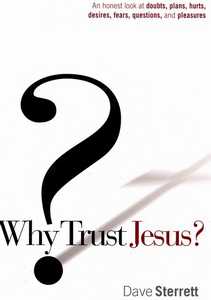
Review of Dave Sterrett's Why Trust Jesus

We were recently sent a copy of the new Dave Sterrett book, Why Trust Jesus, for our review. Dave is an adjunct philosophy professor at Liberty University, a part time missionary, frequent radio guest, and speaker for I am Second and Probe Ministries. He has ministered to a variety of audiences with Christian apologists Josh McDowell and Kerby Anderson.

Dave has written a concise book in order to examine and answer many of the most common questions, doubts and fears expressed by both Christians and non-believers. He maintains a great balance in his sources, using logic to reason from Scripture, history, philosophy, science, and personal experience to provide clear and relevant answers for these questions. It is also evangelical and even devotional at times.

Each question takes the form of “Why should I trust Jesus …?” To name a few, Why should I trust Jesus when there are so many other spiritual paths, when I not sure that God is real, when I’ve been let down so many times, when life is going great or in the midst of suffering and death, when I failed so many times, and several other common questions that most of us have asked at one time or another.

Read the entire Why Trust Jesus review, including a chapter-by-chapter analysis and more.

Monday, October 4, 2010

Introduction to Theology Series

I'm back after being out of touch for a couple of weeks. First, I had a minor reaction to a flu shot. I had taken this shot every year for about twenty years, but then missed the last two years, so this was probably a contributing factor. Switching to some good news, we just got word that our son, serving in the marines in Afghanistan, should be on a plane out of there in the next week or so. God has graciously protected him thus far, and we greatly appreciate all who have been praying for his safe return.

I was only out of commission for three days from the shot, so during the remainder of this time, I was able to complete and upload our Introduction to Theology Series. Many Christians today question the importance of studying theology, considering it boring, irrelevant and divisive. Many argue that we should just love God and love one another. While this is very important, can we even love God and our neighbor without a certain amount of theological knowledge? We explore this question along with many others in this five-article series.

Our introductory series opens with What is Theology? which surveys the various theological disciplines. Our Why Study Theology? article discusses the importance of theology and sound doctrine, and addresses the reasons why we shouldn't just skip to the practical teachings. We've also included an article detailing the Benefits and Blessing of Studying Theology. Next, we've outlined typical Approaches, Process and Methods with helpful hints and instructions on doing theological studies. Finally, because of the importance of loving God and loving our neighbor, we've concluded the series with Theology, Doxology and Biblical Love. We pray that this series will encourage everyone to study theology and develop sound Biblical doctrine.

To read the Introduction to Theology series, just follow the link to our Theology page and look under the "General & First Principles" heading.