Showing posts with label church. Show all posts

Tuesday, September 2, 2025

Essential First Steps for Families After Closing on a New Home

Webmaster Note: Guest Post by Lucille Rosetti from The Bereaved Blog, an independent and frequent valuable contributor to our blog. The views and opinions expressed in the article are those of the author, and may or may not necessarily reflect those of ad Dei Gloriam Ministries. We have no relationship with any of the organizations linked within the article.

Caution!!! Links in this article are provided by the guest author and may link to Content Marketing / Native Advertising and other sites containing first and third party ad trackers and cookies, along with other privacy threats such as passing on your info to social media sites. We urge our readers to take precautions such as using privacy browsers, ad-blocking apps, VPNs, anti-tracking devices, disabling third-party cookies and other appropriate measures before clicking on any external links.

Image Source: Pexels

Man Gardening Buying a house marks more than a financial milestone—it represents the beginning of a new chapter for your family. Once the papers are signed and the keys are in your hands, the work of shaping a safe, stable, and faith-centered household begins. These early days set the tone for years to come, and the choices you make immediately after closing matter greatly. Think of them as foundations, not just for the structure you purchased, but for the rhythms of family life inside it. By approaching this transition thoughtfully, you can protect your investment, nurture your loved ones, and open space for God’s guidance in your new surroundings.

Secure the Home Inside and Out

One of the first priorities is protecting your household from preventable risks. Changing locks, adding lighting, and checking every entry point gives your family peace of mind before your first night in the house. This is also the moment to walk your property line and think about practical safety layers. Whether it’s a new fence, outdoor motion lights, or landscaping choices, being intentional early will keep intruders and accidents at bay. Many families overlook how important the outside perimeter can be in shaping daily comfort. Reviewing proven methods of securing your property’s perimeter ensures you can rest without worry, confident that your new home is both welcoming and protected.

Review and Transfer the Builder Warranty

If your home is newly built, don’t forget to examine your warranty documents. Many builders provide coverage for structural elements, systems, and workmanship, but you must confirm the transfer is complete and active under your name. Missing this step could leave you paying for expensive repairs that were otherwise covered. Mark the expiration dates of each category—roofing, HVAC, foundation—and set calendar reminders. Families that stay proactive in this area often save thousands of dollars and preserve peace of mind. Understanding the importance of a structural warranty helps you lean on protection already in place, with some warranties like 2-10 offering up to 10 years of structural coverage.

Learn the Utilities and Shut-Off Points

Water, electricity, and gas are lifelines in your home, and knowing where the shut-offs are located isn’t optional—it’s essential. If a pipe bursts or a gas leak occurs, minutes can mean the difference between minor damage and major disaster. Take time now to explore your basement, crawl space, or utility closet to find the controls, label them clearly, and explain their function to older family members. Keep a simple flashlight nearby so you’re never caught fumbling in the dark during an emergency.

Organize Important Documents Immediately

Closing day leaves you with a stack of paperwork thicker than most people expect. Deeds, loan agreements, warranties, and receipts should never be tossed in a random drawer. Instead, purchase a fireproof lockbox or filing system to keep everything protected and easy to find. Make it a family standard from day one by organizing closing documents safely and storing them in a place everyone can access if needed. This habit not only saves time when tax season comes but also reduces stress when questions about property lines or loan terms arise. Family members who step in during illness or travel will also benefit from knowing exactly where these papers are kept.

Test Every Safety Detector

Fire and carbon monoxide are invisible dangers that no new homeowner should ignore. Even if the previous owner assured you the detectors were fine, test them yourself and replace batteries immediately. Consider upgrading to interconnected models that alert the entire home if one sensor detects a problem. Children, elderly family members, and pets rely on you to keep these systems working flawlessly. Schedule reminders on your phone for regular checks, turning safety into a habit rather than a once-and-done task.

Prepare Financially for Home Repairs

Homeownership doesn’t end with a mortgage payment—repairs and replacements will come faster than you think. A broken appliance, roof leak, or unexpected plumbing issue can derail family budgets if no reserve is set aside. Starting a separate savings account for housing emergencies removes the temptation to dip into funds meant for tithes, groceries, or schooling. Even modest contributions add up over time and cushion you against costly surprises.

Find a Faithful New Church Home

Beyond locks and documents, your new community will shape your family’s spiritual growth. Seeking out a local church where worship, teaching, and fellowship align with your beliefs ensures your transition doesn’t stall your walk with Christ. Visit several congregations, talk to leaders, and observe how children’s ministries or outreach programs fit your family’s needs. Remember, a church is more than a building—it’s the people who will pray with you, support you, and hold you accountable in seasons of both joy and hardship. Relocating can feel disorienting, but anchoring yourself in a congregation quickly restores rhythm and belonging.

These first steps aren’t simply chores—they are investments in safety, stability, and spiritual well-being. Let each measure remind you that a house may be purchased in a day, but a home is built through daily care and prayer.

Sunday, April 3, 2022

3 Tips for Organizing an Overseas Church Mission

Guest Post by Camille Johnson from The Bereaver Blog. The views and opinions expressed in the article and associated links are those of the author, and although we strongly agree with the premise of the article, all specific details may or may not necessarily reflect those of ad Dei Gloriam Ministries. We have no relationship with any of the organizations linked within the article.


Image Source: Unsplash

Organizing a church mission to another country is a wonderful way to bring a congregation closer together and show young members of the church how to spread God’s love around the world. This is a big undertaking, but if you're feeling overwhelmed, take a business-like approach. Establish steps for reaching your goals and get as many people on board as possible, taking into account each individual’s needs and finding out what motivates them.

Baptist Press notes that preparing for a successful journey involves a great deal of work and planning, including consideration of some of the challenges that are involved in traveling overseas with a group of teenagers. These three tips will make organizing an overseas church mission more manageable.

1. Involve Church Youth in Fundraising Efforts

Mission trips are more successful when participants feel comfortable around one another and have invested time and effort in preparing for the trip. That’s why you should involve your church youth from the very beginning by including them in fundraising efforts. The trip will hold more meaning for them when they have worked for it.

Popular youth fundraisers include selling faith-based candles, using church scratch cards, selling cookies and cookie dough. Your young church members also may hold car washes, bake sales, yard sales, or other community events to raise money for their trip.

Because you will involve the community in your fundraising events, you should advertise in your church bulletin, on your church sign, and in local newspapers. If your church has a social media page, put a few of your youth in charge of creating and sharing fundraising events because it is an inexpensive way to reach a larger audience.

If you plan to stand in front of local stores with cans to collect donations, design matching T-shirts for your mission participants to make them more visible and credible when they are out and about in the community. Of course, everyone should pack their shirts and wear them on the mission itself when the time comes.

Another important fundraising tool you could use is marketing via email. Email marketing has a very high return on investment, so you should leverage it for raising funds and awareness for your mission trip. If you can use the email list of your whole church’s congregation, then you should have no problem reaching your fundraising goals.

2. Make Sure Everyone is Onboard with the Mission’s Purpose

When organizing a mission trip overseas, the church’s mission should be first and foremost in everyone’s minds. Operate under the understanding that you are representing your church and are traveling to do public service and be the face of your church in another part of the world. It’s important for you to share the purpose of the mission with your young participants and their families so everyone understands the trip is not a vacation. You should create a mission itinerary, a daily schedule, and a list of mission goals and share them at the first informational meeting.

3. Clearly State Your Rules and Get Signatures Early in the Planning Process

You also should clearly state your expectations and team rules from the beginning so church members know the do’s and don’ts of the trip and can agree to them well ahead of time. State and explain the rules to parents at the introductory meeting but also invite mission participants to attend so you can spend the evening answering questions and assuaging parents’ fears.

For more ideas on when to hold meetings, which information to share when, and which forms you will need, check out the numerous resource-rich websites like YouthWorks and Faithward. Keep in mind that if you are traveling to a country that allows people younger than 21 to drink or has a reputation for heavy recreational drug use, you should make it very clear that your youth will not be participating even though the laws differ. Studies show that exposing teens to alcohol at an early age puts them at a greater risk of developing drug and alcohol problems later in life, as noted in TIME magazine.

Similarly, experimenting with drugs early in life or using them socially as teens also leads to a high risk of becoming dependent and affects brain development. Alcohol and drugs have no place in a church mission, and you should reiterate these points at your introductory meeting.

Lastly, you may want to clearly state what items they can and cannot bring. It’s also important to give them reminders of important items to bring, such as medications they take daily, clothes that suit the climate, and chargers or power banks for devices they’re bringing along.

Planning an overseas church mission trip requires a great deal of time and organization. But, if you involve church youth and parents early in fundraising and informational sessions and clearly state your purpose and rules early on, you will have a much more successful and meaningful trip.

Saturday, October 10, 2020

Are all Politics Local?

The saying “All politics are local” is typically attributed to Tip O’Neill, the Speaker of the US House of Representatives in the 1970s and 1980s. This saying is still partially true, even with the vast amount of donations that pour in nationally for some state races, but the locals still do the voting (if you don’t count those who are bused in from out of state to vote multiple times). The out-of-state funding of local candidates has become the norm over the past few decades, but this strategy is now being extended to many local races

In the last few years, we’ve even seen George Soros backed funds buy many prosecutor races in targeted cities and counties. In just one example, a liberal prosecutor in North Carolina running on the platform of abolishing bail and refusing to prosecute most crimes received about $1.5 million dollars. In previous years by comparison, each candidate typically received only about $15 thousand. This strategy has led to an epidemic of increased crime and unrest across the country due to the Soros-backed prosecuters refusing to prosecute even serious crimes.

Power of the Majority Party

With the upcoming 2020 elections just around the bend and many voters have already begun to cast their ballots, we like to offer some brief thoughts about the importance of your vote, because you are voting for more than just a candidate. One of the single most misunderstood facts about voting is that when a person casts his or her vote, it is not just for a candidate, but for an entire party, and in the bigger picture, for an entire worldview.

Perhaps the easiest way to explain is to look at the 2108 mid-term elections. Prior to the election, the Republicans held a majority in the House and Senate. We should note that this fact doesn’t necessarily mean the Republicans had a solid majority, since as most people know, all Democrats are solid Democrats, but many Republicans are Republicans in Name Only (RINOs). A prime example was during the Republican’s attempt to repeal the expensive, one-size-fits-all Obamacare disaster and replace it with an individualized, more economical plan, RINO John McCain single-handly dealt one final blow to conservatism with his last vote in the Senate.

Be that as it may, the Democrats won the majority by running candidates proclaiming themselves to be “moderates” in over 30 precincts that had been carried by President Trump in 2016. Videos surfaced of aides to some of these candidates telling prospective voters that, “Our candidate is very liberal, but has to pretend otherwise due to the number of moderate voters in the district”. The “mainstream” media spiked the stories, and the candidates won by promising not to support Nancy Pelosi for Speaker of the House, and to be an independent voice for their constituents.

Regarding the first of these promises, Ms Pelosi was able to win over enough of these new members by cutting individual special deals to be re-elected as Speaker of the House, and place herself third in line for the Presidency. Regarding the new candidate’s promise of being an independent voice, all but one voted the impeach the President over non-criminal, policy disagreements between Trump and the unelected deep-state bureaucrats.

We’ll come back to these “moderates”, but we first must understand the power of the majority party, or more accurately, the power of their leader(s). The leader of the majority party has enormous power, even if that party has only a one-member majority. First, he or she appoints the chairman for each committee and sub-committees. The majority party also holds a majority of members on each committee. Since any legislation must pass several procedural obstacles in the committees to even get to the legislative body, these committee heads also have tremendous authority. The minority party can’t even bring a bill to the floor without getting an agreement with a sufficient number of members from the other party. It’s not surprising that most legislation never makes it to the body for a vote.

So, for the sake of argument, let’s pretend that many of the new “moderates” were sincere in their promises to vote independently, they would still have no control over which legislation the committees and Speaker will bring to a vote. Even if a bill makes it out of committee and they decide to break with the leaders on a vote, they will typically be threatened to either vote the party line, or have the party back an opponent against them in the next primary election. Thus, once they compromised on their “No to Pelosi” pledge, they were basically powerless to keep their promise to their local voters, even if that had been their intention.

So, before you cast a ballot, please consider the entire ramification of your vote. We mentioned that when we cast our ballot, we’re also electing a worldview. Although specifics can vary somewhat by candidates, one party generally believes in natural law (from God), freedom of religion, state and local rights, free-market economics, the right to life, security, free speech and other liberties guaranteed by the constitution; while the other typically believes in federal government autonomous control (socially, economically and otherwise), judicial activism, the right to kill babies, and globalism.

Worldly and Godly Leaders

In 1998, pastor and teacher John MacArthur preached a sermon entitled Characteristics of an Effective Leader in which he painted a picture of an effective leader according to the two prevailing worldviews. The secular world typically prefers a leader with the following qualities. “Visionary – that is looking to the future and, in some degree or another, being able to forecast the future and plan ahead for the future. Action oriented – that is more than just someone who muses about things, more than someone who comes up with ideas and schemes, somebody who can make things happen… So, you have this typical picture of a leader: visionary, action oriented, courageous, energetic, objective oriented, paternalistic, egocentric, intolerant of incompetence in others, and indispensible.” Meanwhile, from a Christian worldview, he states, “What makes an effective leader? He’s respected/trusted, takes initiative, uses good judgment, speaks with authority, strengthens others, is enthusiastic and optimistic about triumph, never compromises absolutes, focuses on objectives not obstacles, and leads by example.” We need more candidates fitting Pastor MacArthur’s description of a leader in all levels of government today.

If I could add a personal observance, worldly leaders tend to be life-long politicians, while Godly leaders often serve for a few years, then return to the private sector. There are many exceptions of course, but as a rule, I believe this is often because worldly leaders often attempt to raise government to the level of diety. Witness Barack Obama’s infamous “You didn’t build that” statement implying that private citizens or corporations are basically powerless without government. One other example is the recent mandates closing houses of worship, mostly in the blue states. While liquor stores and marijuana selers are considered “essential” businesses, churches are considered as “non-essential”. In Pastor MacArthur’s state of California, churches are facing tens of thousands dollars in fines hold holding services.

Loud Dogma

This coming Monday, Supreme Court nominee Amy Coney Barrett will appear before the Senate Judiciary Committee to begin confirmation hearings. In her previous hearing, in which she was confirmed to the US Seventh Court of Appeals, Diane Feinstein, the top Democrat on the committee, attached her for her faith with the now infamous statement, “The dogma lives loudly within you”. Of course, what went, and continues to go unsaid, is that the dogma also lives loudly within Sen Feinstein, albeit a completely different dogma. Still, a secular faith is just as much a dogma as is a religious one, even though it is not recognized as such by most people. Article VI, Section 2 of the US Constitution states “no religious Test shall ever be required as a Qualification to any Office or Public Trust under the United States”. The Constitution, as Obama once noted, can be a real inconvenience.

Finally, as the percentage of authentic Christians continues to drop in our country, we encourage all remaining believers to exercise their right and privilege to vote.

Saturday, December 16, 2017

Open Doors

We’ve just published a new article, Should Christians Celebrate Christmas? on our main site. We always attempt to write all articles with a good balance of conviction and charity, particularly on articles that may involve polemics and gray areas of the Bible. Although we try our best, we often fall short of the ideal, usually on the side of favoring conviction over charity. This subject can be a very emotional one for those on both sides of the argument, so we’ve attempted to make an extra effort to present a balanced account of the evidence. We mention this article because one of the arguments for the celebration of Christmas is that it opens many doors to share with non-believers about the real meaning of the holiday.

When the Scriptures speak of an open door, the author is often referring to an opportunity to share the gospel of Jesus Christ. At the end of Paul’s first missionary journey, he reported back to the church at Antioch how God had opened the door of faith to the Gentiles (Ac 14:24-28). He also spoke of a door that God opened for Him at Troas (2Cor 2:12).

In Paul’s final instructions to the Colossian Church, he had a prayer request. Devote yourselves to prayer, being watchful and thankful. And pray for us too, that God may open a door for our message, so that we may proclaim the mystery of Christ, for which I am in chains. Pray that I may proclaim it clearly, as I should (Col 4:2-4).

Of course, when God opens a door for us, we can almost always count on opposition from adversaries. Near the end of his first letter to the church at Corinth, Paul writes that he plans to visit them soon, but that he will “stay on at Ephesus until Pentecost, because a great door for effective work has opened to me, and there are many who oppose me” (1Cor 16:8-9).

Yet, Paul saw adversity as an opportunity to rely on God’s great strength rather than his own weaknesses. We do not want you to be uninformed, brothers, about the hardships we suffered in the province of Asia. We were under great pressure, far beyond our ability to endure, so that we despaired even of life. Indeed, in our hearts we felt the sentence of death. But this happened that we might not rely on ourselves but on God, who raises the dead. He has delivered us from such a deadly peril, and he will deliver us. On him we have set our hope that he will continue to deliver us, as you help us by your prayers. Then many will give thanks on our behalf for the gracious favor granted us in answer to the prayers of many (2Cor 1:8-11).

In other places, the open door refers to access to God, either in fellowship or in a salvific sense. We first see this in the account of the great flood. After Noah built the ark that was a picture of Christ, the rains came down, Noah’s family and the animals entered the ark, and the Lord shut the door (Gen 7:11-16). Just as the open door represented life, the closed door resulted in a judgment of death for the wicked.

Likewise, in the parable of the bridesmaids (Mt 25:1-13), the ones that were not prepared for the bridegroom (Jesus) when He came, arrived after the door was shut. They called out “Lord, Lord, open the door for us!” But he replied, “Truly I tell you, I don’t know you”. (See also Luke 25:22-30 for the similar parable of the narrow door).

The prophet Isaiah gives us the account of God placing Eliakim as the main “storekeeper” under King David. I will place on his shoulder the key to the house of David; what he opens no one can shut, and what he shuts no one can open (Is 22:22). This gave Elaikim control of the palace among other duties and privileges, but the greatest power is that he controlled who had access to the King. He could allow or block anyone from entering into the king’s throne room. In Revelation, Jesus says to the church at Philadelphia, “These are the words of him who is holy and true, who holds the key of David. What he opens no one can shut, and what he shuts no one can open” (Rev 3:7). Here, Jesus is declaring that He holds the key to the throne room of the Divine King, the throne of Heaven.

So, we see that it is God who opens and closes the doors in all these cases. Yet, there is one case in which we must open the door for ourselves. Going back to the churches in Revelation, Jesus says to the church at Laodicea, “Those whom I love I rebuke and discipline. So be earnest, and repent. Here I am! I stand at the door and knock. If anyone hears my voice and opens the door, I will come in and eat with that person, and they with me” (Rev 3:19-20).

There has been some disagreement on the addressee of this statement. It is in the context of His address to the church, yet he also says “that person”. In addition, the next two verses read To him who overcomes, I will give the right to sit with me on my throne, just as I overcame and sat down with my Father on his throne. He who has an ear, let him hear what the Spirit says to the churches (Rev 3:21-22). These last two verses are obviously admonishing Christians to take heed of what was being said to the seven churches in chapters 2 and 3. If verses 19 and 20 are part of the address to the churches, they are an appeal for individuals within the church to let Him into closer fellowship. If the verses are part of the address to individual Christians, it could be taken as an evangelistic call.

The former interpretation is probably the most likely, however we know that Jesus came to seek and save the lost (Lk 19:10), and that He is the door to Heaven (Jn 10:9). Therefore, when we are called, we must respond to the Gospel by opening the door by faith. If we do so and confess Jesus as Lord, we will be sealed with the Holy Spirit and adopted into the family of God as co-heirs of the Kingdom (Rom 10:9-10, Eph 1:13-14, Rom 8:14-17).

Sunday, February 8, 2015

Spiritual State of the Union 2015

We recently witnessed B Hussein Obama’s State of the Union speech. For those who missed it, we’ll provide a brief paraphrase of what he said (and didn’t say):
The economy is booming and unemployment continues to drop (since we no longer consider those who’ve given up finding work, or who’ve taken part time jobs as unemployed – not to mention the fact that we have a record 92 million not in the workforce). I promise to veto any legislation that would cut Obamacare and thus deprive anyone of insurance coverage (even though Obamacare itself resulted in millions of people losing their insurance coverage with which they were well pleased). The deficit is shrinking (pay no attention to that pesky 18 trillion debt thingy, or the fact that I’ve added more debt than all other presidents combined). Russia and Al Qaeda are no longer a threat and we’ve stopped the (non-Islamic) Islamic State (even though IS has doubled their territory since US airstrikes began). In short, everything is rainbows and unicorns (are you going to believe what you see in the real world, or what I tell you?).
This post however, is not about the make-believe world in BHO’s imagination, but about the spiritual state of our union. As we move into 2015, we could acknowledge the erosion of morality in many areas but for the sake of brevity, we’ll only mention three.

Decreased freedom of religion - Never before in our history has the federal government taken such an active role in attacking the God-given rights of people of faith. Many, including those serving as chaplains in our military, are denied the right to pray in the name of Jesus. In some public organizations, God's name can't even be mentioned, unless it's used as an expression of profanity. Doctors and nurses are being forced to assist in abortions or risk losing their jobs. Religious organizations are being threatened with fines for not providing abortion-inducing drugs to their employees. Barriers that protect children from pornography are being systematically removed, but the children are “protected” from bringing a Bible to school. Parents rights are being stripped away by those who believe instilling them with Christian values is equivalent to child abuse.

Cheapening of Human Life - Approximately 4000 babies continue to be murdered each day while Planned Parenthood receives over 500 million dollars a year in government grants, almost half of its overall revenue. We’re now seeing a renewed push for assisted suicide or “death with dignity” as promoted by the media.

As the population continues to age and with over 62 million potential workers killed by abortionists, the ratio of workers to retirees has shrunk from 34-1 to about 2-1. So, something must be done about these old folks that will be increasing seen as a drain on society. This is where the Independent Payment Advisory Board (IPAB) comes in. I detailed this board three years ago in one of our most-read articles called ObamaCare Death Panels Coming in 2014. The IPAB will determine which patients will get (or not get) certain medical treatments based upon their estimate of the patient’s value to society. If the needed treatment is more expensive than the board's estimate of the patient’s worth (never mind the patient’s worth to his or her family or friends), the patient is out of luck. Members of the panel will be appointed by Obama, not elected, and I can pretty much guarantee that it will be comprised of accountants and lawyers instead of doctors since all decisions will be based strictly on monetary issues; although in swing states, whether or not the patient is a regular supporter of the democratic party could also be a determining factor. There is no oversight or appeals, so any IPAB decision is final.

Finally, and most importantly, we come to

Compromise in the Church - A few weeks ago, I heard the story of a church that was going up in flames. The townsfolk were running with their buckets of water in an attempt to extinguish the flames. It seemed like the entire town pitched in, including several known atheists. As they ran toward the church with their water buckets, one of the church deacons couldn't resist yelling at the group, “Wow, I’ve never seen atheists running to church before”. One of the atheists yelled back without breaking stride, “I’ve never seen a church on fire before”.

The lesson in the story is that, when a church is on fire spiritually, outsiders take notice. Now, there are some local churches across the country that are on fire, but for the most part, the Church as a whole has lost much of her influence over society in America. Call it weariness, discouragement, lack of faith, apathy or a host of other factors, but our modern culture has infiltrated and compromised the church rather than the church transforming the culture by boldly proclaiming the truth and fulfilling the great commission to make disciples.

We’re quick to blame the organizer-in-chief currently occupying the Oval Office for much of the nation’s spiritual problems. Granted, the current president and his administration are one of the most anti-biblical and anti-Christian in our history. BHO still refuses to acknowledge any terrorism committed by radical Muslims; yet at the Nation Prayer Breakfast last week, he was quick to assert that the Crusades, Inquisition, Jim Crow laws and slavery were all carried out “in the name of Christ”, failing to mention the minor detail that much of the Crusades were to defend Christian lands against Islamic aggression.

Still, we should not expect anything different from non-Christians. In Scripture, we constantly read of God taking vengeance on godless nations who were practicing similar abominations that are regularly occurring in America today, but when it came to judging His people of Israel, He often began in the sanctuary (Ez 9, 1Pe 4:17). Even so, He has also given us the promise that, if my people, who are called by my name, will humble themselves and pray and seek my face and turn from their wicked ways, then I will hear from heaven, and I will forgive their sin and will heal their land (2Chr 7:14). Notice that this verse doesn’t say that “if the politicians”, or “if Hollywood”, or “if the abortionists” will get right with God, but “if my people”. So, God is looking to the Church House rather than the White House for leadership on spiritual issues. The spiritual state of the Church will determine the spiritual state of the union.

As believers, we know that God is sovereign over both humans (Ac 17:25-26) and the nations (Job 12:23, Ps 66:7, Jer 27:1-11, Ezk 29:13-16 and many more). In addition, we have been given a prophetic view of things to come in the Scriptures. We have assurances for our future and know that our Lord’s power and grace is the same yesterday, today and forever. Therefore, the church has no excuse for her impotence. With much prayer for revival, we must awaken and confidently go about doing His work until He returns.

Friday, October 25, 2013

Dating Historical Bible Events – Progress Update

Recently, we’ve been working on a series of articles tentatively entitled “The Bible in History” emphasizing the historicity of the Bible; that is to say that the events portrayed as literal episodes really happened and the associated characters were real people that physically existed, as opposed to being myths and legends as critics like to charge. Because these biblical narratives are real, we can date them along the historical timeline along with extra-biblical secular events. Unlike modern historical books however, events in the Bible are not tied to a chronological calendar dating system. Still, there is enough internal (within the Scriptures) and external evidence to date most characters and events with reasonable accuracy.

At the moment, the series will consist of a main article, currently in progress and subtitled simply as “Dating Bible Events”. This article will discuss various methods and challenges of establishing a Biblical timeline within our modern calendar system. There will also be several spin-off articles on subjects such as the date of the Exodus and Conquest and the life of Christ, both in progress.

Part of the series has already been completed and uploaded. We first mention the article Biblical Genealogies - Interpretation Challenges and Bible Inerrancy Issues. This was uploaded to our Bible Genre section in May, but it also contributes. It was written prior to the “Dating Bible Events” series, but contains much info that contributes to the current articles.

A major challenge we face in translating the dates of Bible events is the various calendar systems themselves, so we composed a Calendar Systems series consisting of an introduction and five parts that we uploaded last week. This sub-series not only examines the various calendar and dating systems, but provides much background on the various political and historical backgrounds for the various nations and time periods in which they developed.

The introduction contains a table of contents with links to all chapters. In part 1, we examine the basic types of calendars and dating systems along with their common components. In Part 2 we explore the political and historical context of Israel, Egypt, Babylon, the Roman Empire and other major nations in which the various calendar systems developed during the biblical era and the early church period.

If you think that “BC” stands for “Before Christ” and “AD” for “After Death”, and thus wondered how the years between Christ’s Incarnation and Crucifixion are dated, you might want to check out Part 3. Here, we discuss the origin and significance of our modern dating system (aka Anno Domini system). In part 4, we look at the historical events that led to its acceptance by Christendom in the midst of the church-state power struggles between the papacy and the Roman political leaders from the eighth to the fourteenth centuries. We then consider the development of alternative naming conventions to the Anno Domini system by unbelievers.

In our fifth and final installment, we focus on the historical events that led to the development and adoption of our modern Gregorian calendar system to replace the Julian calendar. We also summarize the methods and process of converting dates between different calendar systems and add some final thoughts on the Anno Domini system as it relates to the Christian era.

Wednesday, July 4, 2012

Happy Independence Day 2012

We'd like to wish all our readers a very Happy Independence day. While most modern liberals spend the day bashing America and complaining about the flags flying, there are still a great many folks who love our nation. We'd especially like to send out a thank you to those who have sacrificed so much from our beginning until today, so that we can enjoy our freedoms that were bought with such a cost.

At the same time, we're only a few days removed from the Supreme Court decision upholding ObamaCare, or at least the bill as re-defined by Chief Justice Roberts. I can't help but think about the contrast between today's liberal court and our original court. Consider the words of John Jay, the first Chief Justice of the Supreme Court:

“Unto Him who is the author and giver of all good, I render sincere and humble thanks for His manifold and unmerited blessings, and especially for our redemption and salvation by His beloved Son.”
It's ironic that the words of our first chief justice would probably be considered unconstitutional to utter in a public building by today's court. Still, even with this unprecedented power grab by the feds at the expense of local, state and individual rights, America remains one of the best countries on this earth.

We as Christians must continually work to bring back the Biblical principles on which our country was founded, including rights to life, religious freedom and personal liberties. Yet, we must not lose sight of the fact that this is not our true home. We must seek first the Kingdom of Heaven (Mt 6:33) and carry out the Great Commission (Mt 28:18-20). Only when hearts are changed can we expect a permanent change in our society.

Yet, we don't have to reform all of society to bring God's blessing on our country. When we quote 2nd Chronicles 7:14, “if my people, who are called by my name, will humble themselves and pray and seek my face and turn from their wicked ways, then will I hear from heaven and will forgive their sin and will heal their land”, we often think first of reforming unbelievers in government, Hollywood, the media etc. But notice that this promise begins with "if my people", so it is contingent upon the heart and mind of the church, not on unbelievers. If we merely reform ourselves, our nation will be blessed (See our article, Can America claim the promises of 2Chr 7:14, or are they reserved exclusively for Israel? for additional information on this topic).

We'd also like to share one of our favorite videos on this Independence Day. Many have probably viewed this (it has almost 2 million viewings as of this writing), but it's always worth watching again. It is Red Skelton's Pledge of Allegiance and a great testimony of a time when the majority still respected the flag.

Sunday, June 24, 2012

Giving Christ His Place

From AW Tozer:
Christianity at large and the Church generally speaking, are afflicted with a dread, lingering illness that shows itself daily in the apathy and spiritual paralysis of its members.

How can it be otherwise when twentieth-century Christians refuse to acknowledge the sharp moral antithesis that God Himself has set between the Church, as the Body of Christ, and this present world with its own human systems?

The differences between the churchly world and the followers of the Lamb are so basic that they can never be reconciled or negotiated. God has never promised His believing people that they would become a popular majority in this earthly scene.

I wonder how many believers would join me in a clear-cut manifesto to our times? I want it to be a declaration of our intentions to restore Christ to the place that is rightfully His in our family situations and in the fellowship of the churches that bear His name.

Are we willing to demonstrate the standards of godliness and biblical holiness as a rebuke to this wicked and perverse generation?

Too many modern churches believe that they can reach the world by becoming more like it. This might initially attract a few curious seekers, usually for misdirected reasons such as their quest for increased prosperity, better health, worry free living, or other goals stemming from promises contained within the "tickle the ear" messages coming from the church. The vast majority of unbelievers however, will generally reject church members attempting to assimilate into the world. Their most common reaction will be to rightly accuse the member of being a hypocrite. "See, I knew you didn't really believe all that Christian morals, ethics and stuff". If the unsaved can't see any difference between us and them, what incentive do they have to join us?

The church cannot transform the world if we are too busy assimilating into it. It is only when the church bends the knee and confesses Jesus as Lord to the glory of the Father (Php 2:10-11), and remains faithful to the Biblical teachings that the unbeliever will see something worth responding to. Returning to Pastor Tozer, he offers this prayer:

Lord, though the Church and the world often collide, I pray that each member of the Body of Christ will be so full of integrity that many unsaved people in the world will be pointed to Jesus Christ.

Friday, November 25, 2011

His Cross is my Cross

From a sermon by AW Tozer:
To take Jesus Christ into your life without reservation is to accept His friends as your friends and to know that His enemies will be your enemies! It means that we accept His rejection as our rejection. We knowingly accept His cross as our cross.

If you then find yourself in an area where Christ has no friends, you will be friendless, except for the one Friend who will stick closer than a brother. I made up my mind a long time ago. Those who declare themselves enemies of Jesus Christ must look upon me as their enemy, and I ask no quarter from them! And if they are friends of Christ they are my friends, and I do not care what color they are or what denomination they belong to.

If the preachers would faithfully tell the people what it actually means to receive Christ and obey Him and live for Him, we would have fewer converts backsliding and foundering.

Preachers who are not faithful one day will stand before the judgment seat of Christ and answer to a faithful Savior why they betrayed His people in this way!

We must pray for and encourage those who are living and serving in those areas that are not friendly to Christ. What shall we say however, about professing Christians (not just preachers) who live in lands still relatively from from persecution? Many have compromised their beliefs and become so entangled with this present world that their faith is barely recognizable. Christians used to view the world as a battlefield, but too many now consider it a playground instead. Rather than holding to the historical doctrines of the Faith, many have now embraced a hybrid creed, interbred with worldly ideology.

We as the Church are called to be holy and set apart, to stand firmly on biblical principles when confronted with moral, ethical and spiritual issues; whether in the social, political, religious or any other realm. We can not remain neutral. We must choose whom we will serve, a choice that leads to either life or death (Dt 30:19). We must say with Joshua, "as for me and my household, we will serve the Lord" (Jsh 24:15).

We are called to transform the world, not to assimilate into it.

Sunday, October 30, 2011

Rejoicing in Heaven

We are saddened by the loss, but know that heaven is rejoicing as Dr Kim Hall is welcomed to his eternal home on October 21. Kim was the Pastor of Hunters Glen Baptist Church here in Plano. From HGBC:
Kim earned his undergraduate degree from Louisiana State University in Shreveport and his Masters and Doctor of Ministry degrees from New Orleans Baptist Theological Seminary. He has served churches in Louisiana and Mississippi during his 35 years of ministry. Dr Hall has served on the Executive Board and the Mission Funding Committee of the Baptist General Convention of Texas. He has served in numerous positions with the Collin Baptist Association. He also has served as a chaplain for the Plano Police and Fire Departments. He has been active in missions worldwide. He is the founder of Advance International, which partners with New Orleans Baptist Theological Seminary and the IMB to provide theological education to Christian leaders in remote areas of the world.

Dr Hall was preceded in death by his parents Dr. Luther & Floriene Hall. He is survived by his loving wife and partner in the ministry Martha Miller Hall, loving son Hunter Hall and wife Becky Merrick Hall, loving son Daniel Hall and his fiancé Jessi James. Two beautiful grandchildren Carson and Saige Hall, siblings; Gladden & Lydia Hall Willis, Bob & Myrna Hall Tarver, David & Madeline Hall and Joey & Judy Hall and many nieces and nephews.

To say that Kim was well-loved would be a vast understatement. His memorial service at Hunter's Glen was standing-room only, overflowed via video to other rooms as well as an internet feed for his international friends and others who could not make the trip. Under the lordship of Christ, Kim was a man of unique vision, reaching out to all peoples without compromising the integrity of the Word of God. Hunters Glen Baptist will continue to reap the benefits of Kim's God-given visions for years to come.

Even though Kim served at Hunters Glen for over 20 years, his influence and love for others was felt worldwide because of his great passion for missions. His vision was that HGBC would involve all the multi-ethnicities of our community by the year 2020 in such a way that the various groups would retain their culturally specific opportunities, yet integrated in order that all members at times could come together for worship as one unified body of believers. Under Kim's leadership, this program was well underway with the establishment of local Chinese, Indian, Russian, Iranian, Spanish and Korean churches. Kim was also instrumental in the establishment of multiple international churches, particularly in Russia. The HGBC staff members remain steadfastly committed to this vision.

For those who would like to help further Kim's vision, memorials & donations can be made to the above-mentioned Advance International, which provides needed training to those serving the Lord in places where there is little to no access to theological education. We miss you Kim, but look forward to seeing you again one day.

Christ has indeed been raised from the dead, the firstfruits of those who have fallen asleep. For since death came through a man, the resurrection of the dead comes also through a man. For as in Adam all die, so in Christ all will be made alive. But each in his own turn: Christ, the firstfruits; then, when he comes, those who belong to him. 1Cor 15:20-23

Tuesday, May 3, 2011

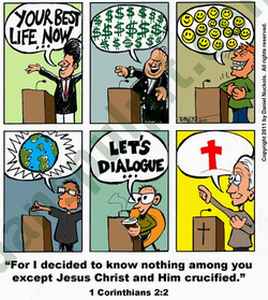
Easter 2011 Afterthoughts – Modern Church Evangelism

I began this article during Easter weekend, and am finally getting back on it. The events of Passion Week such as the denial by Peter, the garden prayer of Jesus, the trial, the tale of Barabbas, the crucifixion, the resurrection, doubting Thomas etc, have inspired countless sermons over the past two thousand years. Indeed, large portions of the four Gospel are dedicated to Jesus’ final week on earth, including half of the Gospel of Mark. There’s an almost endless amount of material on which to teach or write.

This year, I found myself spending some time reflecting on the two thieves who were crucified alongside of Jesus. We find the story in Luke 23:32-43.

Two other men, both criminals, were also led out with him to be executed. When they came to the place called the Skull, they crucified him there, along with the criminals—one on his right, the other on his left. Jesus said, “Father, forgive them, for they do not know what they are doing.” And they divided up his clothes by casting lots.

The people stood watching, and the rulers even sneered at him. They said, “He saved others; let him save himself if he is God’s Messiah, the Chosen One.” The soldiers also came up and mocked him. They offered him wine vinegar and said, “If you are the king of the Jews, save yourself.” There was a written notice above him, which read: THIS IS THE KING OF THE JEWS.

One of the criminals who hung there hurled insults at him: “Aren’t you the Messiah? Save yourself and us!” But the other criminal rebuked him. “Don’t you fear God,” he said, “since you are under the same sentence? We are punished justly, for we are getting what our deeds deserve. But this man has done nothing wrong.”

Then he said, “Jesus, remember me when you come into your kingdom.” Jesus answered him, “Truly I tell you, today you will be with me in paradise.”

In particular, I was contemplating how the one thief came to recognize Jesus as the Messiah. It was certainly not due to physical appearances. Here was Jesus, beaten and bloody, barely recognizable as a man, much less as a god, being executed as a common criminal. Those who insist that baptism and good works are necessary for salvation contend that the thief had become a believer and was baptized sometime in the past. They argue for this scenario based solely upon the fact that the Bible does not specifically deny this. This argument from silence however, is most unlikely since the meticulous author Luke would likely have mentioned such an important detail. In addition, the thief himself never even hints at this and offers not only an appeal, but a confession of faith as well. The only plausible explanation for the thief’s confession is the divine illumination and power of the Holy Spirit.

This should be a lesson for us today. A major objective in many of our modern market driven churches is to increase their membership roles. The salvation of those who join is often optional. Numerous churches however, are honestly seeking to save the lost. Many spend major bucks with marketing consultants in their quest to attract perspective members. While we should be looking at various means of attracting people to church, I’d like to offer my best advise free of charge: Preach the Gospel and rely on the power of the Holy Spirit. I’m convinced that this method will not only result in increased membership, but also accomplish the more important goal of leading others to salvation in Christ.

The Apostle Paul wrote in his letter to the Romans that I am not ashamed of the gospel, because it is the power of God that brings salvation to everyone who believe(Rom 1:16). I don’t know if many modern churches are ashamed of the Gospel or have just lost faith in its power. Some believe it to be old-fashioned, simplistic and out-of-date. It is thought that, if we are to reach people these days, we must be more relevant to our modern sophisticated culture. Yet, we would be hard pressed to find a more simplistic and basic message than the one offered over and over by Billy Graham. Furthermore, we can readily see the results.

I recall a story from few decades back, when Billy was already seeing hundreds and thousands come to Christ with each crusade. One evening, he preached what he thought to be his best sermon yet, but it produced little results. Afterward, he was approached by one of his staff who asked him why he failed to mention the cross in his sermon. Billy initially got angry, thinking “who is he to tell me how to preach?” Later in his hotel room, Billy came to the realization that the staffer was right, and resolved never to preach again without mentioning the cross.

Now, compare Mr Graham’s method with that in many of our modern churches. After ignoring the Gospel during the sermon, the church then resorts to “easy” techniques during the “invitation”. After being careful to not offend anyone by mentioning the fact that we are sinners (the very reason that we need a Savior), visitors are told they can accept Jesus and join the church by “coming down to the front”, or “if you too embarrassed to walk to the front, just slip out to one of our ushers along the back or sides, or if this is too much, simply lift up your hand and we’ll contact you”. What’s next, installing moving sidewalks like we find in airports?

We find another familiar story in Luke 18:35-43.

As Jesus approached Jericho, a blind man was sitting by the roadside begging. When he heard the crowd going by, he asked what was happening. They told him, “Jesus of Nazareth is passing by.”

He called out, “Jesus, Son of David, have mercy on me!” Those who led the way rebuked him and told him to be quiet, but he shouted all the more, “Son of David, have mercy on me!”

Jesus stopped and ordered the man to be brought to him. When he came near, Jesus asked him, “What do you want me to do for you?”

“Lord, I want to see,” he replied. Jesus said to him, “Receive your sight; your faith has healed you.” Immediately he received his sight and followed Jesus, praising God. When all the people saw it, they also praised God.

We thus see a beggar crying out to Jesus (“Son of David” is a recognition of Jesus as the promised Messiah). The surrounding crowd admonished him to be quiet. We can just imagine the comments, “stop making a scene”, “you’re embarrassing yourself”, “have some dignity” etc, but recognizing his own helplessness, he shouted even louder until Jesus healed him both physically and spiritually.

Those who understand will recognize that we’re all like that beggar. Adrian Rogers used to say that witnessing was simply one beggar showing another beggar where to find food. Notice also that the beggar didn’t have to be humanly persuaded to come to Christ. In fact, those surrounding him were actually discouraging him from calling out to Jesus. So, when the Holy Spirit truly regenerates a person, surrounding hardships won’t be able to keep them from Jesus. In many countries, there are people coming to Jesus despite being threatened by death.

I’m certainly not saying we should discourage or make it more difficult in our churches for people to come to Christ, or that we shouldn’t explore various means of attracting perspective members, but these techniques should be supplementary to, rather than a substitute for the Gospel. We must first and foremost preach the truth and allow the Holy Spirit to work. I’m convinced that, as people realize their true state and are persuaded by the power of the Spirit, we could string barbed wire across the aisles and many would still find a way to Jesus.


Notes:

We are saved by placing our faith and trust in Jesus as Savior and Lord. Making a public profession by walking to the front and/or joining a church is a step of obedience, but is not the basis of our salvation.

I’m also not saying that churches should merely go through the “Roman Road” each week. This article only addresses the evangelistic function of the church. Members must also be discipled by a balanced teaching of the other historical doctrines of the faith. We'll take up this topic in future articles.

The illustration is courtesy of the very talented Dan Nuckols of Dan’s Pulpit.

Tuesday, April 12, 2011

Dance Your Shoes Off

Who said Baptists can't dance? More than 2,000 people from Second Baptist Church, Houston, Texas, gathered in the heart of Houston to celebrate the resurrection of Jesus. This event, known as Dance Your Shoes Off! was held to publicly proclaim the resurrection of Jesus Christ in a powerful and celebratory way. The name of the event was chosen because, after the performance, each participant left a new pair of shoes on the field for those in need. These shoes will be given to local mission agencies and to individuals all across the world through their mission partners and mission trips.

This occasion was inspired by a similar event held by believers from Faith Church of Budapest, Hungary.

Sunday, October 24, 2010

Justin Back Safely from Afghanistan

We are overjoyed to relay the news that God has graciously returned our son Justin safely from the war zone in Afghanistan. He had been serving with his US Marine unit since early this year and arrived in Palm Springs, Ca about 3am Thursday morning. My wife Melody and future daughter-in-law Kayla were there to welcome him back. They are currently still visiting since he doesn't have to be back at base until Monday morning.

As only those who have fought in a war zone can fully imagine, Justin is having some minor difficulties adjusting but is certainly glad to be back in the states. Even though they were already considered engaged, Justin proposed and gave Kayla the ring at a scenic overlook yesterday. I’ll post pictures of the California trip in the next couple of weeks.

I’d like to personally thank all our readers, personal friends, and friends at work who have continually prayed for Justin while he was away. While all glory goes to God, we are especially grateful to the members of our local church, and particularly our Sunday School class, who spent time in prayer almost daily for Justin. It is popular these days to love Jesus but reject the local traditional church as irrelevant, but it’s times like these that “Internet churches”, “Relational churches”, the “Church at Starbucks” or the “Church of the Eighteenth Green” just doesn’t measure up. I have always maintained that our website ministry should always be supplemental to the local church, but never a substitute.

Although Justin is stateside for now, we ask that you continue to remember the troops (and their families) who are still bravely serving in harm’s way. Also, continue to remember the families of those who will not return safely. The first young man killed in Justin’s unit left a pregnant wife and a child he’ll never see. While we are rejoicing at Justin's safe return, there are others who are hurting, and we should mourn with them.

After his many close calls, Justin told us that he knew God was watching over him, and that he could feel the prayers of the folks back home. Therefore, to all the prayer warriors, we are forever in your debt. I think of all of you (and many who are unknown to us) every time I hear the Allen Asbury song:

Pressing over me like a big blue sky
I know someone has me on their heart tonight
That's why I know it's gonna be alright
'Cause somebody's praying me through
Somebody's praying me through

It may be my Mother, it might be my Dad
Or an old friend I've forgot I had
But whoever it is I'm so glad that
Somebody's praying me through

Through the tears, through the rain
Through the sorrow, through the pain
It keeps bringing me through
Over and over again

So when you're drowning in a sea of hurt
And it feels like life couldn't get any worse
There's a blessing waiting to push back the curse
'Cause somebody's praying you through
Somebody's praying you through

Someone got down on their knees and prayed for me
Somebody's, somebody's praying you through

Thanks again and God Bless our Troops!

Sunday, August 2, 2009

Should Churches Repent of Religion

I recently read an article on a Christian news site about a well-known pastor speaking at a national conference back in June. The purpose of the conference was to offer suggestions on how to "revitalize" local churches. According to the report, this particular speaker painted religion as a culprit that might be choking the growth of the Gospel and Christianity in America, and said that "until Christians repent of religion, no program, energy or strategy will help them to grow". Finally, he urged the pastors in the audience to repent… not of sin, but of religion.

So, is religion really choking the Gospel, and should we repent of our religious activities? I know members of a few local religious groups who recently returned from mission trips to India, Russia, Peru and Israel. Our church regularly takes up a benevolent offering for those who have lost their jobs. I have other friends that work with those feeding and ministering to the homeless and shut-ins. Others are engaged in prayer, VBS and other ministries. Still others are faithfully involved in church positions such as parking attendants, greeters, and administrators which only indirectly aid in spreading the Gospel. Should these Christians repent of these religious activities?

This illustrates that our original questions cannot be answered without first defining what is meant by the term "religion".

Read the entire Repent of Religion article.