Showing posts with label evangelism. Show all posts

Monday, June 23, 2025

Misunderstood Verses: Camel Through the Eye of a Needle

CamelIn Matthew 29, verses 16-30, we find Jesus telling His disciples the parable of the rich young ruler (see also Mark 10:17-21 and Luke 18:18-30). Most of us are familiar with the parable. A rich young ruler approaches Jesus with the question of how to be saved. Jesus then tells him to keep all of the commandments, and the ruler claims that he has. Jesus then instructs him to sell all his possessions and give the proceeds to the poor so that he might have treasures in heaven. He further instructs him to “come follow Me”. Unfortunately, the ruler rejected Jesus'command and went away sad because he refused to part with his earthly wealth.

Jesus then said to his disciples, “Truly I tell you, it is hard for someone who is rich to enter the kingdom of heaven. Again I tell you, it is easier for a camel to go through the eye of a needle than for someone who is rich to enter the kingdom of God” (Mt 29:23-24). These two preceeding verses sometimes cause some difficulty in their interpretation for some readers.

The first difficulty is in regard to the statement about the camel going through the eye of the needle. Some have interpreted the “eye of the needle” as a city gate in Jerusalem called the “Eye of the Needle” or the “Camel Gate”, a gate so small that a camel could only pass though by kneeling or crouching. This however, strongly appears to be an urban legend. Another version of the legend states that its rider had to dismount, thus becoming vulnerable to predators. These false illustrations did not begin before the eleventh century AD and there is no backing evidence. Jesus is using hyperbole to illustrate the impossibility of anyone obtaining salvation by trusting in riches or anything else other than Him.

The second misunderstanding is that Jesus was stating that it is easier to get to heaven if you are poor. But this is not the way the disciples interpreted His words. If they interpreted Jesus' words to mean that it was almost impossible for rich people to be saved, their reaction would have been of relief because they were poor. Instead, they clearly interpreted His words as meaning that no one could be saved. Notice their reaction in verse 25. When the disciples heard this, they were greatly astonished and asked, “Who then can be saved?”.

To understand their reaction, remember that the New Testament had not even been started at this point. The only Bible they had was the Hebrew Scriptures (Old Testament). In the Old Testament, the Jews were still under the Old Covenant that promised blessings for obedience and judgment for disobedience. During this time, the major OT “role models“ such as Abraham, Moses, David etc were also blessed monetarily.

Of course, in our day, regardless of economic status, there is still only one way to get to heaven, by trusting in the one-time sacrifice of our Lord Jesus.

Saturday, November 14, 2020

When the Skies of November Turn Gloomy

Guest Post by Jim Beatty – a fellow Servant of Jesus Christ… a sinner who has turned away from a sinful lifestyle… writing in hopes of throwing somebody a life ring.

Webmaster Note: This past week marked the 45th anniversary of the event of which Jim writes. He sent the article late last year, but we saved it until now for posting. The image below comes from the US Corps of Engineers and is in the public domain.


Most of us know about Veteran’s Day and I’m sure everyone knows when Thanksgiving is. Those dates are usually marked right on the calendar for us, because they are important days that we should remember. But there’s another important day in November that’s not generally marked on our calendar, and that is November 10th, the anniversary of the sinking of the Edmund Fitzgerald in 1975.

The Fitzgerald wasn’t one of the thousand foot “super tankers”, but a pretty big ship on the Great Lakes, with a length of almost 750 feet. Being what’s known as a “straight decker”, the Fitzgerald was perfect for hauling iron ore pellets, as she was that fateful night. Gordon Lightfoot took poetic liberties when he sang “They left fully loaded for Cleveland” when in fact, they left fully loaded for Zug Island, which is near Detroit, but I suppose you just can’t make Zug Island rhyme.

Captain McSorley was a veteran sailor with over 40 years experience and had taken command of the Fitzgerald only a few years earlier. It’s ironic that this was scheduled to be his final journey before retirement.

Lake Superior that night had waves of 35’, and the wind was about 60 miles per hour. The weather was so bad that the Soo Locks had been closed and the Coast Guard had issued a warning for all vessels to take safe harbor and to remain at anchor until the storm had passed.

The Captain of the Fitzgerald radioed that his ship was listing. They were taking water across the deck and both radars were out. The Steamship Arthur Anderson was following some distance behind, trying to guide them by radio to the safety of Whitefish Bay.

We know how the story ends. The Fitzgerald sunk suddenly... very suddenly in about 600 feet of water and all the men on board died.

I was working on the freighters in those days. In fact, we were safely at anchor in the lee of a small island on Lake Huron. But I remember from our lifeboat training that we were told, “There’s no need to panic, there’s no hurry, you don’t have to rush, it takes at least 45 minutes for a ship to sink. There’s plenty of time to get the lifeboats ready.”

But that’s not how it happened on the Fitzgerald that night. In fact, about a year later, I met a man who said he was working on the Arthur Anderson that night. He said it happened so quickly that with one sweep of the radar screen she was there, and the next sweep she was gone.

Gordon Lightfoot hit it square on when he sang, “The lake it is said... never gives up her dead... when the skies of November turn gloomy”.

You know, I have to wonder how many, if any, of those men had come to Christ at some time before that final journey. And I have to wonder how many of those men cried out to Christ with their last breath as they sank into that icy water.

Sometimes we get so caught up with the cares of the world and our own “stormy situations” that we forget about our relationship with God.

“Oh, you don’t understand! I’ve got to work a lot of overtime to pay off my student loans... or whatever. I don’t have time for that religious stuff right now”, or so we reason.

Others may be caught up in a lascivious lifestyle. Drinking and carousing, carelessly singing, “eat drink and be merry, for tomorrow we die!” Those poor spirits never even see the need to change their course, much less to get the lifeboats ready!

Others may think they can just put it off, “Oh, I’m a good guy and people like me. I mean, I go to church, you know... or at least sometimes. It’s not like you have to really follow all that stuff. Besides, I can always repent on my death bed. Certainly Jesus will wait for ME, won’t he?”

The trouble is, as the Edmund Fitzgerald shows us, sometimes the calamities of life happen so suddenly that we don’t always have time to even LOOK for the lifeboats. Proverbs 27:1 says, “Don’t boast about tomorrow, for a man doesn’t know what a day might bring”.

So the question is, “When should I change my course... when should I get my lifeboat ready?” Paul tells us in 2nd Corinthians 6:2, “And he said, in the favorable time, I listened in the favorable day, you needed salvation and I helped. Behold, THIS is the favorable time. Behold, THIS is the day of salvation”.

If there is anyone reading this message and has come to a point in your life where you see the need to change your course, you see that it’s time to get the lifeboat ready. I urge you to seek out competent biblical teaching, believe in the Word and repent from the world. Be baptized and receive the free gift of the Holy Spirit.

I urge you to seek out and build your relationship with the One who can calm the stormy sea. And I urge you to do this while it is still the favorable day, before one of life’s calamities can strike!

Friday, February 21, 2020

Born this Way?

Guest Post by Jim Beatty – a fellow Servant of Jesus Christ

Webmaster Note: Jim wrote this excellent article after the Lady Gaga song and album came out, but his writing had been previously rejected by others as being “too controversial” and/or anti-gay. Yet, an honest reading of the article makes clear that Jim is addressing a universal condition that affects each of us, both homosexuals and heterosexuals alike.


“Baby, I was Born This Way!” - Lady Gaga, 2011

But the serpent said to the woman, “You will not surely die. For God knows that when you eat of it your eyes will be opened, and you will be like God, knowing good and evil” Genesis 3:4-5 (ESV).

It was the incident in the Garden of Eden that gave each of us all our sinful nature. In Romans 5:12, Paul says “Therefore, just as sin came into the world through one man, and death through sin, and so death spread to all men because all sinned”. Jeremiah 17:9 explains “The heart is deceitful above all things, and desperately sick; who can understand it?” David said in Psalm 51:5 “Behold, I was brought forth in iniquity, and in sin did my mother conceive me”. Solomon said in Ecclesiastes 7:20 “Surely there is not a righteous man on earth who does good and never sins”, and in Romans 3:23, Paul said “for all have sinned and fall short of the glory of God”.

While I don't think that anyone’s theology should be based on some pop/rock song of the past, Lady Gaga does make a good and true point that we're all “born this way” (I can't say that I agree with the rest of the song though, but you can find the lyrics on your favorite search engine and judge that for yourself).

We’re all “born this way”, myself included, which is to say we’re all born with a sinful nature. This sinful nature grows differently in different people and manifests differently in each of us - blossoming into different “flavors”, one might say. A thief is “born this way”, as is an adulterer, a murderer, a liar, a gossip, a greedy person, a swindler, a fornicator, or anyone who oppresses the poor and feeble are all “born this way” (Ref: 1st Corinthians 6:9-10, Galatians 5:19-21, Colossians 3:5-6 and other passages).

God does not want us to stay “this way”, however, as is made abundantly clear throughout scripture, in fact we are at enmity with God when we are “this way” (Genesis 3:15).

God does love us however, and offers us all a way out of our bondage to this sinful nature! Jesus is quoted in Mark 2:17 “Those who are well have no need of a physician, but those who are sick. I came not to call the righteous, but sinners”. Paul also tells us “For while we were still weak, at the right time Christ died for the ungodly” (Romans 5:6), and although we are “born this way” God gives us the opportunity to change all that!

Matthew 3:3-5 says that Jesus answered him, “Truly, truly, I say to you, unless one is born again he cannot see the kingdom of God”. Nicodemus then asked him, “How can a man be born when he is old? Can he enter a second time into his mother’s womb and be born?” Jesus answered, “Truly, truly, I say to you, unless one is born of water and the Spirit, he cannot enter the kingdom of God”. The way to change from being “born this way” is to be “born again”.

So although all of us were truly “born this way”, we don't have to stay this way! Therefore if any man be in Christ he is a new creature: old things are passed away; behold, all things are become new (2nd Corinthians 5:17), and Therefore, since we have been justified by faith, we have peace with God through our Lord Jesus Christ (Romans 5:1).

Saturday, December 16, 2017

Open Doors

We’ve just published a new article, Should Christians Celebrate Christmas? on our main site. We always attempt to write all articles with a good balance of conviction and charity, particularly on articles that may involve polemics and gray areas of the Bible. Although we try our best, we often fall short of the ideal, usually on the side of favoring conviction over charity. This subject can be a very emotional one for those on both sides of the argument, so we’ve attempted to make an extra effort to present a balanced account of the evidence. We mention this article because one of the arguments for the celebration of Christmas is that it opens many doors to share with non-believers about the real meaning of the holiday.

When the Scriptures speak of an open door, the author is often referring to an opportunity to share the gospel of Jesus Christ. At the end of Paul’s first missionary journey, he reported back to the church at Antioch how God had opened the door of faith to the Gentiles (Ac 14:24-28). He also spoke of a door that God opened for Him at Troas (2Cor 2:12).

In Paul’s final instructions to the Colossian Church, he had a prayer request. Devote yourselves to prayer, being watchful and thankful. And pray for us too, that God may open a door for our message, so that we may proclaim the mystery of Christ, for which I am in chains. Pray that I may proclaim it clearly, as I should (Col 4:2-4).

Of course, when God opens a door for us, we can almost always count on opposition from adversaries. Near the end of his first letter to the church at Corinth, Paul writes that he plans to visit them soon, but that he will “stay on at Ephesus until Pentecost, because a great door for effective work has opened to me, and there are many who oppose me” (1Cor 16:8-9).

Yet, Paul saw adversity as an opportunity to rely on God’s great strength rather than his own weaknesses. We do not want you to be uninformed, brothers, about the hardships we suffered in the province of Asia. We were under great pressure, far beyond our ability to endure, so that we despaired even of life. Indeed, in our hearts we felt the sentence of death. But this happened that we might not rely on ourselves but on God, who raises the dead. He has delivered us from such a deadly peril, and he will deliver us. On him we have set our hope that he will continue to deliver us, as you help us by your prayers. Then many will give thanks on our behalf for the gracious favor granted us in answer to the prayers of many (2Cor 1:8-11).

In other places, the open door refers to access to God, either in fellowship or in a salvific sense. We first see this in the account of the great flood. After Noah built the ark that was a picture of Christ, the rains came down, Noah’s family and the animals entered the ark, and the Lord shut the door (Gen 7:11-16). Just as the open door represented life, the closed door resulted in a judgment of death for the wicked.

Likewise, in the parable of the bridesmaids (Mt 25:1-13), the ones that were not prepared for the bridegroom (Jesus) when He came, arrived after the door was shut. They called out “Lord, Lord, open the door for us!” But he replied, “Truly I tell you, I don’t know you”. (See also Luke 25:22-30 for the similar parable of the narrow door).

The prophet Isaiah gives us the account of God placing Eliakim as the main “storekeeper” under King David. I will place on his shoulder the key to the house of David; what he opens no one can shut, and what he shuts no one can open (Is 22:22). This gave Elaikim control of the palace among other duties and privileges, but the greatest power is that he controlled who had access to the King. He could allow or block anyone from entering into the king’s throne room. In Revelation, Jesus says to the church at Philadelphia, “These are the words of him who is holy and true, who holds the key of David. What he opens no one can shut, and what he shuts no one can open” (Rev 3:7). Here, Jesus is declaring that He holds the key to the throne room of the Divine King, the throne of Heaven.

So, we see that it is God who opens and closes the doors in all these cases. Yet, there is one case in which we must open the door for ourselves. Going back to the churches in Revelation, Jesus says to the church at Laodicea, “Those whom I love I rebuke and discipline. So be earnest, and repent. Here I am! I stand at the door and knock. If anyone hears my voice and opens the door, I will come in and eat with that person, and they with me” (Rev 3:19-20).

There has been some disagreement on the addressee of this statement. It is in the context of His address to the church, yet he also says “that person”. In addition, the next two verses read To him who overcomes, I will give the right to sit with me on my throne, just as I overcame and sat down with my Father on his throne. He who has an ear, let him hear what the Spirit says to the churches (Rev 3:21-22). These last two verses are obviously admonishing Christians to take heed of what was being said to the seven churches in chapters 2 and 3. If verses 19 and 20 are part of the address to the churches, they are an appeal for individuals within the church to let Him into closer fellowship. If the verses are part of the address to individual Christians, it could be taken as an evangelistic call.

The former interpretation is probably the most likely, however we know that Jesus came to seek and save the lost (Lk 19:10), and that He is the door to Heaven (Jn 10:9). Therefore, when we are called, we must respond to the Gospel by opening the door by faith. If we do so and confess Jesus as Lord, we will be sealed with the Holy Spirit and adopted into the family of God as co-heirs of the Kingdom (Rom 10:9-10, Eph 1:13-14, Rom 8:14-17).

Sunday, June 24, 2012

Giving Christ His Place

From AW Tozer:
Christianity at large and the Church generally speaking, are afflicted with a dread, lingering illness that shows itself daily in the apathy and spiritual paralysis of its members.

How can it be otherwise when twentieth-century Christians refuse to acknowledge the sharp moral antithesis that God Himself has set between the Church, as the Body of Christ, and this present world with its own human systems?

The differences between the churchly world and the followers of the Lamb are so basic that they can never be reconciled or negotiated. God has never promised His believing people that they would become a popular majority in this earthly scene.

I wonder how many believers would join me in a clear-cut manifesto to our times? I want it to be a declaration of our intentions to restore Christ to the place that is rightfully His in our family situations and in the fellowship of the churches that bear His name.

Are we willing to demonstrate the standards of godliness and biblical holiness as a rebuke to this wicked and perverse generation?

Too many modern churches believe that they can reach the world by becoming more like it. This might initially attract a few curious seekers, usually for misdirected reasons such as their quest for increased prosperity, better health, worry free living, or other goals stemming from promises contained within the "tickle the ear" messages coming from the church. The vast majority of unbelievers however, will generally reject church members attempting to assimilate into the world. Their most common reaction will be to rightly accuse the member of being a hypocrite. "See, I knew you didn't really believe all that Christian morals, ethics and stuff". If the unsaved can't see any difference between us and them, what incentive do they have to join us?

The church cannot transform the world if we are too busy assimilating into it. It is only when the church bends the knee and confesses Jesus as Lord to the glory of the Father (Php 2:10-11), and remains faithful to the Biblical teachings that the unbeliever will see something worth responding to. Returning to Pastor Tozer, he offers this prayer:

Lord, though the Church and the world often collide, I pray that each member of the Body of Christ will be so full of integrity that many unsaved people in the world will be pointed to Jesus Christ.

Wednesday, December 7, 2011

Yet Shall He Live

One of my spiritual heroes is AW (Aiden Wilson) Tozer.  He served as pastor of several churches for about 45 years, including the Southside Alliance Church in Chicago for 30 years.  He then became pastor of Avenue Road Church of Toronto in 1959 before dying suddenly of a heart attack in 1963.

Pastor Tozer never went to college or seminary, and had no formal religious training, yet by spending hours upon hours with an open Bible before God, he was able to speak and write with such conviction that he became one of the most often quoted Christians of the past 50 years.

Here is a short except from one of his sermons about death, based up the Scripture verse, He that believeth in me, though he were dead, yet shall he live (Jn 11:25- KJV).
This may sound strange-but it is a fact that death is not the worst thing that can happen to a believing Christian.

I can recall the first time I heard that statement, in a quiet conversation with Harry M. Shuman, for many years the president of the international Christian and Missionary Alliance. He was a soft-spoken yet forceful man of God, rich in the wisdom of God’s Word. We were talking of the serious issues of life and death. When he had something especially important to say, Dr. Shuman had an unusual way of lowering his voice and tilting his head just a bit. I can see him yet as he looked out from under his shaggy brows straight into my eyes.

"Remember, Tozer," he said, "death is not the worst thing that can happen to a person!".

For the Christian, death is a journey to the eternal world. It is a victory, a rest, a delight. I am sure my small amount of physical suffering has been mild compared to Paul’s, but I feel as Paul did: "I desire to depart and be with Christ, which is better by far!" (Php 2:23)
Pastor Tozer is speaking, of course, of physical death.  All people, both believers and nonbelievers, will experience physical death unless we’re still alive here on Earth when Jesus returns.  However, only nonbelievers (those without a personal relationship with Jesus Christ) will experience the second death - an eternity in hell separated from God.  This eternal state is also known as "eternal death" or "spiritual death".  This should not be confused with the state of being "spiritually dead", the current condition of a nonbeliever, and the former condition of believers prior to being regenerated (made alive in Christ) by the grace of God (Eph 2:1-10).

Many of us have heard the old saying, "Born once, die twice; but born twice, die once".  Christians have been born twice, that is “born again” or “born from above” (Jn 3:3-7), so only Christians will die only once (physically), while unbelievers will experience both physical and spiritual death.  It has rightly been said that "one can't kill a Christian - but can only change his or her address".

For those wanting more info on how to avoid the second death, please read our How to Be Sure You’re Going to Heaven article.

A few years ago, we also wrote a related article on the Differing Views of Death between believers and unbelievers.  We welcome you to check it out.

Sunday, October 9, 2011

Bridge to Life - Gospel Graffiti

After several weeks of being overwhelmed at work, I'm finally seeing some daylight. The overtime came in handy, but it was difficult to find time to study, write or do most anything else. I'm certainly not complaining, especially considering the overall employment situation. We continue to pray for those who would like to work but have been victimized by BHO's De-Development of America agenda.

My workload is beginning to level off, and I even got to watch some college football this weekend. I'm also teaching a Bible study class again and have several new articles in progress for the blog and the main website. In the meantime, here's an outstanding video from the Billy Graham Evangelistic Association containing an excellent blend of graffiti and the Gospel.

Tuesday, July 12, 2011

Trump, Newt and Christianity - Part 1

Like so many articles, I began this a couple of months ago and got sidetracked. Although the news is now a bit dated, the principle remains extremely relevant, even timeless. This writing began when I read a column by CBN News political correspondent David Brady entitled Evangelical Leaders Say Donald Trump May Find Support from Social Conservatives. About ten days later, an article appeared in the Christian Post entitled Donald Trump on Faith: I am Christian, Sunday Church Person.

These articles came out when Mr Trump was flirting with the idea of running for president. He later declared that he is not running, but has said that he might change his mind. Mr Brady’s article was primarily political in nature, reporting the support that Mr Trump might find support among evangelicals due to his conservative positions on some of the issues. The article then provided many quotes from sources identified by the author as “key national Evangelical leaders”. In our opinion, the most accurate quote comes from Tony Perkins of the Family Research Council who stated:

“Given Donald Trump's background in the gambling industry and his flamboyancy, one would not think he would be a fit with Evangelical voters. However, given the wide open field of candidates, strong statements that Trump has recently made on core social issues combined with an overarching desire to see a new occupant in the White House, he may find support among social conservatives.“
This is all we wish to say about the political aspect of this issue. Instead, we’d like to focus on the second article, and examine Mr Trump’s claim to be a Christian. The Christian Post article states:
Potential GOP presidential contender Donald Trump opened up about his faith during an interview with a Christian network, saying he is a Christian and that he's a "Sunday church person."

“I believe in God. I am Christian. I think the Bible is certainly, it is THE book. It is the thing," Trump told Christian Broadcasting Network's David Brody.

[In the interview], Trump shared that he used to attend First Presbyterian Church in Jamaica Queens. "I'm a Protestant, I'm a Presbyterian. And you know I've had a good relationship with the church over the years. I think religion is a wonderful thing. I think my religion is a wonderful religion.”

When asked by Brody where he stores all the Bibles people send to him, Trump said that he keeps them in a "very nice place" since his Manhattan location doesn't allow him to keep all the mail he receives. "There's no way I would ever throw anything, to do anything negative to a Bible, so what we do is we keep all of the Bibles," said Trump. "I would have a fear of doing something other than very positive so actually I store them and keep them and sometimes give them away to other people."

As for church attendance, the host of NBC's "Celebrity Apprentice" indicated that he makes an effort. ”Well, I go as much as I can. Always on Christmas. Always on Easter. Always when there's a major occasion. And during the Sundays. I'm a Sunday church person. I'll go when I can.”

After this article came out, I heard many people say (often with an amazed expression), “I didn’t know that Donald Trump was a Christian.” To which I usually reply, “Neither did I… and I still don’t know”. I’m then often asked, “What makes you think he’s not?” In reply, I usually say something to the effect of, “I’m not saying that Mr Trump is not a Christian. I don’t know him personally so I’m only basing my thoughts on the news accounts, which provide very little evidence either way”.

In examining Mr Trump’ statements, he first says “I believe in God”. To many people, we would ask “Which god?” but his additional comments leads us to believe he is indeed referring to the true God of the Bible. It is not clear how much, or how little he knows about God, but mere acceptance of His existence only qualifies one to be a demon (James 2:19). Mr Trump does state that “I am a Christian”, but merely making this statement only puts him in the same company as Barack Obama and over 80% of Americans who claim to be a Christian. When follow-up questions are asked (which evidently was not done in Mr Trump’s case), we find the number of possible true Christians drops by more than half.

Mr Trump relays how he keeps his Bibles in a “very nice place”, but gives no word on whether he actually reads them. He also spends much time talking of his church denomination and attendance (Christmas, Easter and special occasions). Aside from good deeds, church attendance is one of the first things mentioned by most people when attempting to give evidence of their Christianity. For example, after meeting and attempting to witness several times with Mr Obama, Franklin Graham stated “For [Mr Obama], going to church means he’s a Christian. For me, the definition of a Christian is whether we have given our life to Christ and are following him in faith, and we have trusted him as our Lord and Savior. That’s the definition of a Christian; it’s not as to what church you’re a member of. A membership doesn’t make you a Christian.”

Similarly, we have the article, Newt Gingrich: Why I Became Catholic, that appeared to coincide with Mr Gingrich campaign launch. The difference with Mr Trump's article is that Mr Gingrich’s article only chronicles his choice of denomination and does not address the issue of whether or not he is a Christian. Mr Gingrich writes

Pope Benedict XVI’s visit to the United States in April of 2008 was a turning point for me. The Holy Father presided over solemn vespers with the U.S. bishops in the Crypt Church at the basilica in Washington. Callista’s choir was asked to sing for Pope Benedict at vespers, and as a spouse, I had the unique opportunity to attend the papal visit and was deeply moved by the occasion.

Catching a glimpse of Pope Benedict that day, I was struck by the happiness and peacefulness he exuded. The joyful and radiating presence of the Holy Father was a moment of confirmation about the many things I had been thinking and experiencing for several years.

That evening I told Msgr. Rossi [Walter Rossi, rector of the basilica in DC] I wanted to be received into the Catholic Church, and he agreed to join Callista [Mr Gingrich’s third wife]as my sponsor. Under his tutelage, I studied the Catechism of the Church over the next year and was received into the Church in March of 2009 in a beautiful Mass at St. Joseph’s on Capitol Hill.

Mr Gingrich’s article was primarily about his journey toward the Roman Catholic faith, but the timing suggests that it was also written for political gain (as was Mr Trump’s interview). Some have suggested that if Mr Gingrich had run into the equally peaceful and happy Dalai Llama, he might have become a Buddhist instead. We find this highly unlikely sine there aren’t 40-50 million Buddhist voters in our country. It remains to be seen if this article will help him to erase his divorce problems, since his 6-year extra-marital affair with Callista was a primary cause of the breakup of his second marriage.

This all said, the primary objective of this two-part article is not to focus so much on Mr Trump and Mr Gingrich, but to caution Christians to be alert for false Christians. Before I go any further, let me say again that Mr Trump and Mr Gingrich may both be Christians, but we should be careful to assume this without evidence. Let me further say that, this is not written so that Christians can respond with condemnation, but so that we do not miss a witnessing opportunity.

As we mentioned above, less than half of those professing to be Christians are actually saved. It is very sad that, upon their physical death, so many will hear Jesus say, “Depart from me, I never knew you” (Mt 7:23). Perhaps even sadder still is the fact that many of these lost people genuinely believed that they would go to heaven, and the saddest part of all is that, many true Christians might have missed witnessing to them because we also assumed that they were saved.

The Scriptures tell us that only God can truly know the heart (Lk 16:15), but we can also know blatantly false Christians (Mt 7:20, Titus 1:16) by their actions. Unfortunately, the Bible also speaks of a more difficult case, that of those who are difficult to distinguish from true Christians (Jesus’ parable of the wheat and tares in Mt 13:24-28). So, we must be ever vigilant in our evangelism.

We’ll get much deeper into this issue in Part 2. The link will be posted here when completed.

Saturday, May 7, 2011

G.O.S.P.E.L.

Here's a video containing one of the clearest, theologically rich presentations of the Gospel (Good News) that I've heard in a while. It is compressed into only four minutes and presented by Humble Beast Records.

In the video, G.O.S.P.E.L stand for “God Our Sins Paying Everyone Life”.

Tuesday, May 3, 2011

Easter 2011 Afterthoughts – Modern Church Evangelism

I began this article during Easter weekend, and am finally getting back on it. The events of Passion Week such as the denial by Peter, the garden prayer of Jesus, the trial, the tale of Barabbas, the crucifixion, the resurrection, doubting Thomas etc, have inspired countless sermons over the past two thousand years. Indeed, large portions of the four Gospel are dedicated to Jesus’ final week on earth, including half of the Gospel of Mark. There’s an almost endless amount of material on which to teach or write.

This year, I found myself spending some time reflecting on the two thieves who were crucified alongside of Jesus. We find the story in Luke 23:32-43.

Two other men, both criminals, were also led out with him to be executed. When they came to the place called the Skull, they crucified him there, along with the criminals—one on his right, the other on his left. Jesus said, “Father, forgive them, for they do not know what they are doing.” And they divided up his clothes by casting lots.

The people stood watching, and the rulers even sneered at him. They said, “He saved others; let him save himself if he is God’s Messiah, the Chosen One.” The soldiers also came up and mocked him. They offered him wine vinegar and said, “If you are the king of the Jews, save yourself.” There was a written notice above him, which read: THIS IS THE KING OF THE JEWS.

One of the criminals who hung there hurled insults at him: “Aren’t you the Messiah? Save yourself and us!” But the other criminal rebuked him. “Don’t you fear God,” he said, “since you are under the same sentence? We are punished justly, for we are getting what our deeds deserve. But this man has done nothing wrong.”

Then he said, “Jesus, remember me when you come into your kingdom.” Jesus answered him, “Truly I tell you, today you will be with me in paradise.”

In particular, I was contemplating how the one thief came to recognize Jesus as the Messiah. It was certainly not due to physical appearances. Here was Jesus, beaten and bloody, barely recognizable as a man, much less as a god, being executed as a common criminal. Those who insist that baptism and good works are necessary for salvation contend that the thief had become a believer and was baptized sometime in the past. They argue for this scenario based solely upon the fact that the Bible does not specifically deny this. This argument from silence however, is most unlikely since the meticulous author Luke would likely have mentioned such an important detail. In addition, the thief himself never even hints at this and offers not only an appeal, but a confession of faith as well. The only plausible explanation for the thief’s confession is the divine illumination and power of the Holy Spirit.

This should be a lesson for us today. A major objective in many of our modern market driven churches is to increase their membership roles. The salvation of those who join is often optional. Numerous churches however, are honestly seeking to save the lost. Many spend major bucks with marketing consultants in their quest to attract perspective members. While we should be looking at various means of attracting people to church, I’d like to offer my best advise free of charge: Preach the Gospel and rely on the power of the Holy Spirit. I’m convinced that this method will not only result in increased membership, but also accomplish the more important goal of leading others to salvation in Christ.

The Apostle Paul wrote in his letter to the Romans that I am not ashamed of the gospel, because it is the power of God that brings salvation to everyone who believe(Rom 1:16). I don’t know if many modern churches are ashamed of the Gospel or have just lost faith in its power. Some believe it to be old-fashioned, simplistic and out-of-date. It is thought that, if we are to reach people these days, we must be more relevant to our modern sophisticated culture. Yet, we would be hard pressed to find a more simplistic and basic message than the one offered over and over by Billy Graham. Furthermore, we can readily see the results.

I recall a story from few decades back, when Billy was already seeing hundreds and thousands come to Christ with each crusade. One evening, he preached what he thought to be his best sermon yet, but it produced little results. Afterward, he was approached by one of his staff who asked him why he failed to mention the cross in his sermon. Billy initially got angry, thinking “who is he to tell me how to preach?” Later in his hotel room, Billy came to the realization that the staffer was right, and resolved never to preach again without mentioning the cross.

Now, compare Mr Graham’s method with that in many of our modern churches. After ignoring the Gospel during the sermon, the church then resorts to “easy” techniques during the “invitation”. After being careful to not offend anyone by mentioning the fact that we are sinners (the very reason that we need a Savior), visitors are told they can accept Jesus and join the church by “coming down to the front”, or “if you too embarrassed to walk to the front, just slip out to one of our ushers along the back or sides, or if this is too much, simply lift up your hand and we’ll contact you”. What’s next, installing moving sidewalks like we find in airports?

We find another familiar story in Luke 18:35-43.

As Jesus approached Jericho, a blind man was sitting by the roadside begging. When he heard the crowd going by, he asked what was happening. They told him, “Jesus of Nazareth is passing by.”

He called out, “Jesus, Son of David, have mercy on me!” Those who led the way rebuked him and told him to be quiet, but he shouted all the more, “Son of David, have mercy on me!”

Jesus stopped and ordered the man to be brought to him. When he came near, Jesus asked him, “What do you want me to do for you?”

“Lord, I want to see,” he replied. Jesus said to him, “Receive your sight; your faith has healed you.” Immediately he received his sight and followed Jesus, praising God. When all the people saw it, they also praised God.

We thus see a beggar crying out to Jesus (“Son of David” is a recognition of Jesus as the promised Messiah). The surrounding crowd admonished him to be quiet. We can just imagine the comments, “stop making a scene”, “you’re embarrassing yourself”, “have some dignity” etc, but recognizing his own helplessness, he shouted even louder until Jesus healed him both physically and spiritually.

Those who understand will recognize that we’re all like that beggar. Adrian Rogers used to say that witnessing was simply one beggar showing another beggar where to find food. Notice also that the beggar didn’t have to be humanly persuaded to come to Christ. In fact, those surrounding him were actually discouraging him from calling out to Jesus. So, when the Holy Spirit truly regenerates a person, surrounding hardships won’t be able to keep them from Jesus. In many countries, there are people coming to Jesus despite being threatened by death.

I’m certainly not saying we should discourage or make it more difficult in our churches for people to come to Christ, or that we shouldn’t explore various means of attracting perspective members, but these techniques should be supplementary to, rather than a substitute for the Gospel. We must first and foremost preach the truth and allow the Holy Spirit to work. I’m convinced that, as people realize their true state and are persuaded by the power of the Spirit, we could string barbed wire across the aisles and many would still find a way to Jesus.


Notes:

We are saved by placing our faith and trust in Jesus as Savior and Lord. Making a public profession by walking to the front and/or joining a church is a step of obedience, but is not the basis of our salvation.

I’m also not saying that churches should merely go through the “Roman Road” each week. This article only addresses the evangelistic function of the church. Members must also be discipled by a balanced teaching of the other historical doctrines of the faith. We'll take up this topic in future articles.

The illustration is courtesy of the very talented Dan Nuckols of Dan’s Pulpit.

Sunday, October 17, 2010

Chile Miners Receive Spiritual Support

Here’s a story that was virtually ignored during the massive coverage of the Chilean miners who were recently rescued after being trapped underground for more than two months. Our friends at Love Worth Finding Ministries, the ministry of the late Adrian Rogers, notified us of this inspiring development during the ordeal.

Chilean engineer Igor Bravo is the owner of the geo-technical monitoring company that helped with the rescue effort. While taking part in the operation, Mr Bravo became concerned about the spiritual needs of the trapped miners as well as their physical needs. As reported by the Baptist Press:

"I had to help in some Christian way," Bravo said. "If there is an opportunity to share the Gospel -- even if we're extremely occupied -- and to contribute to the Christian cause and evangelism, it's something that's in [my] blood."

A member of First Baptist Church of Santiago, Bravo realized that though the miners' physical needs were being met, their spiritual needs had been overlooked. He called his pastor, Luis Cortéz, for help.

Cortéz contacted Radio Harmonia, a Christian broadcasting station in Santiago, which was able to provide MP3 files of Pastor Adrian Rogers' sermons and Bible studies in Spanish along with Christian music. Rogers, the late pastor of Bellevue Baptist Church in Cordova, TN, was a former Southern Baptist Convention president, author and TV-radio speaker.

While Cortéz made contacts in Santiago, Bravo searched Copiapó, the nearest town to the mine, for other spiritual materials. He found 33 New Testaments and two entire Bibles that met the size restrictions for what could be sent down the chamber. On Sept. 17 he sent the materials to the miners via the "paloma," a device used to transport objects between the trapped miners and the surface ("Paloma" means "pigeon" or "dove" in Spanish).

Three of the 33 trapped miners were evangelical Christians when the mine collapsed. Since that time, two more of them have made professions of faith.

One of the original believers, José Henríquez, has been leading Bible studies for the miners each evening. "It [Bible study] started out 5, 10, now 20 participants," Bravo said. "[The people on the surface] have José Henríquez identified as the spiritual leader; they call him 'The Pastor.'" Bravo wrote Henríquez's name in one of the Bibles and sent it specifically to him but left the other blank. Henríquez says he intends to give the second to the Bible study's best student.

As Bravo ministered to the miners, he knew their families waiting at Camp Esperanza (Hope) needed spiritual encouragement as well. "A lot of people don't know the Lord," Bravo said. "That's when the second need surfaced."

Bravo called on the Chilean Baptist Union for help, and soon pastor Marcelo Leiva of Vallenar Baptist Church in Vallenar, Chile, was on-site comforting the miners' families. "Pastor Marcelo has been fundamental in meeting that need," Bravo said.

Amid ensuring that both the miners and their families have the spiritual support they need, Bravo continues to play a vital role in the rescue efforts. His company determined the size of the rock blocking the mine following the collapse and is currently monitoring the status of the rescue shaft. "I was very involved in the technical aspects and then later became involved in the spiritual," Bravo said. "It's been a great blessing."

We join with LWF in praying that God will continue to use those messages to provide ministry, encouragement and salvation to the miners and their families

Saturday, October 16, 2010

Third Lausanne World Evangelization Congress

Our friend Sherri, a missionary serving in the Far East, called our attention to the 3rd International Lausanne Congress on World Evangelization that begins today in Cape Town, South Africa and lasts through October 25. According to ChinaAid, the Chinese government has been harassing invited representatives from their country.
Over the past few months, the Chinese government has been suppressing the 200 house church representatives who have been invited to attend this year’s Lausanne Congress. According to information obtained by ChinaAid, all the representatives, whether Uyghur Christians from Xinjiang or Han Christians from Beijing, have been contacted by authorities for questioning. It is sad to report, but family members of the invitees have also been threatened.

Two house church Christians from Baotou City, Inner Mongolia were stopped by officials before they departed for South Africa. On October 9, one of them was placed under a 15-day detention. Five house church invitees were stopped by customs officials at the airport on October 10, and four had their passports confiscated. One was detained.

Dr. Fan Yafeng is a prominent legal scholar, leader of the Chinese Christian Legal Defense Association (defenders of religious freedom, human rights and rule of law in China for years), and winner of the 2009 John Leland Religious Liberty Award. He was harassed by Beijing police on October 12 after accepting an interview from National Public Radio pertaining to the Lausanne Congress. Twenty police officers were assigned to stop him from leaving his apartment.

Dr. Fan commented that underground Chinese Christians should not naively put hope in the Chinese Communist regime, and should place their trust in God, and continue to non-violently strive for religious freedom, human rights, rule of law and democracy in China. Dr. Fan strongly supports legal defense as a very effective tool. He also strongly criticized the persecution of 2010 Nobel Peace Prize winner Mr. Liu Xiaobo and his wife by Chinese government.

It has been 21 years since the Manila gathering, and tens of millions of Christians in China are thriving in the Church of Jesus Christ, and China experiences the fastest growth of Christians. With that said, how long will we have to wait for the 200 unoccupied seats meant for representatives of China to be filled?

Article 13 of the Lausanne Covenant reads

”It is the God-appointed duty of every government to secure conditions of peace, justice and liberty in which the Church may obey God, serve the Lord Christ, and preach the gospel without interference. We therefore pray for the leaders of the nations and call upon them to guarantee freedom of thought and conscience, and freedom to practice and propagate religion in accordance with the will of God and as set forth in “The Universal Declaration of Human Rights.” We also express our deep concern for all who have been unjustly imprisoned, and especially for those who are suffering for their testimony to the Lord Jesus. We promise to pray and work for their freedom. At the same time we refuse to be intimidated by their fate. God helping us, we too will seek to stand against injustice and to remain faithful to the gospel, whatever the cost. We do not forget the warnings of Jesus that persecution is inevitable. (1 Tim. 2:1-4; Acts 4:19; 5:29; Col. 3:24; Heb. 13:1-3; Luke 4:18; Gal. 5:11; 6:12; Matt. 5:10-12; John 15:18-21).”
We would like to pass on a prayer request that is being sent out to Christians around the world to intercede on behalf of the China.

As the day is quickly approaching for Lausanne III to start in Cape Town on October 17, please remember the participants from Mainland China. Participants and volunteers from Mainland China have already purchased their tickets and reserved hotel rooms in preparation to join 4,500 Christian leaders at the Congress. In addition to raising their own support, the Mainland Chinese participants have also given scholarships for 100 neighboring country participants to attend.

There is a possibility that the Chinese participants will not be able to attend.

Please intercede on behalf of the Church in China, that God would have mercy and move the hearts of those who hold the power to change the situation. We serve a God who is above all human systems, understanding and authority. May His Will be done in the Church in China, and His Power known throughout the world.

Please pray for God to change hardened hearts and for the continued faithfulness of the Chinese Christians under persecution.

Saturday, September 11, 2010

Have We Learned Anything in 9 Years?

On this anniversary of 911, after posting a retrospect column by Michelle Malkin, we offer a must read from one of my favorite and most respected contemporary columnists, Joseph Farah, the founder, editor and CEO of WorldNetDaily. Today, he has written a very important article which asks the question, Have we learned anything in 9 years? In the process, Mr Farah goes beyond the usual political rhetoric and identifies the actual underlying spiritual issues, so we take the rare step of reproducing his article in its entirety.
What have we learned in the nine years since history's most devastating attack on America by Islamic terrorists?

Not much.

We're still involved in two seemingly endless wars half-way around the world that doesn’t seem to have any coherent objectives or definitions of victory. Meanwhile, back home where the attack took place, we're planning to allow a Muslim Brotherhood front group to build a victory mosque.

The attack of Sept. 11, 2001, remains a dark cloud in America's history with no silver lining – no awakening to the dangers we face from future subversion by the enemy responsible. It is as if Americans have a collective case of Stockholm Syndrome. Too many of us have become sympathetic to our enemy, the one that killed 3,000 of us and made the rest of us weep.

Who would have believed that only seven years after that attack Americans would elect a president raised abroad as a Muslim, bearing a Muslim name and apparently in love with all things Islamic? It would have been inconceivable. Only when he bankrupted and humiliated the country did Americans begin to wise up.

The mosque at Ground Zero represents the tip of the iceberg in terms of a long-term threat to the security of this nation. New mosques are springing up all over America – most of them funded by foreign money and controlled by the hideous ideology that form the basis for the attack of 9/11.

We're all still screened at airports to prevent yesterday's attack – often by Muslims wearing burkas!

Islam is now taught as a religion of peace in our schools, despite 1,300 years of history to the contrary.

Our media are full of accounts of an imaginary bigotry called Islamophobia.

When Muslims go on the rampage in mass-murder attacks like the one at Fort Hood, members of the media class wring their hands about reporting their names and government officials deny they are examples of terrorism despite the fact that they share the same motivation as the 9/11 hijackers. Muslim Brotherhood front groups parade across our television screens on a regular basis condemning Americans for biases they don't show.

Who could have imagined this would be the paralyzing result of that devastating attack? This is insanity. It's a mental illness. There is no other explanation for it. America is deeper in denial today about the threat Islam poses to our security than it was prior to the attack nine years ago.

Like it or not, Islam is not a friend to Americans, Christians or Jews – no matter how it is soft-pedaled in certain politically correct circles today.

There will be those who try to portray this column as an anti-Muslim screed. It is not. I do not condemn all Muslims. In fact, I have sympathy and compassion for those trapped in their 7th century worldview. I do, however, have a beef with all who subscribe to Saudi-style Shariah law. Muslims in the U.S., who subscribe to Shariah law, have a duty and obligation to place that ideology ahead of any allegiance they might have to the U.S. Constitution. That effectively makes them unworthy of U.S. citizenship.

But, then again, we have a president who wipes his feet contemptuously on the Constitution. So I don't expect even a new class of leadership in Congress to require any loyalty test for new citizens.

There is, however, something we can do – and must do. For those who recognize the truth in what I am saying, particularly evangelical Christians, let me propose a new strategy in line with what Jesus would command us.

Jesus told us to love our enemies. We best express that love by sharing the good news Jesus brought the world.

It's time for American Christians to realize what a fertile missions field we have right here in the United States with an expanding Muslim population and many new gathering places they are building.

If they have the religious freedom to build these mosques all over America, we have the Christian duty to evangelize them, to persuade them they are worshiping a false god and revering a false prophet – one who, by the way, has no record of making even one prophecy!

Since we're all learning more about Islam every day, let's put that knowledge to good use. Let's all vow to make new Muslim friends – and bring them to the saving grace of the one true God of the universe.

Wednesday, September 8, 2010

Happy Jewish New Year 5771

Today at sunset begins the Jewish New Year 5771, so we'd like to wish all our Jewish friends a "L'Shanah Tovah!" (have a good year). This holiday is also known as Rosh Hashanah (head of the year) and Yom Teru’ah (Feast of Trumpets - Lev 23:26-32). Actually, all the Jewish fall festivals, aka "Feasts of the Latter Rain", fall in our month of September this year.

Next up will be Yom Kippur (Day of Atonement), the most solemn of the Jewish festivals, beginning at sunset on September 17. The official date on our calendar is September 18, but all Jewish holidays begin at sunset on the day before. This holiday commemorates the annual service in which the High Priest would make atonement for himself and the people (Lev 23:26-32), but now Yeshua (Jesus) has sacrificed Himself to provide atonement once for all (Heb 9:11-10:4).

Finally, sunset on September 22 begins the seven day celebration of Sukkot (booths), also known as the Feast of Tabernacles (Lev 23:33-43). Sukkot is a joyous time of celebrating the fall harvest. It is also a time of remembrance of how the Jewish ancestors lived in temporary shelters after G-d rescued them from Egypt. Sukkot looks forward to the millennial rest of Israel (Am 9:11-15, Zech 14:16-21) and to all believers, both Jew and Gentile, from all nations being gathered together to worship G-d and Yeshua (Rev 7:9-12).

This holiday season is a great time for Christians to share the Gospel, demonstrating how the Jewish festivals find their ultimate fulfillment in Yeshua. See our Introduction to the Jewish Holy Days for more information. Many Jews may be more open to evangelism as they celebrate their heritage as G-d's chosen people, particularly when one realizes that believing in Yeshua doesn't mean that a person stops being Jewish. On the contrary, a person's Jewishness will become complete by accepting the Jewish Messiah.

It is also important at this time, and throughout the year, for Christians to pray for the peace of Jerusalem (Ps 122:6).

Tuesday, August 31, 2010

I'm Jack Graham and I am Second

We, along with a lot of other folks, received a recent email from Jack Graham, senior pastor at Prestonwood Baptist Church here in Plano. His teaching is also heard throughout the world on PowerPoint Ministries. The email contained Pastor Graham’s “I am Second” testimony.
For those unfamiliar with the I am Second ministries, it began in the minds of two men, Nathan Sheets, a Prestonwood member and vice president of e3 Partners Ministry, and Norm Miller, chairman of Interstate Batteries. I remember Pastor Graham saying one Sunday that, as one of the men was driving down the freeway, he noticed a big billboard that proclaimed “Dirk is Number One”, and thought, wouldn’t it be great to say that “Jesus is Number One”. The men envisioned a series of billboards and other media featuring famous athletes and others proclaiming this message, and thus, the I am Second ministry was born.

The first billboards launched in December of 2007 with a second round (including the one with Pastor Graham’s picture in Fort Worth, less than one mile from his boyhood home) in August of 2009. In addition, the ministry’s website has received more than a million visitors from around the world. This website features video testimonies from such folks as Colt McCoy, Josh Hamilton, Tim Tebow, Brian Welch (ex- Korn guitarist), actor Steven Baldwin, Pastor Tony Dungy, Sam Bradford, Tony Evans, Joe Gibbs, Jason Whitten and many other well-known men and women, including Pastor Graham.

Before we get to Pastor Graham’s testimony, I’d like to briefly address a couple of constructive criticisms that are sometimes mentioned regarding this ministry, the first concerning the name itself. In the Bible, the Apostle Paul says to “Do nothing out of selfish ambition or vain conceit, but in humility consider others better than yourselves” (Php 2:3), so it is argued that the name should be “I am Third” (with Jesus first and others second). Theologically, this is correct, but I don’t believe for a minute that the ministries founders thought of “I am Second” as a statement on our relationship with others. Instead, the emphasis is on putting Jesus first in our lives.

The second critique involves the content of the testimonies, that many follow the format of “I didn’t want to come to God because I was so famous, successful, rich etc, and was afraid I would have to give this up, but after I came to Jesus, I found out that I was making more money, winning more games etc” instead of just presenting the Gospel. Again, the point is valid, but the emphasis is on getting people to consider Jesus. Many folks will watch these films who would never sit through a direct presentation of the Gospel. In a few cases when witnessing, we encounter a person who has already been prepared by the Holy Spirit to respond positively to the Gospel, but in many others, the Spirit will guide us to do some pre-evangelizing first. Thus, any of these testimonies can serve as a wonderful tool for removing objections and roadblocks that can prevent a person from even considering Jesus, and all leave a person wanting to know more about our Savior.

So, if the Lord leads, we hope you consider supporting and getting involved with this great ministry. Now, for Pastor Graham’s testimony:

It was summer of 1970. I was in a place called Crowell, Texas. Backside of nowhere really. Actually I was out preaching a youth revival when my brother called.

He said, “Jack, you need to come to Fort Worth. Our dad’s been hurt.” He said, “He’s been hit with a hammer.” I can remember the night that he died, and literally, the last time I walked in to see him, I gripped his hand and asked him to squeeze my hand. He squeezed my hand ever so faintly, and I can’t help but say that when I walked out of there I thought, “That’s the last time I’m going to see him alive.”

My dad had a hardware store. He worked for Buddy’s Hardware in Fort Worth. A shoplifter came in and ended up with a hammer in his hand and bludgeoned my father in the parking lot. My father lived for ten days. We waited and waited, praying each day that he would recover. He never regained consciousness. After ten days, he did pass away and went on to heaven.

That night, I went down to the little chapel at Harris Hospital. Walked in there by myself, late, late in the evening, and I can tell you that I sensed the presence of God in that room like few other times in my life. In the darkness of that night and incredible loss of that moment and just the traumatic experience of my dad being murdered… the Spirit of God dealt with me in a very powerful way.

I believe what happened that evening when my father died is that I truly surrendered to the lordship of Jesus in my life, and allowed him his rightful place of preeminence and power in my life. As a young minister, that was an important life lesson to learn… that it wasn’t about me, it wasn’t about my ministry, it wasn’t about being a professional. And that’s always been the desire of my life: that people would see Jesus in my life and ministry.

And the only way that can happen, I know, is for him to be first. For me to get out of the way and to let him have his rightful place in my life.

I’m Jack Graham, and I am second.

Monday, May 24, 2010

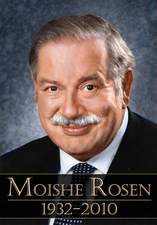
Moishe Rosen, 1932-2010

Moishe Rosen - Jews for JesusMoishe Rosen, the Founder and first Executive Director of Jews for Jesus, died last week. Mr Rosen had battled prostate cancer for an extended period. I was privileged to read some of his last writings as he continued to minister far past his expected time. Perhaps, it is very fitting that he died on Shavuot, the Jewish Festival of Weeks and the Christian Pentecost. The same day that the Law was given at Sinai and the Holy Spirit in Jerusalem as a deposit or guarantee of the promise, Mr Rosen claimed the promise and went to be with Christ forever.

Mr Rosen founded JFJ in September of 1973 and continued making the Messiahship of Jesus an unavoidable issue to his Jewish people worldwide until his death. Mr Rosen had a great passion for Yeshua (Jesus), and properly understood that a Jew does not cease being a Jew by believing in Yeshua. In fact, he becomes completely Jewish by accepting the Messiah. This message is not always welcomed by Orthodox Jews. Dr Vernon Grounds, noted evangelical and President Emeritus of Denver Conservative Baptist Seminary once said of Rosen, “He was a dynamic and creative witness. When Moishe Rosen came into a city there is either a revival or a riot.”

A Memorial Page has been set up on the JFJ website. Mr Rosen also left a pre-written letter of encouragement for his co-workers in Christ, urging them to continue his work. I’ve personally met David Brickner, who took over as executive director in 1996, and Bruce Rapp, who serves as head of the Phoenix branch, and I can vouch that JFJ is still in capable hands with the Lord’s leading. Here is an excerpt from Mr Rosen’s last letter (the entire letter is available from the JFJ website):

If you are reading this, it means that I have gone on to my reward. As I write this, I can only think of what the Scriptures say and that is, "Eye has not seen, ear has not heard, neither have they entered into the heart of man the things that God has prepared for those who love him." (1Cor 2:9) Well, I have a big curiosity and by now, I know.

As I go, I feel that I have left a number of things undone. I think everyone must feel that way… I'd like to encourage you to stay with Jews for Jesus… To be an honest ministry, it can only come from the Holy Spirit; and the Holy Spirit can only indwell those who have the new birth and are born again. Therefore, I would urge you to think very seriously before you support any "ministry" that involves Jewish people and doesn't actually bring the gospel to the Jews. Likewise, I am concerned over something else that I never thought that I would see or hear and that is, Jews who have become believers in Jesus and have important positions in ministry yet feel that their primary purpose is to promote Jewishness and Judaism to the Jews.

I hope I can count on you to show love and respect for the Jewish people, but Jewishness never saved anybody. Judaism never saved anybody no matter how sincere. Romans 10:9-10 make it clear that we must believe in our hearts and confess with our mouths the Lord Jesus in order to be saved. There are no shortcuts. There is no easy way. Within Judaism today, there is no salvation because Christ has no place within Judaism.

I would also encourage you to be faithful to those Bible-teaching, Bible-preaching churches that give spiritual food. More than ever, the church needs faithful members who can be an example to the young people coming in. Maybe there are some features about your church that keep you from being enthusiastic - look around and see if there might be a better church for you. If there is, join it and enjoy it. If your church is doing a lot right, then stay where you’re planted.

I don't expect that Jews for Jesus will be undergoing any turmoil because of my demise. For many years, the leadership has been in competent hands… Anything done for Christ will last. Anything you do to help and encourage Jews for Jesus at this time will have lasting effects on all of us. So instead of saying "good bye," I'll just say, "until then - I'll see you in the sky."

Moishe

Thursday, May 13, 2010

Safe in the Arms of Jesus

I wanted to work on the Book of Ruth in our Interpreting the Books of the Bible section, but kept feeling compelled to write this article on death and life instead. This subject is way out of my comfort zone, but I knew from past experience that I wouldn’t get anything else done until I had completed this post.

To provide a little background on my mental state, we’ve been receiving frequent news that our son’s marine unit in Afghanistan continues to sustain numerous casualties, including several on Mother’s Day alone. We hope our readers are praying daily for the brave men and women risking their lives to protect our country and to secure freedom for other parts of the world. It is unthinkable that anyone can face death without knowing whether his or her future is eternally secure. After my father died, I wrote an article contrasting the differing views of death between believers and non-believers.

Now, we turn to the subject of this post, a baby named Smith, born to parents Kori and Jon up in McKinney (TX) on April 29, weighing only 24 oz. After clinging valiantly to life for almost two weeks, Smith went home to Jesus on May 10. I was alerted to their situation by email from a friend of a friend of a friend, so I don’t know Kori, Jon and family personally, but they have been a real inspiration the past few weeks. Through the various difficulties of this ordeal, Jon shared Smith’s brief, but miraculous and inspiring life on his blog.

I kept thinking, what does one say to such a courageous couple, or to anyone else who has just lost a loved one? Let me preface these comments by saying that I’m no counselor, so these are just my personal thoughts. As Christians, we’re always tempted to quote Scripture (particularly Ro 8:28) in a well-meaning effort to ease the person’s grief, or to defend God. This is good to a point, but I believe it’s sometimes best just to grieve along with the person and let them know you care. You can then speak of the goodness of God as the healing process begins, which will be sooner or later in different instances. In Jon and Kori’s case, it is apparent that they never questioned God’s goodness, but this still does not ease the pain of their loss.

I’ve met a few well wishers with the attitude that, we should not grieve for a loved one because “they’re in a better place”. Fortunately, these folks (almost always meaning well) are usually a small minority. While the destination of the departed is a great comfort, it is entirely biblical to mourn. Jesus Himself wept at the death of His friend Lazarus, even though He knew that He would shortly raise him from the dead (Jn 11:32-36).

As some of my regular readers may know, I love the old hymns and often research their author and some of the fascinating circumstances surrounding their writing. Earlier today, I came across an old hymn by Frances (Fanny) Crosby, who is credited with writing thousands of hymns even though she was blind. Ms Crosby caught a slight cold at about six weeks of age. A country doctor, who (it was later learned) was not qualified to practice medicine, was called because their family physician was away. He recommended the use of hot poultices, which practically destroyed her eyesight. When the doctor learned of the results, he left town, never to be heard of again. Ms Crosby later said "I have not, for a moment, in more than eighty-five years, felt a spark of resentment against him; for I have always believed that the good Lord, in His infinite mercy, by this means consecrated me to the work that I am still permitted to do”.

In 1859, a child was born to Fanny and her husband, but the child died in infancy, and to this day, no one knows whether it was a boy or a girl. Fanny refused to speak of it, even to her closest friends and relatives, except to later say, “God gave us a tender babe… and soon the angels came and took the infant up to God and His throne”.

On April 30, 1968, about a decade after the infant’s death, a Christian musician, Dr WH (Howard) Doane, knocked on Fanny’s door and said “I have exactly forty minutes before my train leaves for Cincinnati. I need some words for this melody”, then began humming a tune. Fanny quickly prayed, went to work and twenty minutes later, dictated the words to Dr Doane just in time for him to catch his train. This brief collaboration produced one of Ms Crosby’s most beloved hymns, Safe in the Arms of Jesus, which became a great comfort to thousands who had lost a loved one, especially a child.

Safe in the arms of Jesus, safe on His gentle breast,
There by His love o’ershaded, sweetly my soul shall rest.
Hark! ’tis the voice of angels, borne in a song to me.
Over the fields of glory, over the jasper sea.

Refrain:
Safe in the arms of Jesus, safe on His gentle breast
There by His love o’ershaded, sweetly my soul shall rest.

Safe in the arms of Jesus, safe from corroding care,
Safe from the world’s temptations, sin cannot harm me there.
Free from the blight of sorrow, free from my doubts and fears;
Only a few more trials, only a few more tears!

(Refrain)

Jesus, my heart’s dear Refuge, Jesus has died for me;
Firm on the Rock of Ages, ever my trust shall be.
Here let me wait with patience, wait till the night is over;
Wait till I see the morning break on the golden shore.

(Refrain)

We must not assume that God allowed Ms Crosby to lose her child for the sole purpose of providing comfort to others, but we can say that God can use all our experiences, good and bad, to minister to others in similar situations.

Thursday, December 31, 2009

Alien Invasion of the Righteous Kind

Our good friend Thomas sent us an recent email exchange with a Christian lady regarding the second coming of Christ that he wanted to share with our readers. The timing of this is very appropriate. As we close out another year, we are reminded that we’re also further down the line on our road to eternity.

Thomas originally sent the following email to several folks.

But you must not forget this one thing, dear friends: A day is like a thousand years to the Lord, and a thousand years is like a day. The Lord isn't really being slow about his promise, as some people think. No, he is being patient for your sake. He does not want anyone to be destroyed, but wants everyone to repent. (2Pe 3:8-9 NLT)

God may have seemed slow to these believers as they faced persecution every day and longed to be delivered. But God is not slow; he just is not on our timetable. Jesus is waiting so that more sinners will repent and turn to him.

We must not sit and wait for Christ to return, but we should live with the realization that time is short and that we have important work to do. Be ready to meet Christ any time, even today; yet plan your course of service as though he may not return for many years.

The nice lady replied that this thought had been on her mind lately. She had watched a couple of movies that were fictitious, but contained a real “underlying meaning” to them that made her take a step back and evaluate her life, as well as those around her. She wondered who would be chosen, and who would be left behind because they couldn’t make a decision or stand up and fight for what they believed. We must clarify here that the lady is making a general contemplation, and is not doctrinally implying that we will be saved by making a one-time intellectual decision, or left behind due to a lack of works. We are saved by faith alone, but this saving faith will produce a changed life, and a lack of works will result in lost blessings (Eph 2:8-10, 1Cor 3:10-15).

Thomas replied, speaking of Christ’s return and Satan’s deception:

Thank you. Sometimes, I get very anxious about the Lord’s return to planet earth (Wow!) and I pray that He returns soon, but when I read 2 Peter 3:8-9, it reminds me of how much Jesus loves us! We are created in their image and likeness! In this sense, they (the Trinity) are our ancestors; we are family (all true believers are adopted in Christ)! The Holy Trinity wants all to repent and be saved. We must have patience and wait for the promise of His return, even if we die before His arrival (the dead in Christ will rise first).

Revelation 19:11-21 describes what I call an alien invasion of a righteous kind! Some of the elements within the account of Christ’s return remind me of some of the alien movies that I have seen over the years. Perhaps, the best known is War of the Worlds, based on a science-fiction novel by HG Wells about a Martian invasion of the earth. In 1938, Orson Welles broadcast an adaptation of the book on radio, but he aired the play as a series of dance numbers being periodically interrupted by “news bulletins” of the invasion. This was done to heighten the dramatic effect, and it would be a gross understatement to say that this technique worked. People panicked and went into frenzy! Many were treated for shock and hysteria. In New Jersey, even some members of our armed reserves reported for duty in anticipation of this invasion, only to discover that it was a hoax!

This event graphically illustrates how easily we can be deceived, and Satan is the master deceiver (Jn 8:44). Indeed, with believers, this is his primary weapon (1Jn 4:1-6), and one of his primary avenues from before 1938 to the present is through the accommodating media. We continue to see his plans unfolding through television (the V series), the movies (Independence Day, War of the worlds, etc), and targeting our kids through games, cartoons, books, etc. Satan is the god of this world and the prince of the power of the air, who works in the sons of disobedience. Getting back to Revelation 19, Satan knows that Jesus will return and the master deceiver is preparing those who do not believe and will not repent, to join him as he dares to assemble the nations of the earth together to fight against the rider (Jesus) on the white horse and the armies that follow Him. To make a long story short, Jesus wins, and we see the fate of Satan’s counterfeit trinity, along with Satan himself in Rev 19:17-20:15.

I know this sounds fantastic! Almost unbelievable! But, it is no less amazing than our belief in the first coming of Jesus Christ. God came to earth in human flesh, born of a virgin, to save man from sin. He died on the cross, arose from the dead on the third day, was seen by eye witnesses, and ascended into heaven. Just as the first coming of Christ was literally fulfilled in history, so the future second coming of Christ will be fulfilled in the same literal manner. Unlike the War of the Worlds however, it will not be a hoax! In fact, the second coming of Christ is one of the most oft-mentioned events in both the OT (Ps 2, 96:10-13, 110, Ezk 37:15-28, Dn 7:13-14, Zech 12, 14:1-9) and the NT (Mt 24:27-31, 25:31-46, Mk 13:24-27, Lk 12:35-40, 17:24-37, 18:8, 21:25-28, Ac 1:10-11, Rm 11:25-27, 2Th 2:1-12, 2Pe 3:3-4, Jd 14-15, Rev 1:7-8 etc).

So, what should we do in the meantime? First, be ready (Mt 24:44) by making sure you have a guaranteed reservation waiting in heaven through a personal relationship with Jesus Christ. Next, become a true disciple (student and/or learner) by consistently reading the word. Let the comforter and teacher, the Holy Spirit, help mold you into the mind of Christ, so that we will not believe the great lie! In His Love, Thomas

For those who are not sure that they are guaranteed the reservation (eternal life) that Thomas mentioned, please see How to Be Sure You’re are Going to Heaven.