Showing posts with label technical. Show all posts

Thursday, October 8, 2026

How to Create a Loving Digital Memory Book to Cherish Family Stories

Webmaster Note: Guest Post by Sara Bailey from TheWidow. The views and opinions expressed in the article are those of the author, and may or may not necessarily reflect those of ad Dei Gloriam Ministries.

For Christian families trying to preserve loved ones’ memories, the hardest part is realizing how quickly stories fade when they live only in scattered phones, forgotten albums, and half-told conversations after church or at the dinner table. Grief, busy schedules, and distance can make it feel simpler to keep postponing, even when a family heritage deserves more than a few random photos saved somewhere. A digital memory book creates one faithful place for photo and story preservation, holding everyday moments alongside the testimony, humor, and details that shape an emotional legacy. This kind of keeping becomes a gift that lasts.

Read the entire article on our Original Blog.

Tuesday, January 2, 2024

Retiring "to" Ministry

Green Waterfall Personal Update: I finally did it! After several years of declarations, promises, postponements, threats, reversals and other false starts, I finally retired from my position at a major international engineering company. I had been working from home the past 8-10 years.

I was never classified as an official tele-worker, just stopped going into the office. My transition from office to home didn’t happen overnight but was more of a gradual process. I was assigned to the Dallas office Water Group, but most of my work came from the Ports and Maritime Division of the Transportation Group. I primarily designed electrical substations, infrastructure and facilities for ports up and down the East Coast of North America from New England to Costa Rico. I also did a fair amount of work for the Power Group in the Middle East, where I designed electrical substations and facilities for privately owned industrial cities.

But, enough of the boring stuff. Let’s talk about “retirement”. The best advice that I ever got regarding retirement was “don’t retire from something, retire to something”. That is, your primary reason for retiring should not be to stop doing what you’re currently doing, but to do something better. In 2006, I began my website ministry, ad Dei Gloriam Ministries but was often frustrated due to the lack of available time for it. Sometimes I would even go months without working on the site. So, I finally put in my retirement papers to the engineering company and retired to devote much more time to my research and writing ministry.

I would also like to greatly thank all the excellent guest authors that have contributed to this blog the past few years. My input has been minimal, so you kept the blog from going almost completely dormant. Finally, a huge “thank you” to our loyal readers of our website and blog that have continued to “tune in” over the past few lean years. Finally, I thank God for His blessings and this opportunity, and hope to continue working as long as He allows. Soli Deo Gloria.

Thursday, February 20, 2020

A Personal Mini-History and Notes

We began our blog (in its current form) in the summer of 2009. As longtime readers have probably noticed, the frequency of our posts steadily decreased after the first few years due to the external workload of the primary blogger (me) sharply increasing. In 2012, I took on several new electrical engineering design projects such as the largest shipping terminal in Costa Rico, a new Substation for the US Coast Guard in Puerto Rico, a Naval Base in Florida, and a major maritime port in New Jersey. Then, from 2013 – 2016, I took on the Substation, Transmission and Distribution, and Telecommunication design of several industrial cities in the Middle East, during which a veteran engineer and great friend whom I’d been splitting some of the work retired.

After getting a few weeks break in the summer of 2016, I then took on several major Ports and Maritime projects along the East Coast, with scarcely a day off (including weekends and holidays) for the next two years. I was then contemplating retirement, but took on another project for the Navy in which the design phase ended last week. So, I’m once again seeking God’s will whether to retire in order to research, write and minister full time, or to continue working. Whatever happens, I’m hoping to at least cut back on my engineering work, perhaps to a part-time consultant, so that I may spend more time on our website, blog, and other ministries. Thank you for your continued prayers and support.

Sunday, November 11, 2018

Honoring our Veterans – Veterans Day Weekend 2018

Each year, November 11 is recognized as a day of solemn reflection throughout many nations in honor of those who bravely served them. The day is known by many names, including Armistice Day, Remembrance Day in British Commonwealth countries, and Veterans Day in the United States. This year also marks the 100 year anniversary of the armistice to end World War 1, signed between the allied countries and Germany at Compiègne, France on November 11, in 1918. The armistice went into effect at 11am Paris time, on the 11th hour of the 11th day of the 11th month.

In the United States this year, Monday, November 12 is set aside to commemorate and honor and recognize their service to the nation. Although we should honor our veterans every day, please make a special effort to thank all of those you know. Although most veterans don’t seek attention, it shouldn’t be difficult to find one. There are over 20 million former and active veterans in our country today. Even if you can’t thank them in person, please observe a moment to thank God for our brave men, women and their families.

Marine Corps Birthday 243rd Birthday

Coinciding with this Veteran’s Day weekend is the 243rd birthday of the US Marine Corps, whose origins trace from an October 1775 plan by the Continental Congress to use Marines to oversee a mission to intercept ammunition shipments from Britain during the Revolutionary War. The following month, a resolution was adopted that officially created a standing Marine Corps force on November 10, 1775, the date that became the USMC birthday. True to their humble roots, the Marine Corps Birthday is not a federal holiday, but observed only internally by the military branches; although some local government and civic organizations sometimes hold various events to honor the men and women of the Marines. The primary historical celebration is the traditional Marine Corps Birthday Ball. The first known Birthday Ball was held in 1925 Philadelphia, but is now held annually in our nation’s capital.

WWI Memorial Cross in Jeopardy

This Veterans Day Weekend also coincides with the recent Supreme Court’s agreement to hear arguments in the case of the Bladensburg Peace Cross. The dispute began in 2014 when members of the American Humanist Association filed a lawsuit to have the memorial removed, claiming it discriminates against soldiers who were not Christian. The humanists were later joined by the Council on American-Islamic Relations in their efforts to destroy the cross that has stood for almost 100 years, and was financed by the American Legion and private donors.

Stella Morabito at the Federalist has a must-read article in which she writes:

Sadly, precious few Americans today know a single thing about World War I. This is unconscionable, because we can still feel its aftershocks all over the world today. Forgetting our history has very damaging consequences if we ever hope to attain real progress in this world. And the point of war memorials is to remind us of such things, and to bid us never to forget.

So there is great poignancy in the timing of the Supreme Court’s recent agreement to consider the case of The American Legion et al. v. the American Humanist Association et al. The court will decide whether a World War I memorial in Bladensburg, Md., may remain standing, or if it constitutes an illegal mix of church and state. The American Legion is appealing the Oct 18, 2017, decision of the Fourth Circuit Court of Appeals that the memorial must go, which overturned a previous ruling allowing the memorial to stand.

Ms Morabito also explains the religious and historical aspects of why we need the memorial cross. Other excellent articles are from World Net Daily, a concise story on the SCOTUS taking the case, and the Daily Signal, who has the perspective from actual veterans on their thoughts about the efforts to remove the memorial cross.

Please be in prayer for the families of these veterans and all others involved in this very important religious freedom case.

WWI and Technology

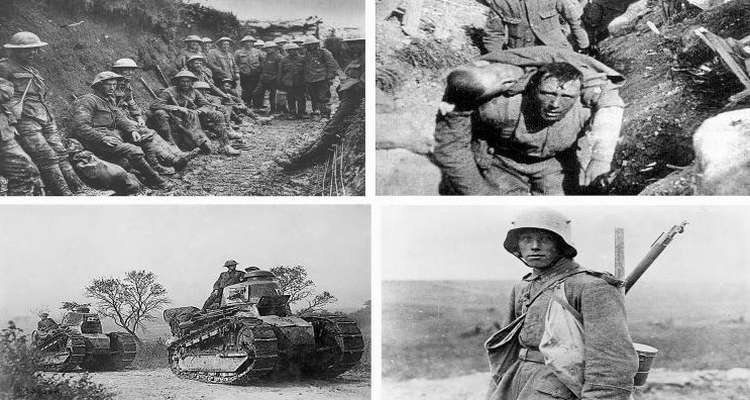
WWI tank We’ll end this post on a lighter note. I was reading through this month’s issue of Electrical Construction and Maintenance (EC&M) Magazine, when I came across an article on Electricity and World War I. The subject of the article was the pivotal role that electricity played in the First World War. This article is also the source of the old photos used in this post.

The article notes some of the “firsts” that were introduced into combat during the First World War, in addition to rapidly developing electrical technology such as warplanes for bombing, steel helmets, blood banks, and guide dogs. In 1917 and 1918, the Holt Manufacturing Co and General Electric Co collaborated to invent the Holt gas-electric tank, the first prototype tank built in the United States. The tank used a gasoline engine connected to an electric generator to provide power to its various parts. Unfortunately, the tank was prone to overheating and lacking maneuverability, so the machine was the only one of its kind built. Fortunately, it was not needed since not a single American-made tank ever saw service in the war, and the US dominated technical development and manufacturing afterward.

In other technological gains, incandescent and carbon-arc searchlights became game changers for the allies. These lights were crucial for nighttime operations such as navigation, illuminating enemy ships, blinding enemy troops to allow torpedo boats to navigate closer to enemy ships, and for spotting and guiding warplanes during bombing raids (no GPS in those days).

WWI battleships also benefited greatly from advancements in electrical technology. Most devices and equipment were electrically power and operated, many by remote control. In addition, electricity was now being used to pivot and aim guns, and to lift ammunition from the magazines up to the guns.

The various weapons such as rifles, machine guns, artillery, mortars, and flamethrowers, led to millions of human injuries and created a medical crisis. In response, Marie Curie, a Polish and naturalized-French physicist and chemist who became the first woman to win a Nobel Prize, invented the “radiological car” (aka the “Curie car”). This vehicle contained an X-ray machine (a recently invented medical diagnostic tool) and photographic darkroom equipment. This invention allowed medics to bring this new technology to the battlefield. Ms Curie also incorporated an electrical generator into the car to power the X-ray machine.

WWI also resulted in the establishment of the first blood bank. Oswald Robertson, a US Army doctor came up with the idea of storing blood prior to the arrival of casualties. He established the first blood bank on the Western Front in 1917, from where it was transported to various medical stations as needed. This idea is credited with preventing thousands of deaths.

Finally, we mention that after the war, Dr Kurt Huldschinsky, a German pediatrician of Polish descent, noticed that many of his young patients were extremely pale. In addition, it is thought that about half of Berlin’s children suffered from rickets (a softening, weakening and/or deformation of skeletal bones). Since sunlamps had been used throughout the war to help treat soldiers’ wounds, the doctor began placing a few of the children under mercury-quartz lamps which emitted ultraviolet (UV) light. His patient’s bones slowly became stronger and the following summer (1919), he also began having them sit in the sun. The doctor’s research eventually led to the discovery that the process of Vitamin D strengthens the bones with calcium is triggered by UV light. Thus, God used the circumstances of the war to cure this children’s ailment.

In closing, we ask once again that we pray for, and honor all our veterans and their families.

Sunday, September 11, 2016

Ministry and Website Programming Update

Finding spare time away from my “other job” (the one that pays the bills) has been quite challenging over the past couple of years, but at least for the past few weeks, I'm finally seeing a small work decrease. The maritime port in South Jersey is under construction and the electrical design for the International Terminal in Virginia is getting close to completion. I'm still working on the electrical substation, transmission, distribution, telecommunication and street lighting design for a few industrial cities in the Middle East, but they've been relatively quiet for the past few months. I'm hoping the trend continues and that I can even drop back to flex or even part-time within the next few years. I can just hear many of my friends thinking, "yeah, we've heard that before", but I did turn down the offer of taking the lead for designing the electrical substation, and associated electrical and telecom distribution for the downtown renovation of a city in the western US, something that I would never have done a few years ago.

I must admit that it was not easy to turn down the renovation project (downtown area renovations appear to be a hot trend), but my current primary goal is to be able to devote more time to our ministry, so I'm renewing my efforts (again) to that end. I must also do a better job in prioritizing the little time that I do have. I've often gotten an article or series to a certain point before getting interrupted (job deadlines, questions from readers or class members, deciding to do additional research on a particular topic, ect) and temporarily switching off onto another engineering or ministry project. As you've probably guessed, many of those temporary detours become permanent, resulting in dozens and dozens of writings in various stages of completion, some from over ten years ago. Therefore, even though I'm still planning and working on new articles and series, I will attempt to place a priority on finishing existing ones.

Website Programming Update

In 2014, we converted our website from "fixed-width" to "flex" or "fluid" pages to make to make it "mobile-friendly". When the site was originally uploaded in December of 2006, I knew very little about web programming (just some basic html), so I used website graphic interface software for the first couple of years. For the 2014 conversion, I worked primarily in the code itself, eliminating much of the bloat added by the software. For this latest update, I'm basically using a text editor and writing the code from scratch. This is leading to much cleaner code (file sizes are only a fraction of the originals) which should result in faster load times for those with slower internet connections. Since we have so many readers for developing countries, our top priority is to maintain a clean look and fast loading times even when adding new features.

I'll share more details and some of the code in future posts, but for now I'd like to share a short list of the upgrades. First, we're adding a Navigation Bar at the top of each individual page for linking to all the major sections of the site. The current design only contains a few relative links. In addition, we're also adding media queries to automatically orient the navbar as horizontal or vertical depending on the size of the reader's screen for our mobile readers. Second (thanks to reader comments), we're increasing the basic font sizes by 25% or more for most elements. As my eyes have grown older, I've also come to appreciate larger text sizes in some instances.

Next, we are moving all styling of text, images, etc from the html code to external css stylesheets. This further decreases the size of the page files, but its greatest benefit is for our sight-impaired readers who utilize audio reading software. Some audio readers have trouble distinguishing the styling within the html code from the actual text itself, so this should result in a much "cleaner" audio reading. Finally, we're updating the html code to include html5 semantic elements. This will be invisible to our readers, but is a big help to the search engine web crawlers, and should result in better search results.

We are currently uploading the updated pages as they are re-coded. Readers who have been on our site the past few weeks may have noticed the difference on some of the pages. If you'd like to check them out, as with our 2014 update, we began with our On-Line Bible pages since these are the only pages that are guaranteed to accomplish their purposes (Is 55:10-11). Both the Old and New Testament books have been converted to the new html/css format, but we're still converting the linked study notes to hover/popups for the NT. We're hoping to complete the conversions of the remaining sections and pages by the end of the year. Our front page will also receive an entire face-lift, but much of this code is still in progress. As always, we welcome and appreciate your comments and suggestions.

Tuesday, March 27, 2012

Blogger Comment Issues

Once again, I’ve been busy designing electrical facilities for some shipping port expansions in the New England area (yes I have a “real job”, contrary to what many of my co-workers might say). Things are once again getting back to normal, so I’m looking forward to posting again.

During my absence, we were notified that many readers were experiencing difficulty while viewing certain pages and leaving comments on others. After some research, we determined that the two issues were inter-related, tracing both back to a recent Blogger update that was producing similar symptoms on many other blogs. This upgrade added Blogger support of threaded commenting, which allows a reader the option of leaving a general comment about the article, or responding to another comment on the thread.

Unfortunately, the upgrade contained a few bugs, so pages containing previous comments appeared as a completely blank white page. Pages without comments could be viewed, but readers were prevented from adding comments. As a temporary fix, we changed our comment settings about six weeks ago from embedded (threaded) to a pop-up window.

We have now been notified that the issue has been fixed, so we’ve re-enabled the threaded comments feature for all pages. We’ve spot-tested several pages using the latest versions of IE, Firefox, and Chrome and encountered no problems. Still, if anyone has any future problems with commenting (or any other technical issues), please don’t hesitate to let us know. Thanks again for your support and feedback.