Showing posts with label faith. Show all posts

Wednesday, December 17, 2025

Beyond Homework: Creative After-School Paths for Christian Families

Webmaster Note: Guest Post by Sara Bailey from TheWidow.

Christian families are often looking for after-school activities that nurture faith, curiosity, and character at the same time, without feeling like an extension of the school day. The familiar options—sports teams, tutoring, church youth group—can be wonderful, yet many parents sense there is more out there. The deeper challenge is helping children discover God’s world as wide, surprising, and full of callings they haven’t imagined yet.

Read the entire article on our Original Blog to learn how to encourage children to enjoy faith-friendly activities that stimulate learning without compromising your family and Christian values.

Tuesday, August 19, 2025

Finding Light in the Middle Years: A Christian Journey Through Crisis

Guest Post by Lucille Rosetti from The Bereaved Blog. The views and opinions expressed in the article are those of the author, and may or may not necessarily reflect those of ad Dei Gloriam Ministries. We have no relationship with any of the organizations linked within the article.

Caution!!! Links in this article are provided by the guest author and may link to Content Marketing / Native Advertising and other sites containing first and third party ad trackers and cookies, along with other privacy threats such as passing on your info to social media sites. We urge our readers to take precautions such as using privacy browsers, ad-blocking apps, VPNs, anti-tracking devices, disabling third-party cookies and other appropriate measures before clicking on any external links.

Image Source: Pexels
hand-opening-bible A mid-life crisis can feel like a private storm, one that shakes your sense of purpose and unsettles your relationships, faith, and vision for the future. For Christians, it can be a strange and sometimes lonely place to stand — caught between what’s been built and what’s still unfinished. The good news is that God’s Word and the lived wisdom of believers offer not just comfort, but a path forward. Inspiration isn’t a magic spark that appears in perfect moments; it’s something we cultivate in the middle of difficulty. Positivity is not a shallow optimism, but a steadying trust that God can work good out of the most uncertain seasons. These years can become a refining fire, not a dead end.

Embrace Your Faith

Some moments in life press us hard enough to make us listen in ways we’ve avoided before. A mid-life crisis can be just that — a divine nudge to re-center your life on what truly matters. Instead of interpreting the struggle as pure loss, consider what if your midlife crisis is a wake-up call to slow down and hear God’s voice in the noise. Scripture is full of people who faced turning points in the middle of their story: Moses at the burning bush, David in the caves, Paul on the road. Each found new strength and direction by trusting God’s leading rather than clinging to their old plans. Allow prayer and the Word to become not just a daily habit, but a place where your new season begins to take shape.

Practical Life Tools

Sometimes the most immediate relief in a stressful season comes from removing small daily frustrations. For example, reducing tech-related headaches can create more mental space for prayer, rest, and focus. Knowing a few ways to convert files to PDF without fuss can cut down on wasted time at work or in ministry prep. These small efficiencies, though they seem unrelated to spiritual renewal, can clear away unnecessary stress so your mind and heart can attend to bigger, more eternal matters.

God’s Steadfast Keeping

There’s comfort in knowing that your stability isn’t dependent on your own grip. As life shifts and questions pile up, resting in God’s steadfast keeping anchors your hope in something unshakable. He is the one who carries you through — not your willpower, not your strategies, but His faithful character. This truth dismantles the fear that you’ll somehow “fail” at navigating this stage. It reminds you that your life is held by hands far stronger than your own, and that every season is within His reach.

Education as a Reset Path

For some, a mid-life crisis is tied to career dissatisfaction or a longing for new challenges. In such cases, pursuing further education can serve as a practical and hope-filled step forward. Exploring the IT bachelor of science degree requirements might open doors to fresh vocational opportunities, providing both a mental reset and a renewed sense of purpose. Learning something new can reignite confidence, expand your community, and create pathways for service you hadn’t considered before.

Find Community & Serve

Isolation has a way of distorting reality. When you serve alongside others, even in small ways, you see that you’re part of a much bigger story than your personal crisis. By letting service reshape your outlook, you open yourself to encounters that shift your perspective and remind you of God’s work in the world. Volunteering at your church, mentoring a younger believer, or joining a local outreach effort puts you shoulder to shoulder with people who also need encouragement. This shared work pulls you out of self-focus and into God’s mission, often bringing joy you didn’t know you’d lost.

Recalibrate Rather Than Collapse

The temptation during a mid-life crisis is to see it as a collapse, a sign that something’s irreparably broken. But it can also be a point to pause and intentionally shift course. You might start steering mid-life recalibration with intention by asking questions about your calling, habits, and the priorities you’ve set over the years. This isn’t about tearing your life down but about refining it — clearing space for the commitments and people who matter most. By approaching this time as a God-led audit, you replace panic with purpose and turn uncertainty into fertile ground for growth.

Creative Renewal

In the thick of change, creativity can become an unexpected lifeline. Mid-life offers the chance to rediscover or develop practices that connect you with God in fresh ways. Some believers find that rediscovering faith through creative practice — whether through painting, gardening, writing, or music — opens new channels for prayer and reflection. Creative acts invite you to slow down, notice beauty, and see God’s hand in the process of making. The act itself becomes a form of worship, a way of honoring the Creator by imitating His inventiveness.

A mid-life crisis doesn’t have to be a breaking point; it can be a turning point. The years ahead can be shaped by faith that listens closely, service that connects deeply, and creativity that refreshes the spirit. Let God’s keeping power steady you, let practical shifts lighten your load, and let purposeful steps guide you toward what’s next. The season you’re in now might hold the seeds of your most meaningful growth — not because it’s easy, but because God is working through it. And that truth, in the end, is where both inspiration and positivity find their deepest roots.

Saturday, May 24, 2025

Duty, Honor, Country

General Douglass MacArthurThis weekend, and particularly on Monday, we set aside a special day to remember and honor our brave troops who made the ultimate sacrifice for our country so that we are able to enjoy the vast freedoms that we currently possess. I'm speaking or course about Memorial Day, a day of somber remembrance and gratitude.

This year, I'm posting an excerpt from his farewell address given by General Douglass MacArthur to the Corps of Cadets at West Point on May 12, 1962.

Duty, Honor, Country: Those three hallowed words reverently dictate what you ought to be, what you can be, what you will be. They are your rallying points: to build courage when courage seems to fail; to regain faith when there seems to be little cause for faith; to create hope when hope becomes forlorn.

Unhappily, I possess neither that eloquence of diction, that poetry of imagination, nor that brilliance of metaphor to tell you all that they mean.

The unbelievers will say they are but words, but a slogan, but a flamboyant phrase. Every pedant, every demagogue, every cynic, every hypocrite, every troublemaker, and I am sorry to say, some others of an entirely different character, will try to downgrade them even to the extent of mockery and ridicule.

But these are some of the things they do: They build your basic character. They mold you for your future roles as the custodians of the nation's defense. They make you strong enough to know when you are weak, and brave enough to face yourself when you are afraid. They teach you to be proud and unbending in honest failure, but humble and gentle in success; not to substitute words for actions, not to seek the path of comfort, but to face the stress and spur of difficulty and challenge; to learn to stand up in the storm but to have compassion on those who fall; to master yourself before you seek to master others; to have a heart that is clean, a goal that is high; to learn to laugh, yet never forget how to weep; to reach into the future yet never neglect the past; to be serious yet never to take yourself too seriously; to be modest so that you will remember the simplicity of true greatness, the open mind of true wisdom, the meekness of true strength.

They give you a temper of the will, a quality of the imagination, a vigor of the emotions, a freshness of the deep springs of life, a temperamental predominance of courage over timidity, of an appetite for adventure over love of ease. They create in your heart the sense of wonder, the unfailing hope of what next, and the joy and inspiration of life. They teach you in this way to be an officer and a gentleman.

And what sort of soldiers are those you are to lead? Are they reliable? Are they brave? Are they capable of victory? Their story is known to all of you. It is the story of the American man-at-arms. My estimate of him was formed on the battlefield many, many years ago, and has never changed. I regarded him then as I regard him now -- as one of the world's noblest figures, not only as one of the finest military characters, but also as one of the most stainless. His name and fame are the birthright of every American citizen. In his youth and strength, his love and loyalty, he gave all that mortality can give. .

He needs no eulogy from me or from any other man. He has written his own history and written it in red on his enemy's breast. But when I think of his patience under adversity, of his courage under fire, and of his modesty in victory, I am filled with an emotion of admiration I cannot put into words. He belongs to history as furnishing one of the greatest examples of successful patriotism. He belongs to posterity as the instructor of future generations in the principles of liberty and freedom. He belongs to the present, to us, by his virtues and by his achievements. In 20 campaigns, on a hundred battlefields, around a thousand campfires, I have witnessed that enduring fortitude, that patriotic self-abnegation, and that invincible determination which have carved his statue in the hearts of his people. From one end of the world to the other he has drained deep the chalice of courage.

As I listened to those songs [from the glee club], in memory's eye I could see those staggering columns of the First World War, bending under soggy packs, on many a weary march from dripping dusk to drizzling dawn, slogging ankle-deep through the mire of shell-shocked roads, to form grimly for the attack, blue-lipped, covered with sludge and mud, chilled by the wind and rain, driving home to their objective, and for many, to the judgment seat of God.

I do not know the dignity of their birth, but I do know the glory of their death. They died unquestioning, uncomplaining, with faith in their hearts, and on their lips the hope that we would go on to victory. Always, for them: Duty, Honor, Country; always their blood and sweat and tears, as we sought the way and the light and the truth.

God Bless our Brave Troops. May we never forget.

Sunday, June 28, 2020

Day of the Christian Martyr 2020

Tomorrow marks the annual Day of the Christian Martyr, and many Christians are paying special respect and honor this weekend to the legacy of those who have sacrificed their very lives for the advancement of the gospel. This day is chosen based on early church tradition that the Apostle Paul was martyred on June 29 in Rome during the reign of Emperor Nero in the mid-to-late sixties of the first century AD.

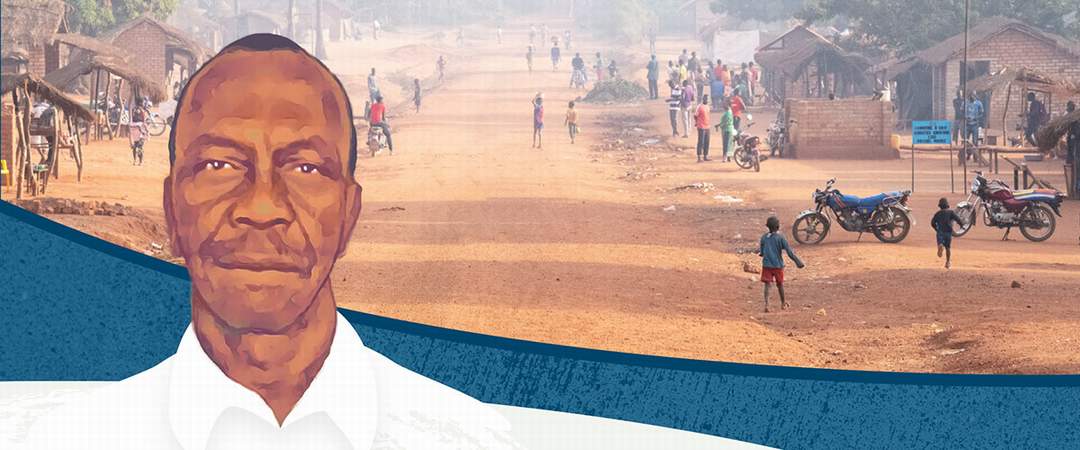
The Voice of the Martyrs (VOM), an interdenominational Christian missions organization that has been serving our persecuted brothers and sisters worldwide for over fifty years, maintains a memorial to Christian martyrs at its Oklahoma headquarters. This year's special inductee is Central African Pastor Jean-Paul Sankagui (Graphic courtesy of VOM).

Pastor Sankagui’s inspiring story is courtesy of the Voice of the Martyrs:

Pastor Jean-Paul Sankagui planted a church in a Muslim neighborhood outside Bangui, capital of the Central African Republic, in 1993. He maintained good relations with the community for years.

But civil war between Seleka rebels, government forces and anti-balaka militias changed everything.

Most of the pastor’s church members fled the area as hostility increased toward Christians. And even the pastor’s wife, Mary, urged him to leave the area and work someplace safer. But Pastor Jean-Paul stayed in obedience to what he believed God had called him to do.

On Feb. 7, 2017, Islamists shot Pastor Jean-Paul to death outside his church in Ramandji before looting and burning his house and church. Mary said they killed her husband because the community no longer wanted Christians in the area. She and Pastor Sankagui had been married 48 years and had 11 children and 17 grandchildren. After losing not only her husband but also her home and all her possessions, Mary had no choice but to leave the area.

Five other evangelical pastors in the region also were killed in the first five weeks of 2017. Pastor Jean-Paul knew the risks, counted the cost and willingly stayed to shepherd his small congregation and serve as a witness for Christ in the neighborhood.

For those who would like additional information and resources about Pastor Sankagui and/or the Day of the Christian Martyr, we encourage you to visit the VOM website for the Day of the Christian Martyr 2020 podcast, and a prayer guide for the Central African Republic. There are also additional resources for your church or small group.

We have supported our friends at VOM for years and believe them to be one of the most vital ministries for our modern turbulent times. In particular, we'd like to alert our readers to a particularly urgent need of our sisters and brothers, not only in the Central African Republic, but also in Nigeria, Sudan, Pakistan, Laos and several other African, Middle Eastern and Far Eastern nations. The number of Christian families forced out of their homes and villages in recent years has increased dramatically. Most are forced to flee with no food or provisions, only the clothes on their backs. They survive by sleeping on the ground and eating whatever edible plants they can find in the forests.

This is due not only to Islamic, Hindu and other militarists, but to superstition as well. The vast majority of many villagers worship the “gods” or “spirits” of nature (the river, forest, livestock, household idols etc). Many Christians are banished from their villages by their superstitious neighbors to avoid angering or offending these false gods or spirits. For those who would like to aid these displaced Christian families, VOM has set up a Help Christians Driven from their Homes campaign that delivers items for their basic needs. Thank you and God bless.

Saturday, June 29, 2019

Day of the Christian Martyr 2019

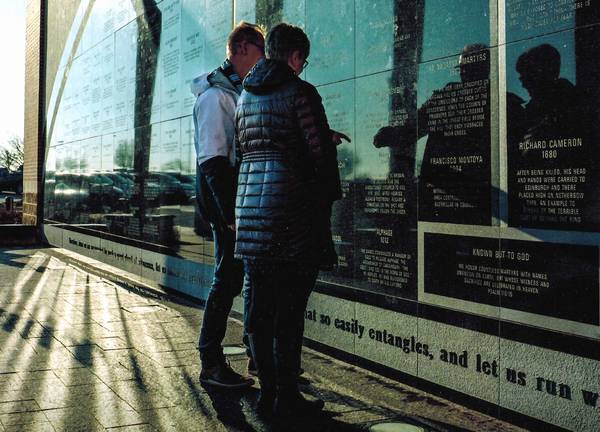
This weekend, many Christians are honoring the memory and legacy of those who have sacrificed their lives for the advancement of the gospel. According to early church tradition, the Apostle Paul was martyred on June 29 in Rome during the reign of Emperor Nero in the mid-to-late sixties of the first century AD. The Voice of the Martyrs (VOM), an interdenominational Christian missions organization that has been serving our persecuted brothers and sisters worldwide since 1967, maintains a memorial to martyrs at its Oklahoma headquarters (all photos courtesy of VOM).

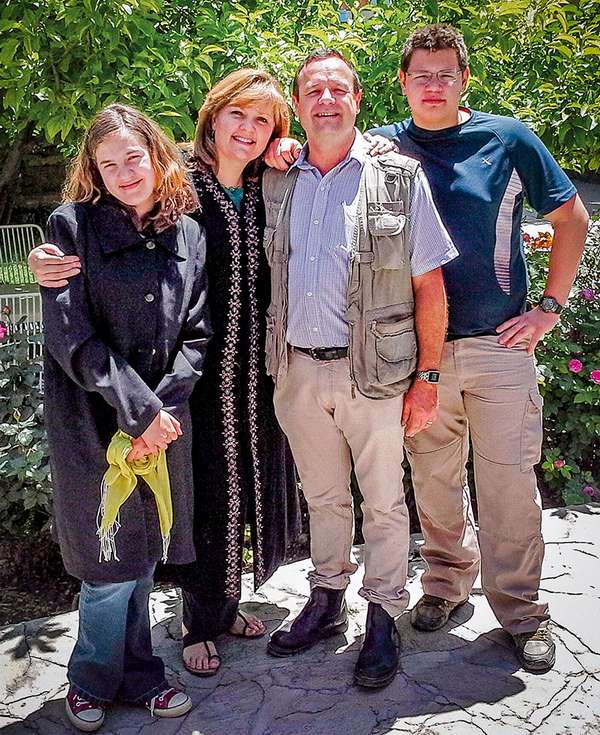
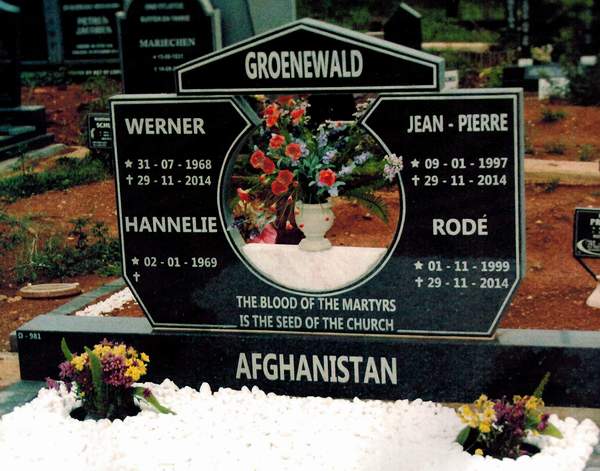
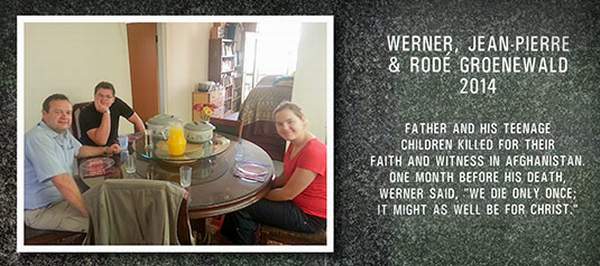
This year, VOM will add a plaque honoring Werner, Rodé and Jean-Pierre Groenewald, who were murdered by the Taliban on November 29, 2014 while serving in Kabul, Afghanistan. On the day of the attack, Taliban fighters (one reportedly wearing a police uniform) scaled the walls of the Christian compound, and began firing with AK-47s. Werner, along with several afghans, were shot to death while he was teaching a leadership-training class. The two teens, Jean-Pierre, 17, and Rodé, 15, were killed in the Groenewald’s upstairs apartment, also with an AK-47. Gunfire and explosions could be heard for over an hour. Werner's wife Hannelie, who was working at a nearby clinic that day, was the only family survivor.


The Groenewalds: Rodé, Hannelie, Werner, Jean-Pierre

It is said of the Groenewalds, like many other Christian martyrs before and after, that "they counted the cost. They knew Christ was worthy, and they willingly put their lives on the line and paid the ultimate price."

We encourage our readers to watch the induction ceremony, as well as read more of their inspiring story at VOM's Day of the Christian Martyr 2019 webpage. It is also a great reminder for us to continue praying for the persecuted worldwide.

The VOM memorial, similar to the Tomb of the Unknown Soldier, also has a plaque labelled "KNOWN BUT TO GOD - We honor countless Martyrs with names unknown on Earth, but whose witness and sacrifice are celebrated in Heaven - Psalm 116:15". The writer of Hebrews undoubtedly had both known and unknown martyrs in mind when he wrote these words:

And what more shall I say? I do not have time to tell about Gideon, Barak, Samson and Jephthah, about David and Samuel and the prophets, who through faith conquered kingdoms, administered justice, and gained what was promised; who shut the mouths of lions, quenched the fury of the flames, and escaped the edge of the sword; whose weakness was turned to strength; and who became powerful in battle and routed foreign armies. Women received back their dead, raised to life again. There were others who were tortured, refusing to be released so that they might gain an even better resurrection. Some faced jeers and flogging, and even chains and imprisonment. They were put to death by stoning; they were sawed in two; they were killed by the sword. They went about in sheepskins and goatskins, destitute, persecuted and mistreated— the world was not worthy of them. They wandered in deserts and mountains, living in caves and in holes in the ground. - Heb 11:32-38
Hebrews chapter 11 is often called "The Faith Chapter". The books of the Bible were not divided into chapters until the sixteenth century AD, so immediately following, we read these words:
Therefore, since we are surrounded by such a great cloud of witnesses, let us throw off everything that hinders and the sin that so easily entangles. And let us run with perseverance the race marked out for us, fixing our eyes on Jesus, the pioneer and perfecter of faith. For the joy set before him he endured the cross, scorning its shame, and sat down at the right hand of the throne of God. - Heb 12:1-2
So, even though all Christians will not have to die a martyr's death, we are to follow the example of these ever-increasing "great cloud of witnesses" by following the Lord Jesus wherever He leads.

Thursday, November 2, 2017

Pray for our Persecuted Christian Family 2017

We should be praying daily for those who are imprisoned, persecuted, and are suffering for their faith, but Sunday, November 5th is the annual day set aside as a special International Day of Prayer for the Persecuted Church. Below are ten ways that church groups and individuals can pray for persecuted Christians. These prayer requests and photos are courtesy of The Voice of the Martyrs.

The Voice of the Martyrs is a dedicated ministry providing spiritual, economic, educational and other support to persecuted Christians and their families worldwide. VOM celebrated their 50th anniversary last month. Their founder, Pastor Richard Wurmbrand, was imprisoned for 14 years in Communist Romania for his faith in Christ, and his wife, Sabina, was imprisoned for three years. In 1965 they were ransomed out of Romania, and shortly thereafter established the global network of missions of which VOM is a part.

We believe VOM to be one of the most important Christian ministries in existence today. We urge all our readers who are not already supporting this vital ministry to please consider doing so. Anyone can visit their website and sign up for their free monthly newsletter that is filled with inspired stories of faithful Christians risking all to serve their Lord and Savior under the most hostile conditions.

10 Ways to Pray for our Persecuted Christian Family

Pray that they will …

1. Clearly Sense God’s presence

Be strong and courageous. Do not be afraid or terrified because of them, for the Lord your God goes with you; he will never leave you nor forsake you. (Dt 31:6)

2. Know the body of Christ is praying for them

I thank my God through Jesus Christ for all of you, because your faith is being proclaimed all over the world. (Rom 1:8)

3. Experience God’s comfort when persecuted

May our Lord Jesus Christ himself and God our Father, who loved us and by his grace gave us eternal encouragement and good hope, encourage your hearts and strengthen you in every good deed and word. (2Th 2:16–17)

4. See God open doors to evangelism

And pray for us, too, that God may open a door for our message, so that we may proclaim the mystery of Christ, for which I am in chains. Pray that I may proclaim it clearly, as I should. (Col. 4:3-4)

5. Boldly share the gospel

Now, Lord, consider their threats and enable your servants to speak your word with great boldness. (Ac 4:29)

6. Forgive and love their persecutors

I tell you, love your enemies and pray for those who persecute you, that you may be children of your Father in heaven. (Mt 5:44-45)

7. Be granted wisdom in covert ministry work

After many days had gone by, there was a conspiracy among the Jews to kill him, but Saul learned of their plan. Day and night they kept close watch on the city gates in order to kill him. But his followers took him by night and lowered him in a basket through an opening in the wall. (Ac 9:23–25)

8. Remain joyful amid suffering

So they went on their way from the presence of the Council, rejoicing that they had been considered worthy to suffer shame for His name. (Acts 5:41 NASB) But if you suffer as a Christian, do not be ashamed, but glorify God that you bear this name. (1Pe 4:16)

9. Mature in their faith

…to equip his people for works of service, so that the body of Christ may be built up until we all reach unity in the faith and in the knowledge of the Son of God and become mature, attaining to the whole measure of the fullness of Christ. (Eph 4:12-13)

10. Be rooted in God’s Word

All Scripture is God-breathed and is useful for teaching, rebuking, correcting and training in righteousness, 17so that the servant of Goda may be thoroughly equipped for every good work. (2Tim 3:16–17)

We mentioned above that we should be continue to pray each day for persecuted Christians, not just one day a year. Please visit I Commit to Pray for additional prayer needs and requests.

Continue to remember those in prison as if you were together with them in prison, and those who are mistreated as if you yourselves were suffering. (Heb 13:3)

Saturday, April 4, 2015

Logic of the Cross

Like clockwork every Easter, we see stories from various TV shows and magazines attempting to discredit the Bible account of Jesus’ death and/or resurrection. Never mind that these stories have been debunked over and over by the evidence, the media continues to pull them out, re-warm them over and breathlessly promotes them as new scientific discoveries that supposedly signals the death knell for Christianity.

Since the Cross is a central foundation of Christianity, it is also a prime target of those who attempt to discredit the Faith. There have been many excellent books written over the years greatly detailing the evidence for the resurrection. Indeed, the evidence supporting the Biblical accounts of the Crucifixion and the Resurrection is much stronger than many of the other historical events that we take for granted. Therefore, even though we have a historically based article in progress, we decided to examine the Cross from a logical viewpoint based upon 1 Corinthians 1:18.

The preaching of the cross is, I know, nonsense to those who are involved in this dying world, but to us who are being saved from that death, it is nothing less than the power of God (Phillips NT).
The first thing Paul notes is that the message of the Cross, that is Jesus dying for the sins of all who would believe in Him as Lord and Savior so that we might be forgiven and spend eternity with Him in Heaven (Jn 3:16, 17:24) is foolishness to those unbelievers dying in their sins. But even though it is considered foolish or even absurd to this group of people, let’s examine the message to determine if it actually makes sense.

I think we can all agree that most people have a built-in conscience that can tell right from wrong, justice from injustice, and good from evil. Even though postmodern thinking has blurred many of the lines of separation between good and evil, most would agree that evil should be punished while good should be rewarded. Most civilized people would not want an evil person to go unpunished so that he would feel free to continue to steal, murder etc.

The cross is God’s rightful and just punishment for the evil (sin) among mankind. Every person has sinned (lied, stolen, lusted, coveted etc) in attitude, thought or deed, and as a result, is deserving of death (Rm 3:23, 6:23). Furthermore, there is no forgiveness of our sins without the shedding of lifeblood (Heb 9:22). In the OT, the priests made continual animal sacrifices as a temporary covering of sin, but these sacrifices could not remove the stain of sin. But the Christ, being the God-Man, voluntarily sacrificed Himself once for all the sins (past present and future) of all those who would believe in Him (Heb 10:11-14). In fact, Jesus was the only perfect sacrifice that had the infinite value required to satisfy God’s righteous wrath against sin and pay the penalty to restore our relationship and judicial status (we are credited with living a perfect life and fulfilling the law – Rm 8:4) before God the Father. There was no other way for us to be reconciled with a Holy God. Thus, the events of the cross were entirely logical.

Of course, only those who believe (trust in, rely on) the work of Christ will be saved (Jn 3:16, Ac 4:12). Those who reject Jesus as Lord and Savior are already condemned (Jn 3:18) and the message of the cross remains illogical. For a more detailed discussion on our topic and subject verse (1Cor 1:18), including its context within Scripture (1Cor 1:18 – 2:5), the historical context of the Jews and Greeks, and Godly vs human wisdom, see The Cross - Foolishness or the Power of God?

Before we end this post, I’d like to address a couple of questions that some may be asking. The first, typical asked by unbelievers and even by some new believers is, “Why couldn’t God just forgive and forget? Why do we have to be perfect to get into heaven? Couldn’t God lower His standard just a bit or grade on the curve?” The thinking here is that, if God is good and He is a God of love, couldn’t He at least ignore the minor stuff.

To answer these questions, we must understand the simplicity of God. By simplicity, we don’t mean that God is a simple God. God is undeniably beyond our comprehensive understanding. By “divine simplicity”, we’re merely referring to His unity of being (or unity of His nature or character), primarily with respect to His attributes. God’s attributes are irreducible in that we can’t separate them or temporarily take one away. We can distinguish between them, but they always work together. Therefore God, whose eyes are too pure to even look upon evil, can’t tolerate sin (Hab 1:13) because His Holiness, Truth and Justice won’t allow it. However, because His Love is also working, He provided a substitute, His own Son. Thus, He is able to punish wrongdoing while still saving those who believe without compromising His Holiness.

The second question that might be asked by anyone is, “Why would God sacrifice His only Son for me?” I must admit that, on the surface, this seems very illogical. I certainly would not allow either of my sons to be sacrificed for anyone. The only rational explanation for God’s actions according to His eternal plan is His great love for each of us (Rm 5:7-8). It has often been said that neither the Roman soldiers nor the nails could have kept Jesus on the cross since He had legions of angels at His disposal (Mt 26:52-54). He voluntarily laid down His life (Jn 10:17-18) and the only thing holding Him to the cross was His great love for us. In light of what He did, shouldn’t we live for Him?

Thursday, March 26, 2015

Ain’t Wasting Time No More

Gregg Allman Last Sunday morning, the sunshine felt like rain.
The week before, they all seemed the same.
With the help of God and true friends, I've come to realize,
I still have two strong legs, and even wings to fly.

So I, ain't a-wastin time no more.
Cause time rolls by like hurricanes.
Runnin' after the subway train.
Don't forget the pourin' rain.
- Gregg Allman

A few months ago, I was challenged by my good friend Stacy on Facebook to share a Bible verse that has a special meaning to me. The biggest challenge turned out to be narrowing my choice to a single verse. I finally chose Joel 2:25 because, as I’ve gotten older and my time on earth is getting shorter, I’ve begun to reflect more and more on the value and proper use of time. This verse, in which God is speaking to the Israelites, reads:

'I will repay you for the years the locusts have eaten - the great locust and the young locust, the other locusts and the locust swarm - my great army that I sent among you (Joel 2:25).
For years, I pondered how God could restore the time out of my life that the locust ate (time I had wasted for selfish reasons). I've now come to the conclusion that the various implications of this verse can only be fully appreciated later in life. As I started entering my response to Stacy it quickly became apparent that it would be too long for Facebook, and that I needed to do a blog post. As I was writing this post, I decided that I needed a full article on the main website to do justice to the subject. After researching the first article, I then decided to write two additional articles and modified this blog post to introduce them.

The first article, entitled The Days the Locusts Ate, is my primary response to Stacy's challenge. I explore the original context of the verse and its meaning for Christians today. I also explain how God can restore lost time in our lives - time that we thought was gone forever.

While Joel 2:25 speaks of God taking the initiative to restore lost time, there is a NT verse in which the Apostle Paul exhorts us to make good use of the time that God has graciously allotted to us.

Be very careful, then, how you live - not as unwise but as wise, making the most of every opportunity, because the days are evil. Therefore do not be foolish, but understand what the Lord's will is (Eph 5:15-17).
I must admit that I have a lot of work to do in allowing God to use my time efficiently for His glory (the irony is not lost that it took several months to budget the time required for writing these articles), but I’m making an honest attempt to improve. As a start, I originally wrote this blog post from the Atlanta airport during a layover from Florida to Dallas.

To expand on the above NT verses from Ephesians, I added the Redeeming the Time article in which we explore the meaning of time, its theological basis, and why we should properly redeem the time to make the most of our opportunities. We also mention several pitfalls to avoid that rob us of time, and offer practical Biblical suggestions for wise use of our time.

Finally, in Jigsaw Puzzles and Roadmaps, we provide a couple of illustrations that contrasts how we understand and interrelate the events of our lives with God’s understanding according to his divine purposes. Abraham had to wait 25 years for the child of promise (Isaac). Our friend Stacy prayed Psalms 113:9 for years in her longing to become a mother. Now she is blessed with two wonderful boys. We’ll never completely understand all the details of why certain things happen (or don't happen) this side of heaven, but we can be confident that God’s timing is perfect as He works out everything for the good of those who love Him (Rom 8:28), even if it doesn’t make sense to us at the time.

Thursday, February 27, 2014

Presidents Day - Our Biblical Foundations

Each February, we set aside a holiday that began as a celebration of George Washington’s Birthday, but later became popularly known as Presidents Day. Unfortunately, the philosophy and resulting policies of our current president has consistently been diagrammatically opposed to biblical principles and out-right hostile toward most Christian beliefs and freedoms. Historically however, this has rarely been the case.

Only a small percentage of our presidents have been evangelical Christians, but until the past 50 years or so, virtually all recognized the providential hand of God in the establishment of our nation, and the abundant contributions that Christianity has made throughout our nation’s history. Even in the last five decades, the majority have either been supportive of Christianity and religious freedoms, or at least remained relatively neutral.

To illustrate, we’ve assembled a small sampling of quotes by a number of US presidents on the subject of God, the Bible, and our country’s Christian foundation. As we read these, let’s pray for another great revival in America.

Sunday, November 17, 2013

The Circle Game

Almost every year around my birthday, a couple of favorite songs from my school daze inevitably pop into my head. This year, they were triggered by a conversation with my cousin Sandi about the great childhood days visiting my grandmother’s old country farm and home place.

The first was written by Neil Young, who holds the distinction of ranking second only to Bob Dylan in the number of volumes in my CD collection. Growing up in Canada, he often played in front of his many friends at his favorite hangout known as “Sugar Mountain”, in which only teenagers were admitted. On November 12, 1964 (his 19th birthday), Neil wrote the song Sugar Mountain lamenting the end of his teenage years when he could no longer hang out with his friends.

Oh, to live on Sugar Mountain
With the barkers and the colored balloons,
You can't be twenty on Sugar Mountain
Though you're thinking that
You're leaving there too soon.
While the younger band members continued to play the club, Neil struck out on his own. Shortly thereafter, fellow Canadian folk singer Joni Mitchell wrote a song for Mr Young called The Circle Game. My favorite version is the 1974 live performance that ended up on the “Miles of Aisles” album (think large vinyl CD with grooves for those under thirty), but I found a nice video with excellent graphics by Bob Marshall

In Ms Mitchell’s response, she offers hope for a bleak future.
So the years spin by and now the boy is twenty
Though his dreams have lost some grandeur coming true
There'll be new dreams, maybe better dreams and plenty
Before the last revolving year is through.

And the seasons they go round and round
And the painted ponies go up and down
We're captive on the carousel of time
We can't return we can only look
Behind from where we came
And go round and round and round
In the circle game.

Yet as Christians, our hope is not merely a wish or desire, but a rock-solid expectation based on revelation from God. While we are in some sense “captive on the carousel of time”, we serve a God that is not bound by space and time.

I would also contend that the Christian life is more like a spiral than a circle. Although some events tend to repeat themselves in our lives, we are growing and following a set plan for us as decreed by God before time began. Each year, we are being made into the image of Christ (Rom 8:29), although I seem to be getting there slower than many others. Nevertheless, in contrast to unbelievers, we can have this confident assurance that although we may face many hardships, we’ll never have to face them alone or under our own power.

Even if our gospel is veiled, it is veiled to those who are perishing. The god of this age has blinded the minds of unbelievers, so that they cannot see the light of the gospel of the glory of Christ, who is the image of God. For we do not preach ourselves, but Jesus Christ as Lord, and ourselves as your servants for Jesus' sake. For God, who said, "Let light shine out of darkness," made his light shine in our hearts to give us the light of the knowledge of the glory of God in the face of Christ. But we have this treasure in jars of clay to show that this all-surpassing power is from God and not from us.

We are hard pressed on every side, but not crushed; perplexed, but not in despair; persecuted, but not abandoned; struck down, but not destroyed. We always carry around in our body the death of Jesus, so that the life of Jesus may also be revealed in our body. For we who are alive are always being given over to death for Jesus' sake, so that his life may be revealed in our mortal body. So then, death is at work in us, but life is at work in you.

It is written: "I believed; therefore I have spoken." With that same spirit of faith we also believe and therefore speak, because we know that the one who raised the Lord Jesus from the dead will also raise us with Jesus and present us with you in his presence. All this is for your benefit, so that the grace that is reaching more and more people may cause thanksgiving to overflow to the glory of God. Therefore we do not lose heart. Though outwardly we are wasting away, yet inwardly we are being renewed day by day.

For our light and momentary troubles are achieving for us an eternal glory that far outweighs them all. So we fix our eyes not on what is seen, but on what is unseen. For what is seen is temporary, but what is unseen is eternal. (2Cor 4:3-16)

So as we get older, we get closer and closer to the unseen, our real eternal life in which we’ll see our Savior face to face and be re-united with our loved ones who have gone on before. What a glorious day that will be.

Sunday, October 20, 2013

Face to Face with Christ my Savior

In the June 2013 issue of Turning Point magazine, Pastor David Jeremiah relays a story about pastor and author Robert J Morgan’s visit to Vietnam. During the trip, Pastor Morgan met a local elderly pastor who had been previously imprisoned for his faith. When asked how the pastor endured those many years of hardship, he stated “My two 333's got me through”.

He then explained that the first 333 was Jeremiah 33:3, in which God promises “Call to Me, and I will answer you, and show you great and mighty things, which you do not know” (NKJV). The other comfort was song number 333 in the Vietnamese hymnbook. The elderly pastor didn’t know the English title so he began singing it in his native language. Pastor Morgan immediately recognized the tune as “Face to face with Christ my Savior” written in 1898 by Carrie Elizabeth Ellis Breck (1855-1934).

As told in Pastor Morgan’s book, Then Sings My Soul - Volume 1, the tune that he recognized was originally meant for another hymn. Its composer was Grant Colfax Tullar who was named after Ulysses S Grant and Schuyler Colfac, the president and vice-president of the US in the year of Tullar’s birth (1869). Years later, Grant was leading the music at a revival in Rutherford NJ. One afternoon, he sat down at the piano in the local pastor’s house and penned a song and music, “All for me the Savior suffered; All for me He bled and died.” The local pastor, Rev Charles Mead reportedly sang the song at the evening service. Due to the events of the following morning however, “All of Me” would never be published.

Read the entire Face to Face with Christ my Savior article, including the hymn's lyrics.

Friday, November 25, 2011

His Cross is my Cross

From a sermon by AW Tozer:
To take Jesus Christ into your life without reservation is to accept His friends as your friends and to know that His enemies will be your enemies! It means that we accept His rejection as our rejection. We knowingly accept His cross as our cross.

If you then find yourself in an area where Christ has no friends, you will be friendless, except for the one Friend who will stick closer than a brother. I made up my mind a long time ago. Those who declare themselves enemies of Jesus Christ must look upon me as their enemy, and I ask no quarter from them! And if they are friends of Christ they are my friends, and I do not care what color they are or what denomination they belong to.

If the preachers would faithfully tell the people what it actually means to receive Christ and obey Him and live for Him, we would have fewer converts backsliding and foundering.

Preachers who are not faithful one day will stand before the judgment seat of Christ and answer to a faithful Savior why they betrayed His people in this way!

We must pray for and encourage those who are living and serving in those areas that are not friendly to Christ. What shall we say however, about professing Christians (not just preachers) who live in lands still relatively from from persecution? Many have compromised their beliefs and become so entangled with this present world that their faith is barely recognizable. Christians used to view the world as a battlefield, but too many now consider it a playground instead. Rather than holding to the historical doctrines of the Faith, many have now embraced a hybrid creed, interbred with worldly ideology.

We as the Church are called to be holy and set apart, to stand firmly on biblical principles when confronted with moral, ethical and spiritual issues; whether in the social, political, religious or any other realm. We can not remain neutral. We must choose whom we will serve, a choice that leads to either life or death (Dt 30:19). We must say with Joshua, "as for me and my household, we will serve the Lord" (Jsh 24:15).

We are called to transform the world, not to assimilate into it.

Saturday, August 27, 2011

Present Living in Light of Prophecy

This article is the final entry in our prophecy trilogy. In part 1, we examined the question, Are we living in the last days?. We determined that the Bible gives many clues on how to recognize the signs and events indicating that the end is near, but that no one knows the date or time. In part 2, The Study of Bible Prophecy - in Perspective, we discussed the study of prophecy within the context of our overall Bible study practice. We now turn our attention to the subject of practical living while awaiting the return of our Lord Jesus.

For those who have yet to secure their salvation, or for others that are unsure, the most important step is to make sure of your eternal destination. Once Jesus returns, it will be too late (Mt 25:1-13). For information on how to deal with this critical matter, see How to Know for Sure that You're Going to Heaven.

For believers, we turn to the last writing by the Apostle Peter just before his martyrdom. In the first two chapters of his second epistle, he testifies to being an eyewitness to the events and teachings of Jesus, and to the reliability of Scripture. He then profiles false teachers, against whom he warns his readers to be on guard. In the final chapter, he turns his attention to the last days, explaining that the heavens and earth have been stored with fire, awaiting the final judgment. He then writes of Jesus’ return:

But do not forget this one thing, dear friends: With the Lord a day is like a thousand years, and a thousand years are like a day. The Lord is not slow in keeping his promise, as some understand slowness. He is patient with you, not wanting anyone to perish, but everyone to come to repentance. But the day of the Lord will come like a thief. The heavens will disappear with a roar; the elements will be destroyed by fire, and the earth and everything in it will be laid bare. (2Pe 3:8-10)
Peter then asks a question which reveals his true purpose for writing about the last days, “Since everything will be destroyed in this way, what kind of people ought you to be?”. He then proceeds to answer his own question, “You ought to live holy and godly lives as you look forward to the day of God…” (2Pe 3:11-12).

Therefore, we must not become complacent, but continue to grow in the grace and knowledge of our Lord and Savior Jesus Christ as we live our lives in eager expectation of his return. As Adrian Rogers once said, “We ought to be living as though Jesus died yesterday, rose this morning, and is coming back this afternoon”.

When Jesus ascended back into heaven after His first advent, He sent the Holy Spirit to guide and empower us to live our lives worthy of our calling within this world, yet also set apart from it. We are also encouraged to live righteously because of the hope He has given us. This “hope” is not merely a “wish for”, but a confident assurance that all of God’s promises for us will be fulfilled according to His perfect plan, a plan that can’t be altered by the forces of this world. The word “hope” is mentioned over 150 times in the Bible, such as hope does not disappoint, because the love of God has been poured out within our hearts through the Holy Spirit who was given to us. (Rom 5:5). As Christians, we have inner peace, fellowship with other believers, unseen angelic helpers, a purpose for living, and the one true God that we can call upon at any time. We also have the assurance that God will work all things for good for those who love Him (Rom 8:28).

To summarize this trilogy of articles, we can say that no one knows the exact day or time that Jesus will return, so we are to be watchful and prepared by living holy and righteous lives. We should balance our study of Biblical prophecy within our overall study of the Scriptures. Finally, while the media and others are in full panic as current events unfold around us, we as Christians can be confident that God is in sovereign control of all that is happening, and of all that will transpire between now and the last day.

Sunday, November 28, 2010

A Joyful Thanksgiving 2010

We appear to be back up and running after several computer glitches over the past few weeks. We had a system crash almost a month ago, so we reloaded all software. We then had a hard drive crash about two weeks ago. We now have new internal and external drives, a couple of new cards, and software re-loaded again, so we’re thankful for the end result.

We of course realize that this is just a minor inconvenience when compared to what many are going through these days, yet it was very frustrating at the time so we’re using this experience as a Thanksgiving illustration. The Apostle Paul writes that we should

Rejoice always, pray continually, give thanks in all circumstances; for this is God’s will for you in Christ Jesus. (1Th 5:16-18)
Many would say that this is impossible. We might be able to give thanks for minor inconveniences, but what about major tragedies? Notice however, that these verses tell us to give thanks “in” all circumstances, not “for” all circumstances. Thus, in all circumstances, we can be thankful for God’s sovereignty and trust Him to work all things together for the good of those who love Him (Rom 8:28).

Happiness is a fleeting feeling, but joy is a state of mind based on our faith in God. So, even though we’re a few days late due to computer problems, we wish everyone a very joy filled Thanksgiving weekend.

Saturday, June 12, 2010

A Confession

Baldilocks just posted a very powerful and inspirational must-read article on her blog. We’re proud to feature it here and share in her hope “that a young lady reading this will take it to heart and turn away from a faulty life”.
I’m 48 and I’ve been pregnant twice but I have no children for two reasons: immorality and morality.

My first pregnancy occurred when I was 17 and not married. I had an abortion because it was convenient–I had no spiritual beliefs at the time. My second pregnancy occurred 13 years later when I was married. It was planned and conception happened after the nuptials were said, but I miscarried–it was an ectopic pregnancy and it happened because, before I married, I continued to fornicate and contracted chlamydia, a venereal disease which is easily cured but which scars the fallopian tubes and can prevent the fertilized egg from traveling to the uterus where it needs to implant and grow. In an ectopic pregnancy, the fertilized egg implants in the fallopian tube–a place too small for a growing human. If an ectopic pregnancy is allowed to advance past 1 month, it will kill the mother and, obviously, the baby.

I still mourn both of my children. Afterward, however, I decided to do things God’s way–the God of the Bible–even if it meant that I would never have children. (My ex asked me for a divorce right after I miscarried and I have never remarried.) There are always miracles.

My point is that if I had conducted my relationship and reproductive lives differently, I’d have children. However, I am content to carry on my life as is and to accept God’s grace.

Faith, forethought and behavior are the keys. Some of you [commenters] may not agree with my premises, but, perhaps a young lady or two reading this will take my words as a cautionary tale.

We thank this great lady for her courage in posting this, and pray God will use it to encourage and guide other women who may be facing similar situations and decisions. May God continue to bless her ministry.

Saturday, June 5, 2010

Brad McCoy: Raising Godly Children

I received this story from Dr Kim Hall (via Tammy) over at Hunters Glen Baptist Church. It was written by a person who recently attended the Dallas Christian Leadership Prayer Breakfast, an annual event started by Tom Landry and others over 40 years ago. This year’s speaker was Brad McCoy, the father of former University of Texas quarterback Colt McCoy and two other sons. Colt was also scheduled to speak, but had to withdraw due to an illness. Kim pointed out that this speech was especially relevant during this time of year as many prepare for their children’s graduations.

Brad McCoy said that he and his wife raised their children according to the following four principles:
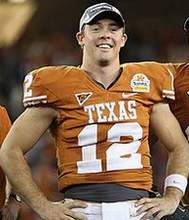
Colt McCoy1. "Prepare your child for the path, not the path for your child." Brad said this is not just for our kids - it is for us as parents. The road is rough, narrow and hard to find. We have a book (the Bible), a map vis-à-vis the Bible and God to help us. We must prepare ourselves and our kids for moments in life when doors open and close. He cited Proverbs 22:6: "Train a child in the way he should go, and when he is old he will not turn from it." He also cited, almost in jest but also in reality, Proverbs 23:13, "Do not withhold discipline from a child; if you punish him with the rod, he will not die." It was a funny contrast, but a real contrast. He then said, "Dads, fight for your kids, prepare them!"

2. "Prepare to be our best." This was one of the four McCoy family mottos. He cited 1 Corinthians 9:24, "Do you not know that in a race all the runners run, but only one gets the prize? Run in such a way as to get the prize." He stated that every day he would take his kids to school and upon them exited the car, he would say to them, "Do your best and be a leader!" He said that they listened every time and even as they got older (4th, 5th and 6th grades) he would repeat these words even if they said, "Yeah, Yeah, Dad, I know, do your best and be a leader!"

He said that as a coach for 27 years, he would always lead his team onto the field and leave his team at every practice with the chant, "Expect to Win, Play to Win." And he implored us as parents to instill the same attitude in our homes and in our children. He cited Jim Collins book, "Good to Great", stating that good is the enemy of Great! We don't aim high and miss - as we would like to believe. In fact, most times, we aim low and hit the mark! As parents, he implored us not to aim low! Aim high!!!

3. "Be a Leader." He stated that we are surrounded by such a great cloud of witnesses - great leaders that we can draw from and that our kids can draw from. He said we are all at the mercy of time and money and asked a rhetorical question: How do you spend your time and money. He then said that how we spend our time and money is a direct reflection on where our true priorities lie. Convicting!

He then said as a leader that he has always loved the quote by Ghandi (even though he didn't ascribe to all of Ghandi's beliefs): "I will not let anyone walk through my mind with dirty feet." He said that as he taught this principle to his three boys that Colt McCoy turned this phrase into his own words: "Thoughts become things." Colt would tell his younger brothers as he mentored them, "You can't talk like that or think like that, because thoughts become things that play themselves out in your life."

4. "Prepare for Open and Closed Doors." As a Dad, he said it was painful beyond all of his years on this earth to watch his son get hurt in the first series of play in the National Championship at the Rose Bowl. A perfect setting. A setting his son had dreamed of ever since he threw the football with his Dad in the front yard as a kid. As a Dad, he went over to his son's hotel room after the Championship loss and the demoralizing fate for such a NCAA football star. He went to his son's room to cheer his son up and was praying to God for the right words. He entered his son's hotel room to find his son finishing a devotional.

The devotional read as follows: "My positive energy must be better than my negative energy. My certainty must be stronger than my doubt. The battle is won before I ever start the fight. I choose faith over fear. Leave a legacy of excellence, love, dedication and service. Jeremiah stated, 'Blessed is the man whose trust is in the Lord.' He said he had to find a corner of Colt's hotel room to sit down and cry over the maturity of his son. His son was prepared for open and closed doors! Wow!!

He then finished his speech by stating that as he consoled his son under the Rose Bowl stadium (after it was readily apparent that Colt would not be able to go back onto the field and play for the Longhorns), as he was trying to motivate his son, his son motivated the team and his Dad. His son stepped into a new mantle of leadership. Rather than return to the field in pedestrian clothes, Colt insisted on returning to the field to help his team win. He walked back onto the field in his uniform and helped the second string quarterback read the defense and mentored the second string quarterback over the course of the 3rd and 4th quarters.

He said that his son had been studying "trust" in a Bible Study all year long leading up to the National Championship game. He said his son had told his mom and dad that he didn't know why he had been studying that "trust" concept all year, but he fully knew why in the moments leading up to the National Championship loss. He told his parents that he came to the conclusion that God had "prepared me for years leading up to that game, because He wanted me to "trust" Him!"

When Colt was approached by news reporters after the Longhorns had lost the National Championship, the reporters asked Colt how he was feeling and Colt replied: "I always give God the glory. I never question what God does. God is in control of my life and if nothing else, I am standing on the Rock!" Brad McCoy said that his cell phone began lighting up with texts after the game with friends, ministers and family members wildly acclaiming the statement that Colt had made to the reporters. He said that he received letters from non-believers, Jewish ministers, Muslim ministers and atheists in the days following the game - all pointing to the AMAZING statement that Colt had made after the game.

He said that as he entered Colt's hotel room that night, he asked his son, "What did you say after game?" [He had not been able to hear it in the mayhem of the stadium.] Brad McCoy, Colt's Dad, asked two to three times, "Son, what did you say after the game?" Colt said, "Dad, I don't know. I really don't remember what I said. All I remember is that the reporter asked me a question and I prayed that God would supply me with the right answer." Wow!!

Brad McCoy then ended his speech by telling a story about a young football player that he was coaching back in his hometown. He said the young football player approached Brad McCoy after he returned from Pasadena and said, "Coach, I heard what your son said after the game, but I have one question: What is the rock?" He said it's funny son. We sing about it in church. He then began singing a cappella:

My hope is built on nothing less, Than Jesus' blood and righteousness. I dare not trust the sweetest frame, But wholly trust in Jesus' Name. On Christ the solid Rock I stand, all other ground is sinking sand; all other ground is sinking sand.

When darkness seems to hide His face, I rest on His unchanging grace. In every high and stormy gale, My anchor holds within the veil. On Christ the solid Rock I stand, All other ground is sinking sand; All other ground is sinking sand.

His oath, His covenant, His blood, Support me in the whelming flood. When all around my soul gives way, He then is all my Hope and Stay. On Christ the solid Rock I stand, All other ground is sinking sand; All other ground is sinking sand.

When He shall come with trumpet sound, Oh may I then in Him be found. Dressed in His righteousness alone, Faultless to stand before the throne. On Christ the solid Rock I stand, All other ground is sinking sand; All other ground is sinking sand.

By the end of his singing, the entire room of men and women were singing in unison with Brad McCoy. It was truly an amazing morning for the Lord and a truly amazing speech for us to learn from as parents and Grandparents.

Monday, May 17, 2010

Feast of Weeks - Shavuot

A few weeks ago, I posted about Christ in the Passover. At that time, our Jewish friends began the 50-day countdown to the Feast of Weeks, or Shavuot. The Passover (Pesach) commemorated God’s deliverance of Israel from bondage in Egypt. Shavuot celebrates the giving of the Law to Moses at Mt Sinai fifty days later. This year, Shavuot begins tomorrow, May 18, at sunset.

The festivals of Judaism are closely connected with the events of the agricultural year, and Shavuot is no exception. The festival’s Biblical basis is found in Leviticus 23:15-22, which instructs the Israelites to “count down” fifty days “from the day you brought the sheaf” (bundle of wheat). So, the period between Passover and Pentecost became known as the “omer” (Hebrew word meaning “sheaf”) and the countdown as “counting the omer”. This countdown was a reminder to the Israelites to count on God for a fruitful crop. Because Israel was an agrarian society, they were entirely dependent upon God’s favor for their livelihood, since the right land and weather conditions were critical for a bountiful harvest. Likewise, Christians must count on God for fruitfulness in our own lives.

Today, there are many other traditions associated with Shavuot. Observing Jews often read the book of Ruth (harvest theme), the Ten Commandments, or even study the Torah (“Law” - first five books of the Bible) to recall the revelation at Sinai. Homes and synagogues are often decorated with flowers and greens, and festive meals, usually involving dairy foods are eaten.

Christians know this holiday as Pentecost (from the Greek word meaning “fifty”), commemorating the birth of the Church at the pouring out of the Holy Spirit (Acts 2) in fulfillment of Joel 2:28. In addition, the prophet Zechariah predicted a future great harvest that would involve another pouring out of the Spirit onto the Jewish people in the end times, ”And I will pour on the house of David and on the inhabitants of Jerusalem the Spirit of grace and supplication; then they will look on Me whom they pierced. Yes, they will mourn for Him as one mourns for his only son, and grieve for Him as one grieves for a firstborn” (Zech 12:10).

After the giving of the law on Shavuot, the Jewish people looked forward to their entry into the Promised Land of Canaan. Likewise, after the receiving of the Holy Spirit, Christians look forward in anticipation of our heavenly Promised Land.

See our article Hebrew Feasts and Festivals for an introduction to additional Jewish Holy Days.

Thursday, May 13, 2010

Safe in the Arms of Jesus

I wanted to work on the Book of Ruth in our Interpreting the Books of the Bible section, but kept feeling compelled to write this article on death and life instead. This subject is way out of my comfort zone, but I knew from past experience that I wouldn’t get anything else done until I had completed this post.

To provide a little background on my mental state, we’ve been receiving frequent news that our son’s marine unit in Afghanistan continues to sustain numerous casualties, including several on Mother’s Day alone. We hope our readers are praying daily for the brave men and women risking their lives to protect our country and to secure freedom for other parts of the world. It is unthinkable that anyone can face death without knowing whether his or her future is eternally secure. After my father died, I wrote an article contrasting the differing views of death between believers and non-believers.

Now, we turn to the subject of this post, a baby named Smith, born to parents Kori and Jon up in McKinney (TX) on April 29, weighing only 24 oz. After clinging valiantly to life for almost two weeks, Smith went home to Jesus on May 10. I was alerted to their situation by email from a friend of a friend of a friend, so I don’t know Kori, Jon and family personally, but they have been a real inspiration the past few weeks. Through the various difficulties of this ordeal, Jon shared Smith’s brief, but miraculous and inspiring life on his blog.

I kept thinking, what does one say to such a courageous couple, or to anyone else who has just lost a loved one? Let me preface these comments by saying that I’m no counselor, so these are just my personal thoughts. As Christians, we’re always tempted to quote Scripture (particularly Ro 8:28) in a well-meaning effort to ease the person’s grief, or to defend God. This is good to a point, but I believe it’s sometimes best just to grieve along with the person and let them know you care. You can then speak of the goodness of God as the healing process begins, which will be sooner or later in different instances. In Jon and Kori’s case, it is apparent that they never questioned God’s goodness, but this still does not ease the pain of their loss.

I’ve met a few well wishers with the attitude that, we should not grieve for a loved one because “they’re in a better place”. Fortunately, these folks (almost always meaning well) are usually a small minority. While the destination of the departed is a great comfort, it is entirely biblical to mourn. Jesus Himself wept at the death of His friend Lazarus, even though He knew that He would shortly raise him from the dead (Jn 11:32-36).

As some of my regular readers may know, I love the old hymns and often research their author and some of the fascinating circumstances surrounding their writing. Earlier today, I came across an old hymn by Frances (Fanny) Crosby, who is credited with writing thousands of hymns even though she was blind. Ms Crosby caught a slight cold at about six weeks of age. A country doctor, who (it was later learned) was not qualified to practice medicine, was called because their family physician was away. He recommended the use of hot poultices, which practically destroyed her eyesight. When the doctor learned of the results, he left town, never to be heard of again. Ms Crosby later said "I have not, for a moment, in more than eighty-five years, felt a spark of resentment against him; for I have always believed that the good Lord, in His infinite mercy, by this means consecrated me to the work that I am still permitted to do”.

In 1859, a child was born to Fanny and her husband, but the child died in infancy, and to this day, no one knows whether it was a boy or a girl. Fanny refused to speak of it, even to her closest friends and relatives, except to later say, “God gave us a tender babe… and soon the angels came and took the infant up to God and His throne”.

On April 30, 1968, about a decade after the infant’s death, a Christian musician, Dr WH (Howard) Doane, knocked on Fanny’s door and said “I have exactly forty minutes before my train leaves for Cincinnati. I need some words for this melody”, then began humming a tune. Fanny quickly prayed, went to work and twenty minutes later, dictated the words to Dr Doane just in time for him to catch his train. This brief collaboration produced one of Ms Crosby’s most beloved hymns, Safe in the Arms of Jesus, which became a great comfort to thousands who had lost a loved one, especially a child.

Safe in the arms of Jesus, safe on His gentle breast,
There by His love o’ershaded, sweetly my soul shall rest.
Hark! ’tis the voice of angels, borne in a song to me.
Over the fields of glory, over the jasper sea.

Refrain:
Safe in the arms of Jesus, safe on His gentle breast
There by His love o’ershaded, sweetly my soul shall rest.

Safe in the arms of Jesus, safe from corroding care,
Safe from the world’s temptations, sin cannot harm me there.
Free from the blight of sorrow, free from my doubts and fears;
Only a few more trials, only a few more tears!

(Refrain)

Jesus, my heart’s dear Refuge, Jesus has died for me;
Firm on the Rock of Ages, ever my trust shall be.
Here let me wait with patience, wait till the night is over;
Wait till I see the morning break on the golden shore.

(Refrain)

We must not assume that God allowed Ms Crosby to lose her child for the sole purpose of providing comfort to others, but we can say that God can use all our experiences, good and bad, to minister to others in similar situations.

Friday, February 12, 2010

What hath Tim Tebow Wrought?

Congratulations to the New Orleans Saints on their 2010 Super Bowl victory. It was a fun game to watch, including the Who’s somewhat strained performance at halftime. I last saw them in Houston in the early eighties. The Super Bowl is the only program I know that many people tune in to watch the commercials. I don’t usually get hyped up about them, since most are way overdone, but I guess when a company is paying several million dollars a minute, they are pressured to come up with something out of the ordinary.

Perhaps the most anticipated commercial came in the first quarter. I’m speaking of the Focus on the Family (FOTF) Celebration of Life ad that featured Tim Tebow and his mom, and had been greatly panned by pro-abortion groups for the past few weeks. Tim is a dedicated Christian who won the 2007 Heisman trophy as the quarterback for the Florida Gators, the first sophomore to accomplish this feat. I worked in Gainesville and Jacksonville, Florida for a couple of years (2002-04), becoming somewhat of a Florida Gators fan (I already followed Florida State after meeting Coach Bobby Bowden, another great Christian, about ten years ago). We have a few Gator fans that have transferred to our Dallas office and I still work closely with our Florida offices on a few projects. This connection peaked my interest in what was already an intensely remarkable, appealing and motivating story of the Tebow family.

While Tim is not an activist, his faith has nonetheless consistently annoyed the "tolerant" secular left. Read the entire Tim Tebow Celebration of Life article, including transcripts, commentary, secular protests and reactions etc.

Sunday, January 10, 2010

Discernment, Cynicism and Childlike Faith

I began this post several weeks ago, but am just now returning to finish it. I was talking with a friend and co-worker around the first of December regarding Christmas music being played on the Christian radio stations. She is a relatively new Christian and was enjoying the exclusively Christmas format that begins every year on a particular station. We have a commercialized Contemporary Christian station here in Dallas whose format throughout the year, other than the music, is similar to the secular stations, complete with the overdosing on the self-promos. Even their Christmas music had a heavy rotation of Santa and generic holiday tunes. So, when she asked if I listen to this local station, I somewhat sarcastically replied, “only if I need a new car, insurance or whatever they’re advertising, or if I’m in the mood to listen to disc jockeys talking halfway through the songs”. She then made one of the most profound statements that I’ve heard in a while, “I guess I haven’t been a Christian long enough to become cynical yet!” I immediately replied that I wasn’t being cynical, just discerning.

Over the next few days, I kept thinking about this conversation, coming to the conclusion that she was right. I’ve been working on some articles regarding discernment when watching, listening to, or reading any Christian media short of the Holy Scriptures, and being overly sensitive to this subject, I crossed the line between discernment and cynicism with my comments. I also was reminded of two very good lessons that I’d like to pass along, actually three points, the first being that, as representatives of Christ, people are closely scrutinizing our words and actions.

The next point is that God’s truth is so overpowering, that it easily comes through despite the imperfection of the person or organization through which it is delivered. So while we should be discerning about methods, we should do so with gentleness and respect (1Pe 3:15, Jude 22). We should also rejoice that the Gospel is being advanced (Php 3:15-18), whether through imperfect radio stations or websites such as our own.

Finally, I am reminded that, after being a Christian for over forty years, how easy it is to get complacent and take God’s love and grace for granted. New Christians remind us of the childlike faith that we should always possess (Mk 10:15). A childlike faith allows us to trust in God’s Word without questions, but we often begin relying on our own abilities as we gain more knowledge. This is not to say that we should not grow in the faith. Refusing to grow is to have a childish faith, against which we are warned by the Apostle Paul (1Cor 13:11). By relying on God’s Word with a true childlike faith, we’ll continue to mature in the faith (1Cor 14:20, Heb 5:12-14).

If we follow these principles under the guidance of the Holy Spirit, we’ll never become complacent with the wonder of God. The steadfast love of the Lord never ceases; his mercies never come to an end; they are new every morning; great is your faithfulness (Lam 3:22-23 ESV).