In the video, G.O.S.P.E.L stand for “God Our Sins Paying Everyone Life”.
In the video, G.O.S.P.E.L stand for “God Our Sins Paying Everyone Life”.
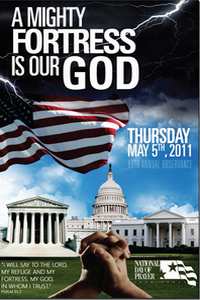 Tomorrow marks the 60th Anniversary of the Nation Day of Prayer, originally signed as a declaration in 1953 by Harry Truman. In 1988, Ronald Reagan signed a declaration designating the first Thursday in May as its annual observance.
Last year a Jimmy Carter appointed federal judge declared the day of prayer unconstitutional, but a recent ruling by a panel of the U.S. Court of Appeals affirmed the constitutionality of the law. The U.S. Court of Appeals for the 7th Circuit, based in Chicago, ruled 3-0 that the Freedom From Religion Foundation (FFRF) and its plaintiffs do not have standing to continue their challenge of the 1952 congressional act that declared an annual National Day of Prayer.
This year, millions will participate in organized events to be held in thousands of public venues where citizens will unite in prayer for America and its leadership. This year’s theme, “A Mighty Fortress Is Our God,” is based on Psalm 91:2, which states, “I will say of the Lord, He is my refuge and my fortress, my God, in whom I trust.” For a wealth of information, or to find a National Day of Prayer event in your area, visit the National Day of Prayer website.
The official 2011 National Prayer is by Joni Eareckson Tada, Honorary Chairman.
Almighty God, you are our Mighty Fortress, our refuge and the God in whom we place our trust. As our nation faces great distress and uncertainty, we ask your Holy Spirit to fall afresh upon your people — convict us of sin and inflame within us a passion to pray for our land and its people. Grant the leaders of our country an awareness of their desperate need of wisdom and salvation in You until sin becomes a reproach to all and righteousness exalts this nation.With all the uncertainty in the world, along with the most anti-Christian administration in history currently in power, our country needs our prayers more than ever. The following is a video released by the Walton County Florida chapter.Protect and defend us against our enemies and may the cause of Christ always prevail in our schools, courts, homes, and churches. Lord God, send a spirit of revival and may it begin in our own hearts.
Remember America, we pray. Remember the foundations on which this country was built. Remember the prayers of our nation’s fathers and mothers, and do not forget us in our time of need.
In the name of our Savior, Jesus Christ, Amen.
This year, I found myself spending some time reflecting on the two thieves who were crucified alongside of Jesus. We find the story in Luke 23:32-43.
Two other men, both criminals, were also led out with him to be executed. When they came to the place called the Skull, they crucified him there, along with the criminals—one on his right, the other on his left. Jesus said, “Father, forgive them, for they do not know what they are doing.” And they divided up his clothes by casting lots.In particular, I was contemplating how the one thief came to recognize Jesus as the Messiah. It was certainly not due to physical appearances. Here was Jesus, beaten and bloody, barely recognizable as a man, much less as a god, being executed as a common criminal. Those who insist that baptism and good works are necessary for salvation contend that the thief had become a believer and was baptized sometime in the past. They argue for this scenario based solely upon the fact that the Bible does not specifically deny this. This argument from silence however, is most unlikely since the meticulous author Luke would likely have mentioned such an important detail. In addition, the thief himself never even hints at this and offers not only an appeal, but a confession of faith as well. The only plausible explanation for the thief’s confession is the divine illumination and power of the Holy Spirit.The people stood watching, and the rulers even sneered at him. They said, “He saved others; let him save himself if he is God’s Messiah, the Chosen One.” The soldiers also came up and mocked him. They offered him wine vinegar and said, “If you are the king of the Jews, save yourself.” There was a written notice above him, which read: THIS IS THE KING OF THE JEWS.
One of the criminals who hung there hurled insults at him: “Aren’t you the Messiah? Save yourself and us!” But the other criminal rebuked him. “Don’t you fear God,” he said, “since you are under the same sentence? We are punished justly, for we are getting what our deeds deserve. But this man has done nothing wrong.”
Then he said, “Jesus, remember me when you come into your kingdom.” Jesus answered him, “Truly I tell you, today you will be with me in paradise.”
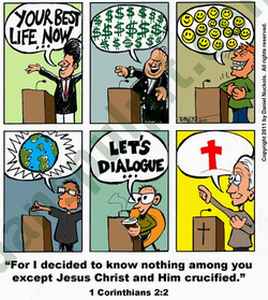 This should be a lesson for us today. A major objective in many of our modern market driven churches is to increase their membership roles. The salvation of those who join is often optional. Numerous churches however, are honestly seeking to save the lost. Many spend major bucks with marketing consultants in their quest to attract perspective members. While we should be looking at various means of attracting people to church, I’d like to offer my best advise free of charge: Preach the Gospel and rely on the power of the Holy Spirit. I’m convinced that this method will not only result in increased membership, but also accomplish the more important goal of leading others to salvation in Christ.
The Apostle Paul wrote in his letter to the Romans that I am not ashamed of the gospel, because it is the power of God that brings salvation to everyone who believe…(Rom 1:16). I don’t know if many modern churches are ashamed of the Gospel or have just lost faith in its power. Some believe it to be old-fashioned, simplistic and out-of-date. It is thought that, if we are to reach people these days, we must be more relevant to our modern sophisticated culture. Yet, we would be hard pressed to find a more simplistic and basic message than the one offered over and over by Billy Graham. Furthermore, we can readily see the results.
I recall a story from few decades back, when Billy was already seeing hundreds and thousands come to Christ with each crusade. One evening, he preached what he thought to be his best sermon yet, but it produced little results. Afterward, he was approached by one of his staff who asked him why he failed to mention the cross in his sermon. Billy initially got angry, thinking “who is he to tell me how to preach?” Later in his hotel room, Billy came to the realization that the staffer was right, and resolved never to preach again without mentioning the cross.
Now, compare Mr Graham’s method with that in many of our modern churches. After ignoring the Gospel during the sermon, the church then resorts to “easy” techniques during the “invitation”. After being careful to not offend anyone by mentioning the fact that we are sinners (the very reason that we need a Savior), visitors are told they can accept Jesus and join the church by “coming down to the front”, or “if you too embarrassed to walk to the front, just slip out to one of our ushers along the back or sides, or if this is too much, simply lift up your hand and we’ll contact you”. What’s next, installing moving sidewalks like we find in airports?
We find another familiar story in Luke 18:35-43.
As Jesus approached Jericho, a blind man was sitting by the roadside begging. When he heard the crowd going by, he asked what was happening. They told him, “Jesus of Nazareth is passing by.”We thus see a beggar crying out to Jesus (“Son of David” is a recognition of Jesus as the promised Messiah). The surrounding crowd admonished him to be quiet. We can just imagine the comments, “stop making a scene”, “you’re embarrassing yourself”, “have some dignity” etc, but recognizing his own helplessness, he shouted even louder until Jesus healed him both physically and spiritually.He called out, “Jesus, Son of David, have mercy on me!” Those who led the way rebuked him and told him to be quiet, but he shouted all the more, “Son of David, have mercy on me!”
Jesus stopped and ordered the man to be brought to him. When he came near, Jesus asked him, “What do you want me to do for you?”
“Lord, I want to see,” he replied. Jesus said to him, “Receive your sight; your faith has healed you.” Immediately he received his sight and followed Jesus, praising God. When all the people saw it, they also praised God.
Those who understand will recognize that we’re all like that beggar. Adrian Rogers used to say that witnessing was simply one beggar showing another beggar where to find food. Notice also that the beggar didn’t have to be humanly persuaded to come to Christ. In fact, those surrounding him were actually discouraging him from calling out to Jesus. So, when the Holy Spirit truly regenerates a person, surrounding hardships won’t be able to keep them from Jesus. In many countries, there are people coming to Jesus despite being threatened by death.
I’m certainly not saying we should discourage or make it more difficult in our churches for people to come to Christ, or that we shouldn’t explore various means of attracting perspective members, but these techniques should be supplementary to, rather than a substitute for the Gospel. We must first and foremost preach the truth and allow the Holy Spirit to work. I’m convinced that, as people realize their true state and are persuaded by the power of the Spirit, we could string barbed wire across the aisles and many would still find a way to Jesus.
Notes:
We are saved by placing our faith and trust in Jesus as Savior and Lord. Making a public profession by walking to the front and/or joining a church is a step of obedience, but is not the basis of our salvation.
I’m also not saying that churches should merely go through the “Roman Road” each week. This article only addresses the evangelistic function of the church. Members must also be discipled by a balanced teaching of the other historical doctrines of the faith. We'll take up this topic in future articles.
The illustration is courtesy of the very talented Dan Nuckols of Dan’s Pulpit.
This occasion was inspired by a similar event held by believers from Faith Church of Budapest, Hungary.
Before we go any further, I’d like to clarify the meaning of "prophecy" as used in this post. The chief Biblical use of the word “prophecy” entails forth telling, that is to accurately proclaim God’s message or Word, with primary application on the present times. Thus, anyone who can properly interpret and elucidate God’s word by the illumination of the Holy Spirit is a prophet. In this article however, we’re referring to the other Biblical meaning of prophecy, that of foretelling or predicting the future.
The Bible tells us that “All Scripture is God-breathed and is useful for teaching, rebuking, correcting and training in righteousness, so that the man of God may be thoroughly equipped for every good work” (2Tim 3:16-17). This statement alone confirms the importance of studying Biblical prophecy. Over one-fourth of the Bible was prophetic at the time each book was written. Over half of the roughly two thousand documented prophecies have already been fulfilled without error, so we can be confident that the others will likewise be fulfilled in the future. Therefore, the study of prophecy familiarizes us with God’s plan for the ages, protects us from the deception of false teachings, and gives us confidence for the future. It is also evangelistic and apologetic in that, our studies impart in us the urgency to share our faith in whatever time we have left, and enhances our knowledge of doctrine which further equips us to defend the Faith. In addition, much of the proof of Jesus as the Messiah rests upon fulfilled OT prophecy.
So, we easily see that we should not neglect the study of Biblical prophecy. Nevertheless, we’d like to offer a few comments on balancing the study of prophecy with the study of other Biblical doctrines.
When studying systematically, we generally maintain a pretty good balance between most of the topics such as the Bible, God, Christ, the Holy Spirit, Man, Sin, and Salvation; although some erroneously minimize the essential study of the Church. With the study of Eschatology (last things) however, many tend to go to one of two extremes, either outright neglect or becoming so preoccupied with prophecy that the other doctrines are practically ignored. We’ve already mentioned several reasons not to overlook the study of prophecy, so we'll make a few remarks on the latter case.
One glance at the number of teachers and internet sites devoted exclusively to prophecy (some Biblical, others not so much) gives us a hint of its popularity. Most people are fascinated by the unknowns of the future, so it’s easy to see how we can easily become engrossed in the study of prophecy while overlooking the other Biblical doctrines, but we must be careful to avoid this trap. For one thing, our understanding of prophecy will be sorely lacking without a good working knowledge of the other essential doctrines.
Some folks might ask, what about those scholars who specialize in the study of prophecy. We are grateful for those who have dedicated a good part of their research time to Bible prophecy, but keep in mind that the more orthodox ones had already developed sound doctrine based upon all Scripture prior to their decision to specialize. For example, well known pastor and author Tim LaHaye, who has written many books on prophecy including the Left Behind series, had already researched and written many other books on a variety of other Biblical topics, and continued to study the entire Scriptures while concentrating on prophetical writings. Therefore, before anyone decides to “specialize”, they should become very familiar with the whole of Scripture.
This last statement also applies to other Biblical and related subjects other than prophecy. Many times, I’ve been in a Christian bookstore and overheard a customer ask for books on a topic such as predestination, non-Christian cults, or some gray area that doesn’t affect any major doctrines. After a minute or two, it often becomes obvious that the customer has little overall Bible knowledge. While a few these areas of study can be somewhat profitable after we obtain a solid Biblical foundation, they will be of little use to anyone with limited understanding of the Scriptures and, in some cases, can be outright dangerous. For example, David Jeremiah, a very respected pastor and author once testified that he was never so relieved to finish a project because, as he researched the occult for an upcoming book, he could feel the dark forces attempting to draw him in. We must be firmly anchored in historically orthodox doctrine prior to venturing into secondary topics.
I can speak from experience about wasting a lot of study time during my younger days. I began seriously researching Biblical doctrine about twenty years ago. Rather than consulting with experienced orthodox pastors and teachers, I set out on my own. I would often gauge a topic based upon interest rather than importance or truth. Unlike many others that fall into this trap, I had read the Bible most of my life, so I was fortunate enough to discern that many things that I was reading were not correct, but because I had yet to spend enough quality time studying the basics, I had no idea how to respond to these errors. Therefore, I decided that I must first become very familiar with orthodox Biblical doctrine before branching out into these side issues. Even today, I study the Bible daily, adding the study of an additional four to six books on rotating days. In an attempt to stay well rounded, I choose books from different categories such as Systematic Theology (includes prophecy), Church History, Apologetics, Prayer, Hebrew Heritage, Christian Philosophy, Evangelism, Christian Living, Spiritual Warfare etc.
In summary, we recommend that everyone first become well grounded in the historical Biblical doctrines of the Faith (which also includes the basic study of prophecy). Then, for those who are called to devote additional study time to Biblical prophecy, go for it. Just remember however, while you are spending time trying to determine who or what the third toe on the right foot of the image in Daniel 2 represents, don’t neglect your other Bible studies.
Speaking of Daniel, his OT book is filled with various prophecies given during the sixth century BC, some that came to pass over the next several centuries (primarily during the Intertestament period) and others that still await their fulfillment during the last days. In the final chapter, Daniel asks the angel for more information concerning the end times prophecies. The angel basically tells Daniel to go his own way (Dan 12:9) and not concern himself with the extra details that are sealed up until the end. This does not mean that we should not have a healthy interest in prophecy, but we should not become so obsessed with the future that we fail to faithfully carry out our faithful duties in the present. This will be the subject of our third and final post in this trilogy.
Update: Part 3, Present Living in Light of Prophecy is loaded.
With so much war, turmoil, disease, natural disasters, and economic uncertainty in the world today, a common question being asked is, “Are we living in the end times?” Theologically speaking, the “end times”, or “last days” began about 2000 years ago with the first advent of the Christ (Heb 1:1-2, 1Jn 2:18). I believe what most people mean by the question however, is “Will Jesus return during our lifetime, or soon thereafter?”
When Jesus’ disciples inquired about the time and circumstances of his return, He replied, “Watch out that no one deceives you. For many will come in my name, claiming, 'I am the Christ,' and will deceive many. You will hear of wars and rumors of wars, but see to it that you are not alarmed. Such things must happen, but the end is still to come. Nation will rise against nation, and kingdom against kingdom. There will be famines and earthquakes in various places. All these are the beginning of birth pains” (Mt 24:4-8). He then elaborates and illustrates further throughout the chapter, including making references to the OT book of Daniel.
Looking at history, we find many wrong predictions regarding the end of days. In the second century, a Roman priest predicted Jesus would return in 500AD based upon the dimensions of Noah’s ark. Many predicted the end would come at the beginning of 1000AD and 2000AD simply because of the year number. Others predicted 1033AD or 1533AD based on a crucifixion date of 33AD (Christ was crucified either 30AD or 33AD). Archbishop Ussher forecast a particular day in 1644 while others predicted 1666 because of the number of the beast. Jehovah’s Witnesses guessed 1874, 1878, 1881, 1910, 1914, 1918, 1925, 1975, and 1984 before announcing they would make no further predictions. In our modern times, a popular book in the 80s gave 88 reasons why Jesus would return in 1988. When this failed, the same author wote another book offering 89 reasons why the rapture would occur in 1989 (which didn’t sell many copies for some odd reason). Just this year, Harold Camping set his latest date for the rapture when his previous predictions failed to come true. This is just a few of the predictions that have been made throughout history, so maybe we should look instead at what Jesus himself had to say on the subject.
Regarding the time of his return, Jesus says “No one knows about that day or hour, not even the angels in heaven, nor the Son, but only the Father. As it was in the days of Noah, so it will be at the coming of the Son of Man. For in the days before the flood, people were eating and drinking, marrying and giving in marriage, up to the day Noah entered the ark; and they knew nothing about what would happen until the flood came and took them all away. That is how it will be at the coming of the Son of Man. Two men will be in the field; one will be taken and the other left. Two women will be grinding with a hand mill; one will be taken and the other left.” Mt 24:36-41.
Just before his ascension, they asked Him, "Lord, are you at this time going to restore the kingdom to Israel?” He said to them: "It is not for you to know the times or dates the Father has set by his own authority” (Ac 1:6-7).
So, we know that Jesus will definitely return (1Th 4:16-17), but we can only speculate whether the Second Advent will take place in our lifetime, shortly afterward, or at a date in the distant future. The signs are certainly evident, and there are no additional events that have to occur before His return. In addition to those already mentioned, we’ve witnessed a great increase in knowledge (primarily from technology) and the resettling of the Nation of Israel in the Promised Land. We’ve also seen more major wars in the last hundred years than in the past two millennia. Furthermore, just in the last ten years or so, we seen an unprecedented amount of natural disasters and human crisis such as war in Iraq, Afghanistan and Libya, hurricanes (Katrina), tsunamis (Japan), earthquakes (China), AIDS, Swine flu, famines, and economic collapses. We also see the current administration in America virtually abandoning Israel as other countries line up against her. With the current conditions surrounding us, it’s difficult to imagine the world lasting much longer.
On the other hand, many men who were much smarter than me, such as Martin Luther (early 1500s) and Jonathan Edwards (mid 1700s), thought Christ would return in their lifetimes. Therefore, while I believe Jesus’ return is likely to be relatively soon, it could still be hundreds of years away. This uncertainty however, should make us no less diligent in our Christian walk. As I once heard it so well stated, we should prepare for a journey of a thousand years, but be prepared to abandon ship at any moment.
Update: Part 2, The Study of Bible Prophecy - in Perspective is loaded. In this post, we discuss the study of prophecy within the context of our overall Bible study practice.
Update: Part 3, Present Living in Light of Prophecy is loaded.
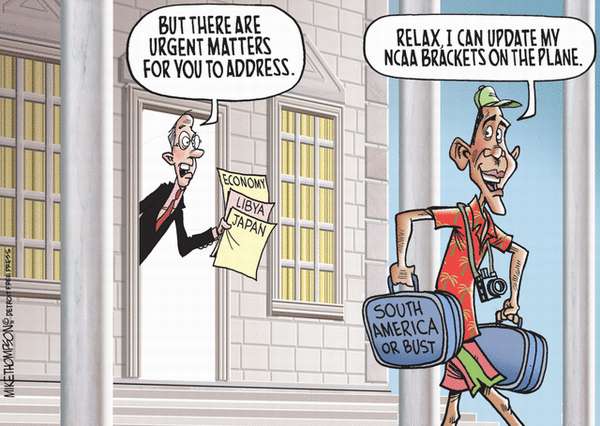
See the archive at March 2011 Toon Review. This month focuses primarily on the UN and foreign policy.
During this time, we were able to finish several projects on our main site. We made some headway on our Bible Book Intros section, consisting of Brief Surveys, Historical Backgrounds, Timelines, Main Themes, Outlines, Interpretation Challenges and more for each book of the Bible. We still hope to finish all the books in the next two years or so. We also just uploaded a major article Can America Claim the Promises of 2nd Chronicles 7:14? in our Bible Commentary and America’s Christian Heritage sections that also examines how the Old Testament applies to Christians today. We invite you to visit our What’s New page for other recent writings.
Thanks again for all the support and God Bless.
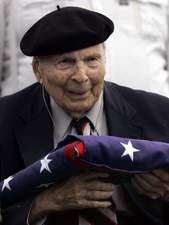 Frank Buckles, the last surviving American veteran of WWI died this week at the age of 110. Mr Buckles was born in Missouri in 1901 and was raised in Oklahoma. He was rejected numerous times by military recruiters for being under-aged, until he finally convinced an Army captain that he was 18, and joined the military at the age of 16. Despite his efforts however, Mr Buckles never got to see combat. Nevertheless, his family obtained an exception to government rules, and plans are to bury him at Arlington National Cemetery. The latter years of his life were spent advocating for a national monument to honor veterans of the Great War.
As reported in The Marine Times:
Buckles, who also survived being a civilian POW in the Philippines in World War II, died of natural causes Sunday at his home in Charles Town, biographer and family spokesman David DeJonge said. He was 110. Buckles would have wanted people to remember him as “the last torchbearer” for World War I, DeJonge said Monday.During the trip to attend the ceremony for Gen Pershing in 2008, Mr Buckles noticed memorials for WWII, Korean, and Vietnam veterans, but nothing for the heroes of WWI. David DeJonge became the president of the The World War I Memorial Foundation and made Mr Buckles the honorary chairman.Buckles had been advocating for a national memorial honoring veterans of the Great War in the nation’s capital and asked about its progress weekly, sometimes daily. “He was sad it’s not completed,” DeJonge said. “It’s a simple straightforward thing to do, to honor Americans.”
On Nov. 11, 2008, the 90th anniversary of the end of the war, Buckles attended a ceremony at the grave of World War I Gen. John Pershing in Arlington National Cemetery. He was back in Washington a year later to endorse a proposal to rededicate the existing World War I memorial on the National Mall as the official National World War I Memorial. He told a Senate panel it was “an excellent idea.” The memorial was originally built to honor District of Columbia’s war dead.
More than 4.7 million people joined the U.S. military from 1917-18. As of spring 2007, only three were still alive, according to a tally by the Department of Veterans Affairs: Buckles, J. Russell Coffey of Ohio and Harry Richard Landis of Florida. The dwindling roster prompted a flurry of public interest, and Buckles went to Washington in May 2007 to serve as grand marshal of the national Memorial Day parade. Coffey died Dec. 20, 2007, at age 109, while Landis died Feb. 4, 2008, at 108. Unlike Buckles, those two men were still in basic training in the United States when the war ended and did not make it overseas. The last known Canadian veteran of the war, John Babcock of Spokane, Wash., died in February 2010. There are no French or German veterans of the war left alive.
Buckles served in England and France, working mainly as a driver and a warehouse clerk. An eager student of culture and language, he used his off-duty hours to learn German, visit cathedrals, museums and tombs, and bicycle in the French countryside. After Armistice Day, Buckles helped return prisoners of war to Germany. He returned to the United States in January 1920.
In 1941, while on business in the Philippines, Buckles was captured by the Japanese. He spent more than three years in prison camps. “I was never actually looking for adventure,” Buckles once said. “It just came to me.”
In spring 2007, Buckles told the AP of the trouble he went through to get into the military. “I went to the state fair up in Wichita, Kansas, and while there, went to the recruiting station for the Marine Corps,” he said. “The nice Marine sergeant said I was too young when I gave my age as 18, said I had to be 21.” Buckles returned a week later. “I went back to the recruiting sergeant, and this time I was 21,” he said with a grin. “I passed the inspection ... but he told me I just wasn’t heavy enough.” Then he tried the Navy, whose recruiter told Buckles he was flat-footed.
Buckles wouldn’t quit. In Oklahoma City, an Army captain demanded a birth certificate. “I told him birth certificates were not made in Missouri when I was born, that the record was in a family Bible. I said, ‘You don’t want me to bring the family Bible down, do you?’” Buckles said with a laugh. “He said, ‘OK, we’ll take you.’” He enlisted Aug. 14, 1917, serial number 15577.
Bills regarding the WWI Memorial have been introduced in both the US House and Senate, yet neither has passed to date. During a time when Congress can find time to pass tax-payer funded memorials such as an almost $70 million dollar shrine to Ted Kennedy, a $150 million plus airport memorial that services about 20 people per day for John Murtha, and numerous other wasteful projects, it is downright shameful that our legislators can’t establish a memorial to our true heroes that is being paid for primarily by private funds.
Finally, we’d like to say to Mr Buckles and the countless other veterans who have made, and continue to make, great sacrifices in order to serve our country even though their efforts often go unnoticed or taken for granted, “Thank You and God Bless”.

The Real Issue is a blog of ad Dei Gloriam Ministries. We discuss various issues of spiritual, moral, ethical, political, social, philosophical and economic interests. These issues however, are merely symptoms of the central issue, which is how we view God. What we think of God determines our worldview, through which all our thoughts are filtered. So, while we're discussing the merits of various opinions on cultural topics, keep in mind that ultimately, God is the real issue.
The Real Issue Home